


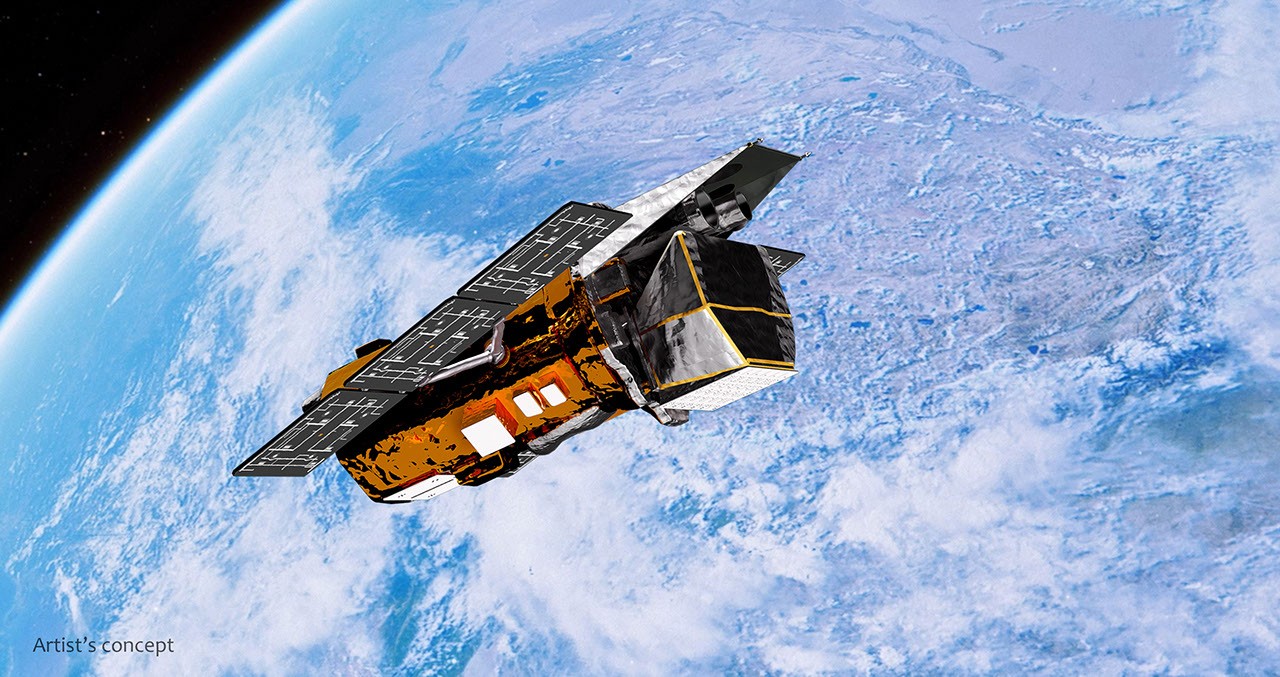
NASA’s Neil Gehrels Swift Observatory has ended its science mission after atmospheric drag lowered the spacecraft’s orbit to less than 171 miles (275 kilometers) above Earth’s surface. Swift made its final observation on October 20th and is expected to re-enter the atmosphere within the next few weeks, concluding a mission that operated for more than 10 times its planned two-year primary mission.
A long-running observatory
“Swift has delivered an incredibly sustained return on investment for the nation. Although it was designed for a two-year primary mission, it was productive for more than 10 times that period,” said Sean Domagal-Goldman, director of NASA’s Astrophysics Division. “At the time, Swift was part of a revolution in astrophysics that played a key role in advancing our understanding of the changing Universe and demonstrated how important rapid-response observations are for the entire community.”
Domagal-Goldman added that NASA will continue exploring ways to respond rapidly to cosmic events in a post-Swift era, including commercial capabilities and efficient, innovative new missions. Swift’s extensive archive is expected to support new discoveries for decades.
During its mission, Swift observed more than 2,000 gamma-ray bursts, the most powerful explosions in the universe, and studied more than 1,400 supernova explosions. It also observed stars being disrupted by black holes, monitored active galaxies, carried out an all-sky X-ray survey, and investigated asteroid and comet activity. Swift data has contributed to approximately 7,000 published scientific papers.
Designed to chase fleeting explosions
“Swift was designed as a satellite specifically for the study of gamma-ray bursts, gamma-ray bursts that come and go so quickly that we couldn’t target them with large telescopes to learn more about them,” said S. Bradley Senko, the mission’s principal investigator at NASA’s Goddard Space Flight Center in Greenbelt, Maryland.
Swift was built to detect and locate a gamma-ray burst, transmit its position to other observatories, and then turn its telescopes toward the event before its afterglow faded. The process typically took about a minute.
Led by its first principal investigator, Neil Gehrels, Swift began as a multiwavelength observatory equipped with co-located optical, ultraviolet and X-ray telescopes. These instruments allowed it to rapidly image bursts and refine their positions. The mission launched on November 20, 2004, and became operational the following month. In 2018, NASA renamed the mission to honor Gehrels after his death.
Swift’s speed was especially important for studying short gamma-ray bursts, which reach peak brightness in less than two seconds. Before Swift, scientists could not rapidly and accurately locate these events or observe their afterglows.
In May 2005, Swift achieved this milestone with GRB 050509B, a burst that lasted just 0.03 seconds. Swift responded quickly enough to detect 11 X-ray photons, making it the first short burst for which an afterglow was detected. The observations supported a long-standing theoretical model and showed that short gamma-ray bursts likely result from the merger of two neutron stars—objects with the mass of the Sun compressed into a city-sized volume.
A flexible astronomical tool
Swift’s flexible planning system also contributed to its success. Astronomers could request “target of opportunity” observations from the ground, with some observations scheduled within minutes. They could also establish monitoring programs lasting anywhere from a few minutes to several months. The system could schedule up to 75 independent targets per day.
“The unique response speed of Swift’s hardware, the extraordinary success of rapid mission operations, and the close teamwork of the Swift flight and science operations teams have placed Swift at the crossroads of a burgeoning research field,” said mission operations director John Nousek, professor of astronomy and astrophysics at Penn State’s Eberly College of Science in University Park, Pennsylvania.
An archive for future research
Swift’s archive contains nearly 22 years of brightness measurements from many types of cosmic explosions, multiwavelength spectra, and more than 1.5 million images from its ultraviolet and optical telescopes. The complete dataset, made publicly available through NASA’s Open Gold Standard Science Initiative, spans approximately 12 terabytes—the equivalent of about 600 high-definition movies.
As part of its plans for the end of Swift’s mission, NASA will continue prioritizing new ways to respond quickly to events in space, using the current mission to help bridge the gap.
Source: science.nasa.gov