


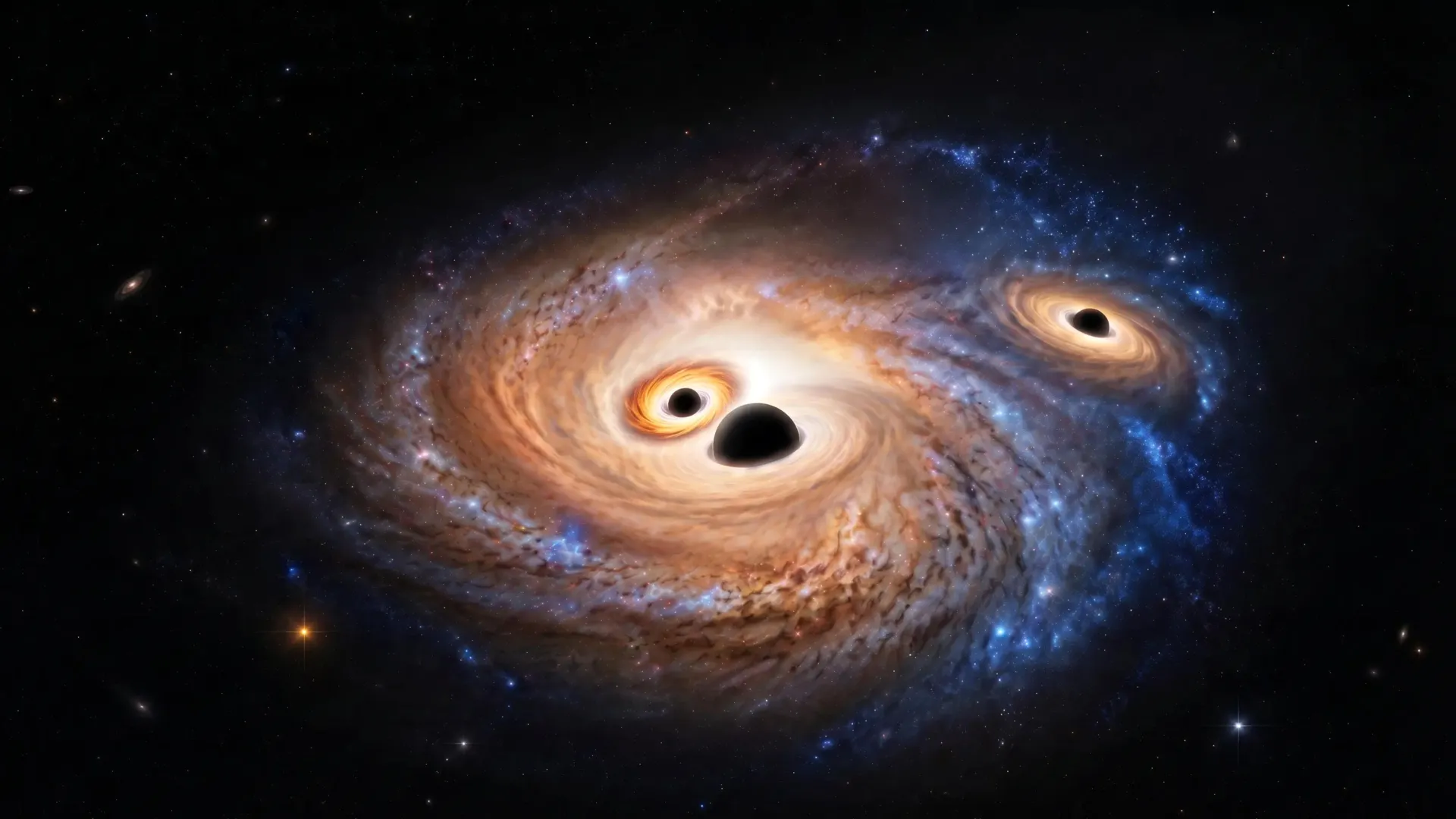
Astronomers have identified three actively feeding supermassive black holes in a single galaxy more than 12.5 billion light-years away. Led by the Max Planck Institute for Extraterrestrial Physics (MPE), an international research team used observations from the James Webb Space Telescope to study galaxy J0148-4214, offering a rare view of how black holes formed, grew and interacted when the universe was only about 1.2 billion years old.
Three black holes in one ancient galaxy
All three black holes are actively accumulating matter. Gas and other material spiral through disks surrounding the black holes as they fall inward. Because J0148-4214 is so distant, its light has taken about 12.5 billion years to reach Earth, allowing astronomers to observe the galaxy as it existed shortly after the Big Bang.
As light travels across the expanding universe, its wavelengths are stretched toward the red end of the spectrum. Astronomers measure this effect using redshift. For J0148-4214, the team measured a redshift of z=5.02, confirming the galaxy’s great distance.
“This is the first evidence of three active black holes in a single galaxy in the distant Universe,” said Hanna Uebler, a research group leader at MPE and the study’s lead author.
Two of the black holes are close to the galaxy’s center, separated from it by only about 620 light-years. The third lies farther out, approximately 5,500 light-years from the center.
The finding provides evidence about how supermassive black holes may have formed and come together in the young universe.
“This suggests that processes in the early universe efficiently combined massive black holes, setting the stage for the massive black hole mergers that we expect to detect with future gravitational wave observatories,” Uebler said.
Galaxy collisions and mergers are thought to have been common during the universe’s early history. When galaxies merge, their central black holes can also move closer together and may eventually combine. These events produce increasingly massive black holes at the centers of newly formed galaxies and could help explain how some galaxies grew to enormous sizes soon after the Big Bang.
How astronomers identified the hidden black hole
The researchers identified the three black holes by analyzing distinctive patterns in light emitted by hydrogen gas. Near a black hole, intense gravity causes gas to move at very high speeds. Those movements leave recognizable signatures in the gas’s spectrum, allowing astronomers to detect black hole activity even when the black holes themselves cannot be seen directly.
The team found an unusually complex pattern of hydrogen emission at the core of J0148-4214. The most plausible explanation was that the signal came from two closely spaced black holes rather than a single source.
To distinguish between them, the scientists used spectroscopic astronomy. By tracking subtle changes in the position of spectral features across the galaxy, they pinpointed the locations of both central black holes, even though the telescopes could not resolve them as two separate points of light.
The observations also revealed a third active black hole in the galaxy’s outer regions.
Black holes with very different masses
The three black holes differ substantially in size. According to the researchers’ calculations, their masses are approximately 80 million, 600,000 and 2 million times the mass of the Sun.
Surprisingly, the largest black hole is not feeding most rapidly. Its smaller neighbor, with a mass of about 600,000 Suns, is accumulating material at a much higher rate. Its estimated feeding rate exceeds the maximum predicted by basic models of black hole growth, known as the Eddington limit.
This unusually rapid growth could offer clues to how some black holes became extraordinarily massive within a relatively short period in the early universe.
“With the JWST data, we were able to not only identify the three black holes, but also estimate their mass, accretion rate, and the mass of the stars in the galaxy,” said Dr. Giovanni Mazzolari, the study’s second author and a researcher at MPE. “The total mass of the star was found to be about 1.3 billion Suns, and the black hole makes up a significant portion of it.”
An ancient black hole merger may be underway
The two black holes near the galaxy’s center are expected to merge within the next few hundred million years. Their eventual collision could create an even more massive black hole, pointing to a process that may have contributed to the growth of cosmic giants in the early universe.
“These results are very interesting,” said Roberto Maiorino, a professor at the University of Cambridge and a co-author of the study. “They suggest that black hole mergers may be an additional rapid route for the rapid growth of black holes in the early universe.”
The third black hole raises another possibility. Because it is located well outside the galaxy’s center, it could be the remnant of an earlier merger that was pushed outward by a strong gravitational reaction. Such kicks can occur when merging black holes emit gravitational waves unevenly, sending the resulting black hole in a different direction.
Alternatively, the third black hole could be gradually moving toward the center and may eventually interact with the other two.
Webb reveals activity that might otherwise remain hidden
The discovery demonstrates the James Webb Space Telescope’s ability to investigate black holes in extremely distant galaxies. It also highlights the value of integral field spectroscopy, which allows astronomers to examine how light and its spectral properties vary across different parts of a galaxy.
Using Webb’s near-infrared spectrometer in integral field spectroscopy mode, or NIRSpec-IFS, the researchers isolated signals that might otherwise have appeared to come from a single black hole.
Without this detailed spatial information, astronomers would likely have identified only one of the galaxy’s three active black holes.
The result suggests that other distant galaxies could also contain multiple growing black holes that have not yet been detected. Finding more of these hidden systems could help scientists reconstruct the history of black hole mergers and better understand how the universe produced its most massive black holes so early in its history.
Source: www.sciencedaily.com