


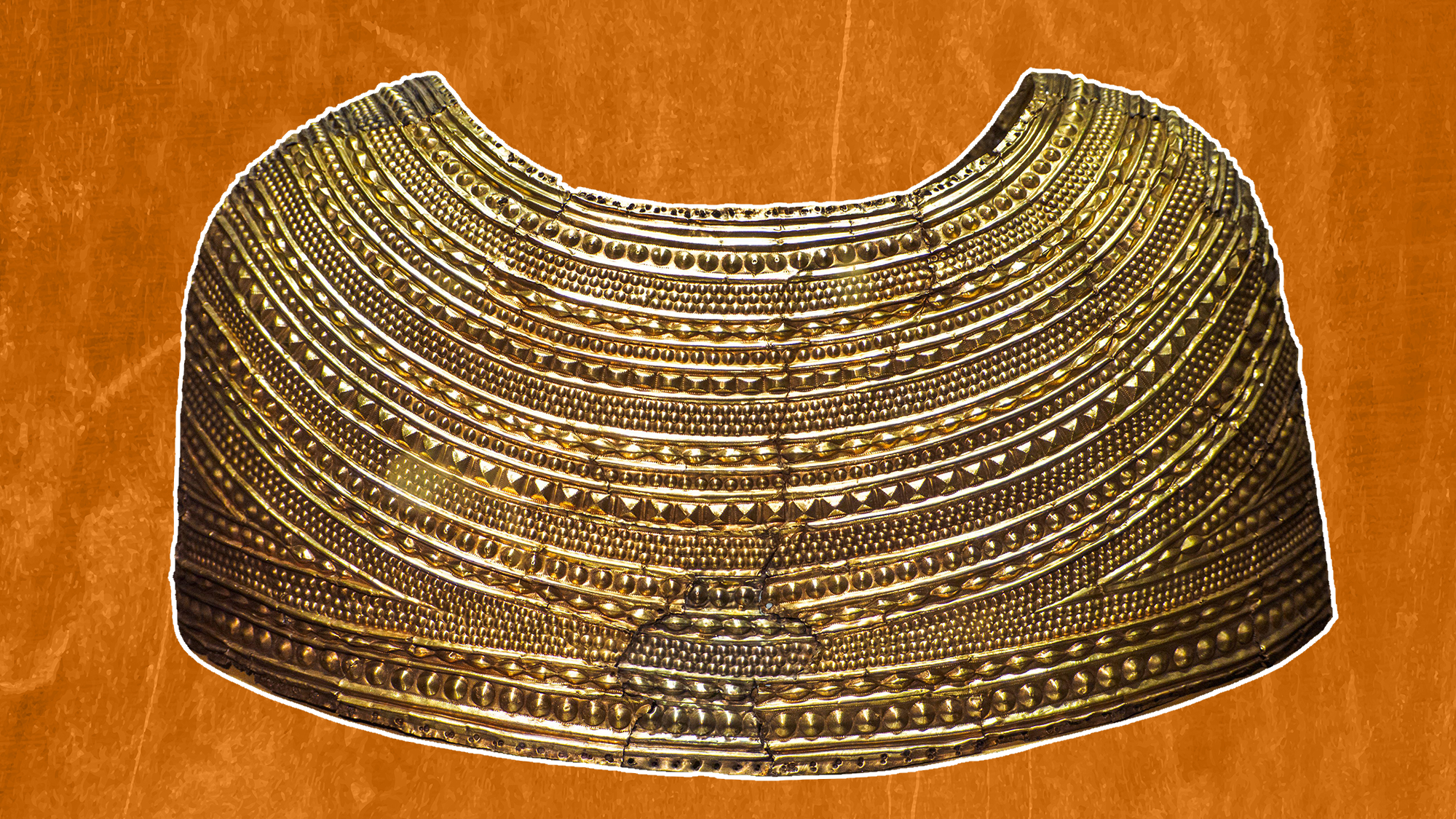
Discovered in 1833 in a Bronze Age tomb near Mold, Wales, the Mold gold cloak is a crushed but remarkably elaborate gold accessory unlike any other known example in Europe. The object was probably made between about 1900 and 1600 BC, and its unusual design has led researchers to suggest that it may have been a ceremonial garment associated with religious or political authority.
The Mold gold cloak
- What it is: Hammered gold accessories
- Where it was found: Bryn Yar Elyon, or Goblin’s Hill, Wales
- When it was created: Circa 1900 to 1600 BC
Quarry workers found the ancient tomb at Goblin’s Hill, near the Welsh town of Mold, in 1833. At its center was a stone-lined burial containing fragmented human remains and a gold, cloak-like object that had been crushed over time. After the fragments were reconstructed, the artifact emerged as one of the finest examples of prehistoric goldwork ever discovered. The artifacts are exhibited at the British Museum.
The headland’s history dates to Britain’s early Bronze Age, around 2500 to 1200 BC. During this period, metalworking expanded beyond the production of flint tools to include gold, copper and bronze weapons and jewelry.
A unique prehistoric ornament
When the tomb was first excavated, experts inferred from the object’s spectacular design that it belonged to a warrior, chieftain or religious leader. Benjamin Roberts, who later served as curator of the European Bronze Age collection at the British Museum, told the BBC in 2010 that the cloak’s small size, revealed after the fragments were reassembled, suggested it may instead have been worn by a woman or a child.
The cloak measures approximately 9.3 inches (23.5 centimeters) high and 18.3 inches (46.5 centimeters) wide. It weighs about 1.2 pounds (560 grams) and was probably made from a single gold nugget roughly the size of a pingpong ball.
According to the British Museum, gold was hammered into extremely thin sheets, shaped into a cloak and decorated to imitate beads and necklaces. Hundreds of amber beads were also found on the tomb’s promontory and may have enhanced the ornaments’ golden appearance. A hole around the neck opening suggests that the cloak once had a lining made from leather or another perishable material, but that lining did not survive.
Its purpose remains uncertain
Because the gold cloak would have restricted movement of the upper arm when worn, it may have been a ceremonial ornament that conferred religious authority and was used only on special occasions. However, researchers still do not know why the person was buried with it, or whether the individual was a man or a woman. Quarry workers in the 19th century did not recover enough remains to answer that question.
“This cape is unique. There’s nothing to compare it to in all of Europe,” Roberts told the BBC. “This makes it even more difficult to understand why it was created and what it meant.”
Source: www.livescience.com