


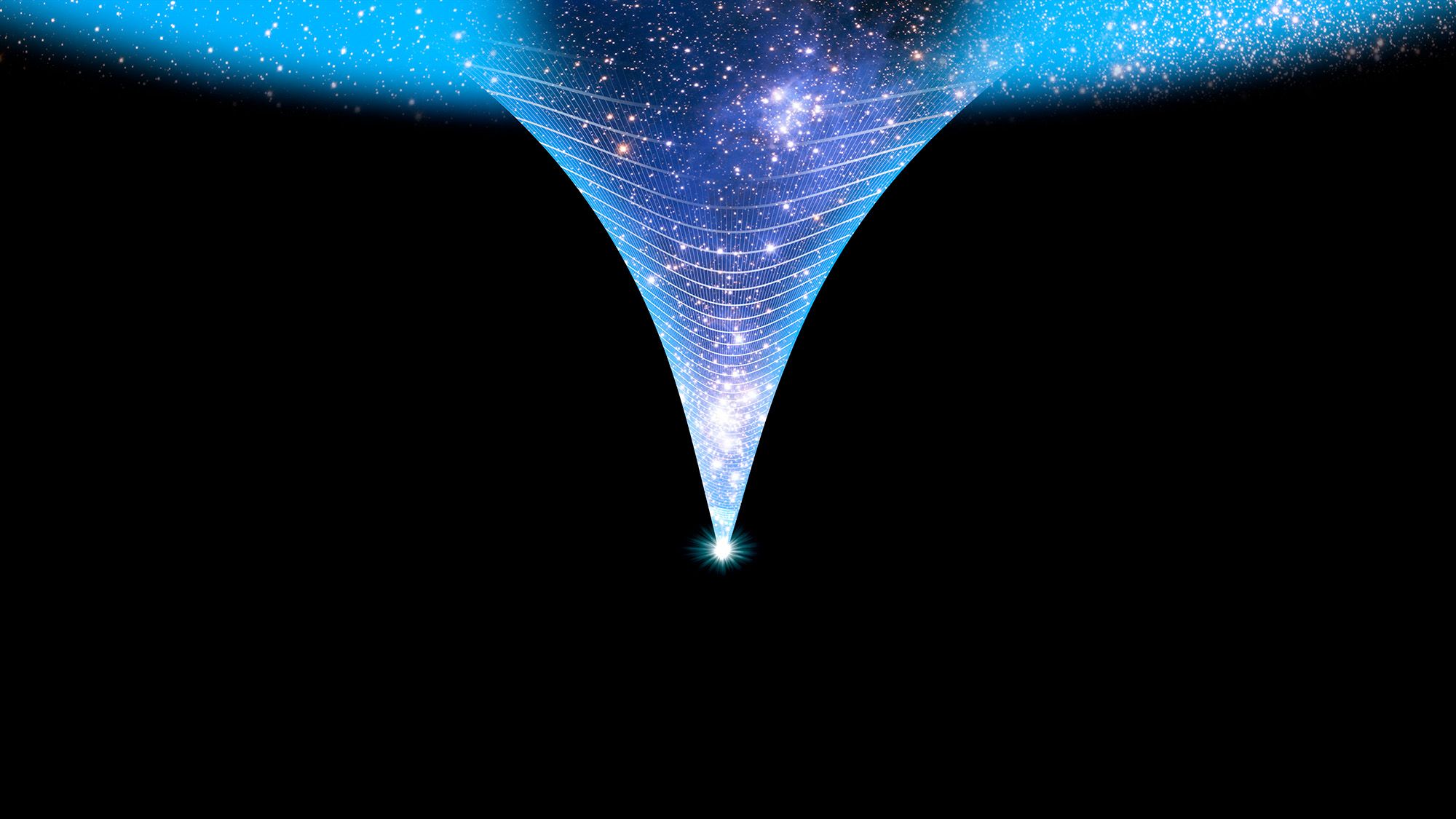
A new study suggests that hypothetical “right-handed” neutrinos may have briefly dominated the energy of the universe shortly after the Big Bang. If these heavy, weakly interacting particles existed, they could have changed how quickly the early universe expanded and helped create the imbalance between matter and antimatter that allowed the universe to form as we know it.
The study, published September 8 in Physical Review Letters, proposes that right-handed neutrinos may temporarily have held more energy than all other components of the early universe combined. Their influence could have slowed key particle interactions and altered the conditions under which matter eventually came to outnumber antimatter.
Ghostly particles and a cosmic seesaw
Neutrinos are extremely elusive particles that barely interact with matter. A typical neutrino from the sun could travel through a 1-light-year-thick slab of lead — about 5.9 trillion miles (9.5 trillion kilometers) — before striking a single atom.
Neutrinos come in three types, or “flavors,” and can switch between them as they travel. These changes arise from quantum effects that require neutrinos to have mass, even though the Standard Model of particle physics originally predicted that neutrinos should be massless.
One proposed extension of the Standard Model introduces “right-handed” neutrinos. Particles have a property called spin, and physicists describe them as left- or right-handed according to how their spin relates to their direction of travel. All neutrinos detected so far are left-handed. Right-handed neutrinos remain hypothetical.
“Right-handed neutrinos are hypothetical particles that do not feel the weak nuclear force, unlike left-handed neutrinos, which are part of the Standard Model,” study co-authors Rishav Roshan, a theoretical physicist at the University of Southampton in the U.K., and colleagues told Live Science by email. The particles would have no electric charge and would be extremely heavy.
Right-handed neutrinos could mix with ordinary, left-handed neutrinos. “Right-handed neutrinos can mix with left-handed neutrinos, which helps explain the latter’s mass and why it switches flavors,” Roshan said.
This idea is often described through the seesaw mechanism. In this framework, each ordinary neutrino contains a small contribution from a much heavier right-handed partner. The heavier the partner, the smaller the mass of the ordinary neutrino — like the two ends of a playground seesaw moving in opposite directions.
The particles could also help address “the origin of neutrino mass, the matter-antimatter asymmetry of the universe, and the nature of dark matter,” Roshan said.
How heavy neutrinos could have shaped the early universe
If equal quantities of matter and antimatter had formed in the Big Bang, the two would have annihilated one another, leaving no matter from which galaxies, stars and planets could develop. Right-handed neutrinos may offer a way to explain how the observed imbalance arose.
In the proposed model, decaying heavy neutrinos would have left behind a slight excess of leptons, a group of particles that includes electrons. That excess could eventually have been converted into the surplus of matter observed today.
The seesaw framework typically includes three right-handed neutrinos. Because two are sufficient to explain existing data, physicists have often paid less attention to the third, assuming it might be too heavy or interact too weakly with matter to have detectable effects.
In the new study, Roshan and Sudipta Shaw, a physicist at the Indian Institute of Technology Kanpur, examined what may have happened to these neglected particles after the Big Bang. In the team’s primary example, the heaviest particle was about 100 trillion times heavier than a proton.
At first, the particles would have moved at approximately the speed of light. Their energy would therefore have diluted as the universe expanded, much like light is stretched to longer, weaker wavelengths. As the universe cooled, however, the particles would have slowed, and more of their energy would have become locked in their mass.
According to the researchers’ calculations, the particles’ share of the universe’s total energy could then have increased until they dominated the universe. They would have remained dominant until long-lived particles decayed into other particles.
The neglected right-handed neutrinos “have a significant impact on the expansion dynamics of the early universe, driving the early epoch of matter-dominated matter,” Roshan said. This change “affects various Standard Model interactions” that could help explain the matter-antimatter asymmetry.
Because interactions become possible only as the universe expands and cools, a universe dominated by heavy neutrinos would have expanded faster and delayed those interactions. The delay could have affected how different lepton flavors emerged and how the matter surplus formed.
The researchers found that right-handed neutrinos about 100 billion times lighter than protons could, under the proposed conditions, have produced the observed amount of matter before the different flavors became distinguishable. This could have happened even after some of the matter was diluted by the decay of heavier neutrinos.
Testing the idea indirectly
Heavy neutrinos would be too massive to produce in particle accelerators, so scientists would need to search for indirect evidence of their effects.
Gravitational waves — ripples in space-time — could provide one possible test. An era dominated by heavy neutrinos may have left a distinctive signature in the early universe’s gravitational-wave background, including waves associated with hypothetical “cosmic strings,” or threadlike defects in the fabric of the universe.
Those signatures could be investigated with future observatories such as the Laser Interferometer Space Antenna (LISA) and the Square Kilometre Array Observatory (SKAO), Roshan said. The European Space Agency’s space-based LISA mission is scheduled to launch around 2035. SKAO, a large radio-telescope project under construction in Australia and South Africa, could search for related signals by timing pulses from distant pulsars.
Testing could begin “as these facilities become operational and data collection begins,” Roshan said. A faint hum from the hot primordial plasma could also contain clues, although its frequency lies beyond the reach of existing detectors.
Image credit: IceCube/NSF
Roshan, R., and Shaw, S. (2026). “Minimal seesaw delays the equilibrium of the charged lepton Yukawa.” Physical Review Letters, 137(11), 111802. Read the study.
Source: www.livescience.com