


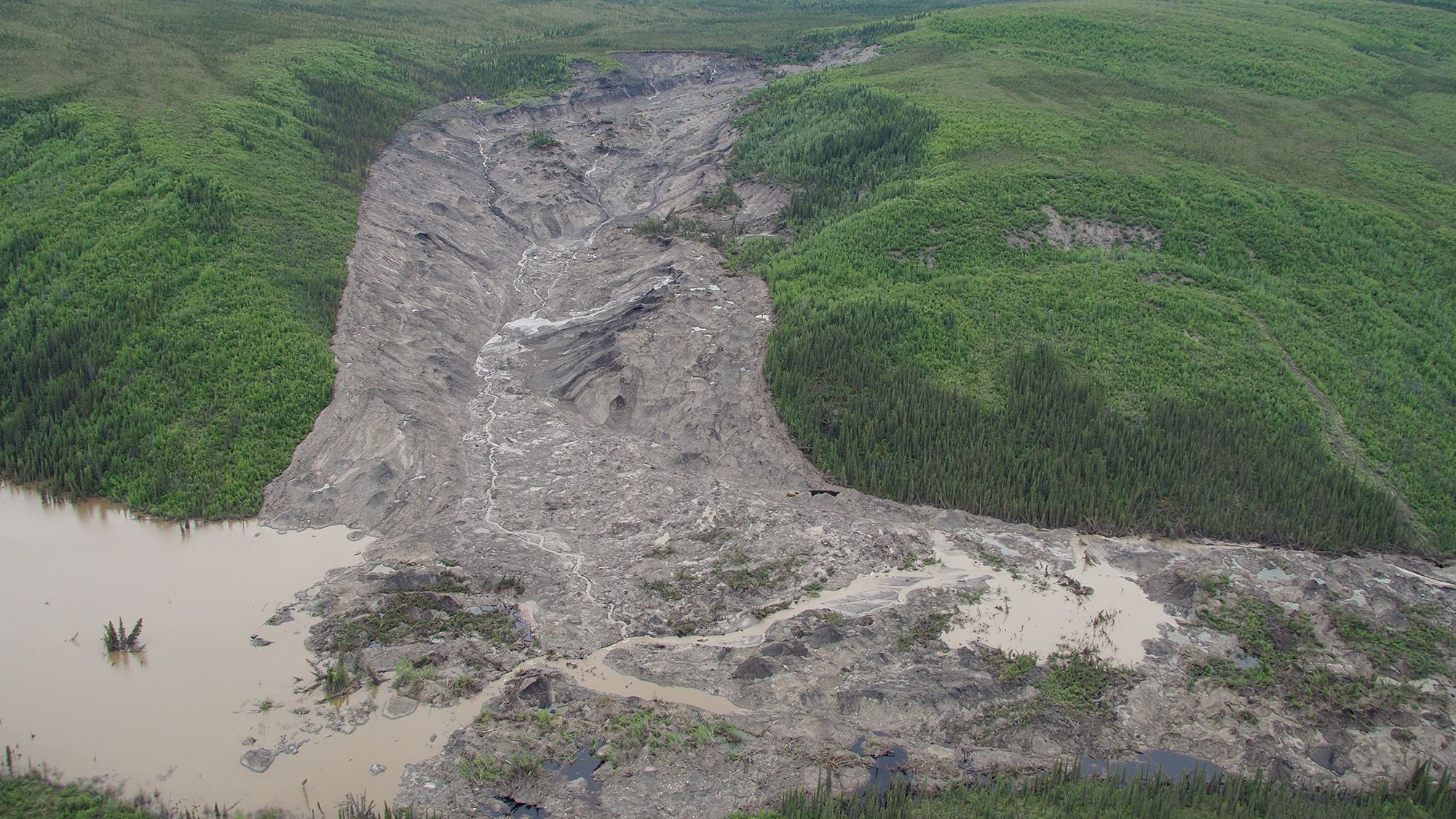
A newly identified type of landslide is occurring in northern regions with relatively thin permafrost, and researchers say it could become more widespread as the planet warms and wildfires intensify. Known as permafrost avulsion slides, these events may be a long-term consequence of wildfires and could be unprecedented in the region for more than 10,000 years, according to research published Sept. 23 in Geophysical Research Letters.
Joseph Young completed the research as part of his PhD at the University of Alberta. “It was stable, but basically it just flipped a switch,” Young told Live Science.
Frozen blocks in the debris
While conducting field observations in Canada’s Northwest Territories, Young and his colleagues noticed scars from large landslides in valleys where permafrost — ground that remains frozen year-round — had historically been stable. They used satellite imagery to map the changes and carried out field surveys, which showed that the landslides did not result from the usual form of permafrost thaw.
“Normally, in permafrost, everything just melts into a slurry and goes downhill like mud,” Young said. “But in large landslides like this, chunks of frozen material were found among the debris.”
Some of the frozen blocks were 33 feet (10 meters) high, about the height of a two-story house. To measure the depth of permafrost on the slopes, the researchers passed an electric current through the ground.
The team focused on two landslides. One occurred in the Johnson River Valley in 2017 and displaced more than 636 million cubic feet (18 million cubic meters) of soil and rock. The other occurred in the Redstone River Valley in 2018, moving about 159 million cubic feet (4.5 million cubic meters) of debris. The smaller slide left a scar three-quarters of a mile (1.2 kilometers) long, while the larger slide gouged nearly two miles (3.2 kilometers) into the hillside.
Wildfire and warming combined
The researchers used their field measurements to model how the slides formed. Since monitoring began in 1980, the region’s permafrost has warmed by about 0.54 degrees Fahrenheit (0.3 degrees Celsius) per decade. Severe wildfires also occurred nearby in 1995.
Rather than thawing from the top downward into a muddy slurry, the permafrost appears to have been destabilized by a combination of wildfire-related thawing and rising temperatures. The process created cracks near the top of the slope, allowing snowmelt to penetrate deeper and eventually thaw the base of the permafrost.
This progression can take 20 years to reach a depth of 66 feet (20 meters), which corresponds to what happened in the Johnson and Redstone river valleys.
“There was a fire in 1995, and 20 years later, we started having a lot of these large-scale disturbances,” Young said.
A potential warning for northern regions
The two large slides examined by the researchers are among more than 150 in the area, Young said. Other slides are smaller, but they typically move more than 35 million cubic feet (1 million cubic meters) of land each.
Because the landslides occurred in a remote part of Canada’s Northwest Territories, they have not yet damaged infrastructure. However, the slides dammed a river, creating a new lake and rapidly releasing sediment into waterways downstream, Young said.
Other parts of Canada and Alaska could be vulnerable to the same type of landslide where permafrost is 20 to 40 meters (66 to 130 feet) deep. The risk may be increased by the growing intensity of wildfires at northern latitudes.
“This is a glimpse into the future of what we can expect in these areas as wildfire dynamics change,” Young said.
Research citation
Young, J. M., Van Der Sluijs, J., Kokelj, S. V., Gruber, S., Herring, T., Rudy, ACA, Alvarez, A., and Froese, D. (2026). Permafrost detachment slide: A unique high-grade permafrost mass wasting process. Geophysical Research Letters, 53(18).
Source: www.livescience.com