


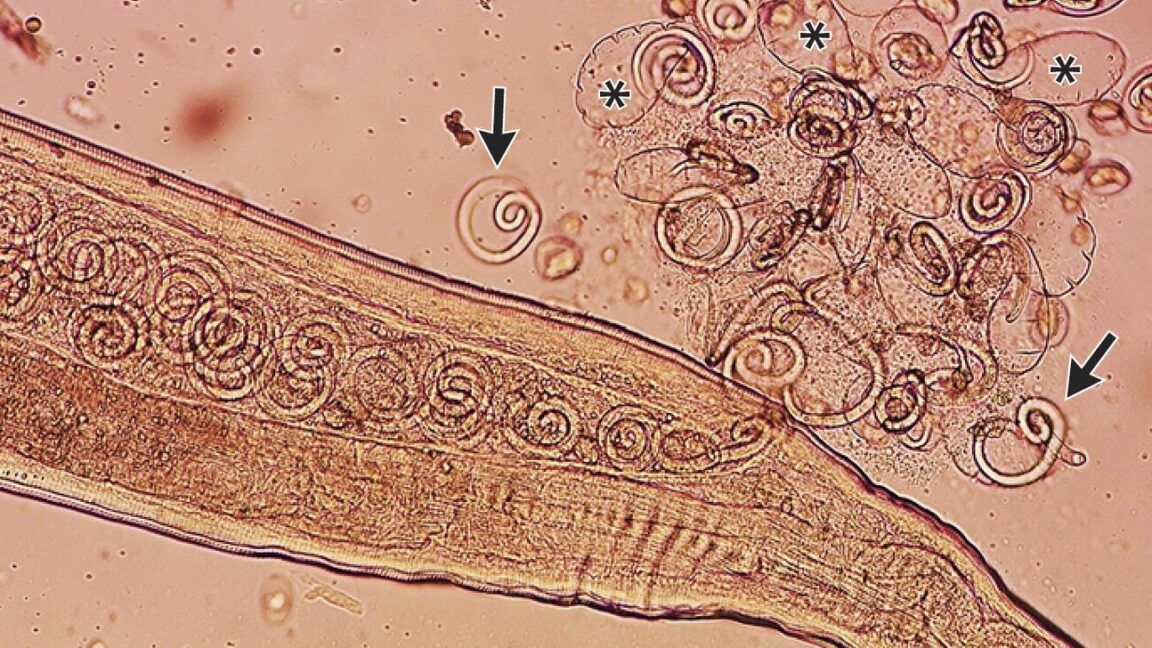
The nematode Thelazia californiensis completes its life cycle with help from flies that feed on tears and eye secretions. The flies carry the parasite’s larvae between hosts, allowing the worms to develop before settling in a person’s eye, where adult males and females mate. In one reported case, doctors removed all of the adult worms from a man’s eye, and his symptoms resolved without antiparasitic medication.
How the eye worm spreads
The nematode’s life cycle depends on a fly that feeds around an animal’s eyes, consuming tears and other secretions. After a fly feeds on an infected eye, it takes up the parasite’s first-stage larvae. The insect then serves as both an incubator and a flying transport system.
Inside the fly, the larvae molt twice and develop into third-stage larvae. They then move to the insect’s mouthparts, where they wait until the fly reaches another suitable, watery eye. The larvae leave the fly and settle in the new host’s eye, where they undergo additional molts before becoming adults. The mature worms remain in the eye and reproduce.
Females release larvae inside the host
T. calipeda is ovoviviparous, meaning its embryos develop inside eggs within the female worm’s body. The females release large numbers of tightly coiled first-stage larvae, which can then be taken up by thirsty flies feeding on eye secretions.
Some of the female worms removed from the man’s eyes contained fully developed eggs. Doctors observed that, after extraction, some of the coiled larvae began emerging from the worms. They identified the male worms by their mating spines—needle-like structures that help facilitate reproduction.
The infection resolved after removal
Fortunately for the man, doctors removed all of the adult worms from his eye, ending the infection. Antiparasitic drugs were not needed, even though some larvae may have remained.
At a follow-up examination two months later, the doctors reported that the man’s eye symptoms had completely resolved and that no worms were present.
Source: arstechnica.com