


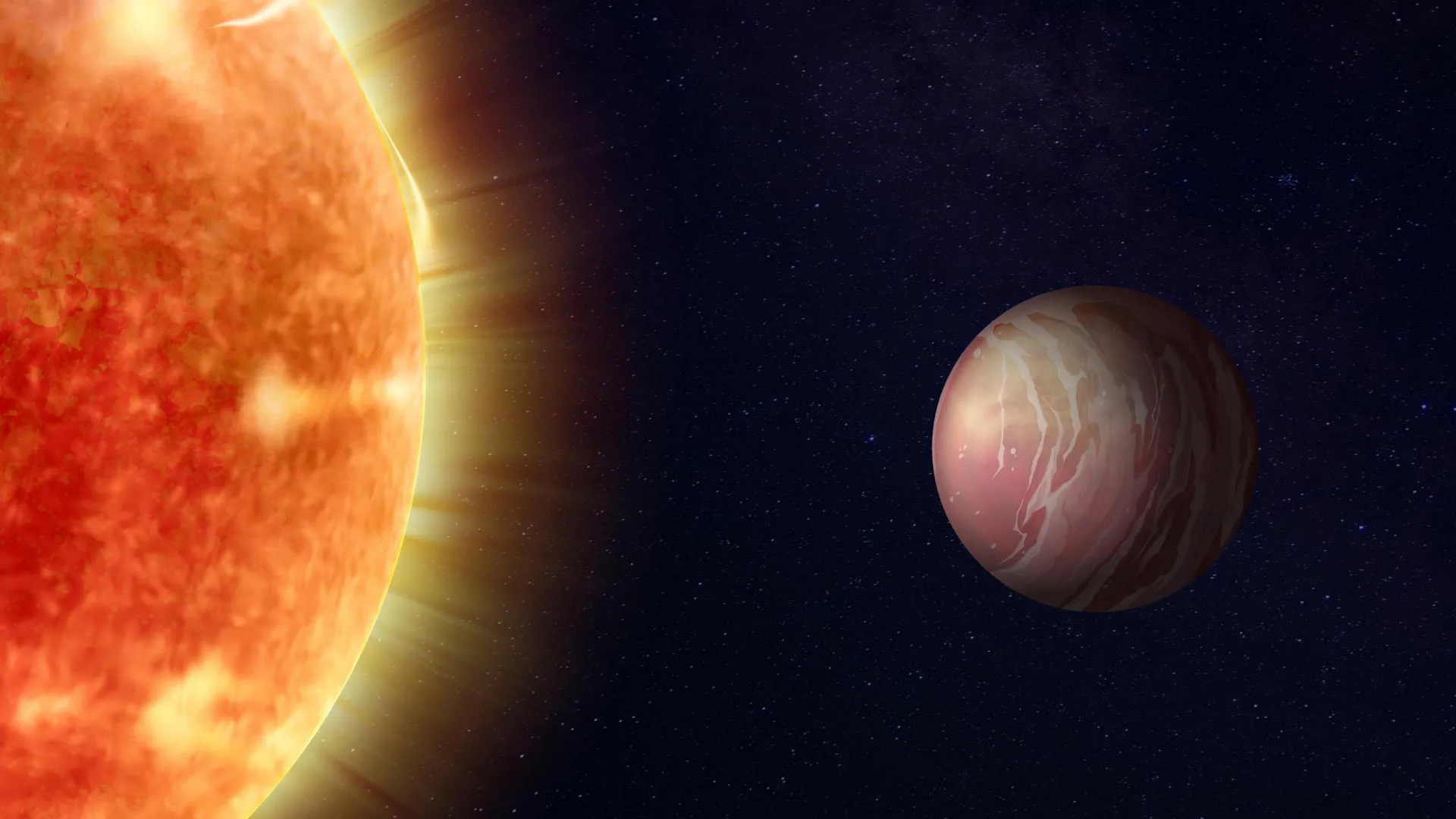
Astronomers have found evidence that TOI-561 b, a scorching rocky exoplanet covered in molten rock, may retain a substantial atmosphere despite receiving intense radiation from its star. Observations from the James Webb Space Telescope (JWST) suggest that reflective clouds could act as a giant sunscreen, bouncing about 75% of the incoming starlight back into space while the atmosphere redistributes heat to the planet’s night side.
An international team of researchers, including astrophysicist Dr Anjali Piett of the University of Birmingham, reported the discovery in an astronomical journal. The team used JWST to monitor TOI-561 b, which is about 280 light-years from Earth, for 37 hours—nearly four complete orbits around its host star.
The observations indicate that TOI-561 b may be surrounded by a significant atmosphere, although its environment is far too harsh for life as we know it. The atmosphere may help reflect much of the radiation from the star and transport heat from the permanently illuminated day side to the night side, reducing the temperature on the side facing the star.
A lava planet with an atmosphere that should have disappeared
Scientists do not yet know which gases make up TOI-561 b’s atmosphere. One possibility is a thick layer of carbon dioxide, similar to Venus’s atmosphere but under much hotter conditions. Another is an atmosphere resembling that of Jupiter’s moon Io, which consists mostly of sulfur dioxide released by volcanic activity.
Dr Anjali Piett, assistant professor of astronomy at the University of Birmingham, said: “Our discovery challenges current theory. A rocky planet like TOI-561 b, exposed to large amounts of radiation, would be expected to have lost its atmosphere billions of years ago.”
“Instead, the evidence suggests that the planet still has a significant atmosphere. This raises big questions, such as whether the planet started out with an unusually large supply of gas, or whether oceans of lava covering the surface act as planet-wide volcanoes, constantly feeding the atmosphere.”
Reflective clouds may keep the planet cooler
Early measurements revealed a puzzling feature of TOI-561 b: its day side was much cooler than expected for a dark, rocky planet orbiting so close to its star. This suggested that much of the incoming energy was either being transferred to the night side or reflected into space before it could heat the surface.
To investigate, the team observed the planet through its entire orbit, allowing researchers to examine its night side for the first time. The same side of TOI-561 b always faces its star, leaving the night side in permanent darkness. However, measurements showed that the dark hemisphere was not warm enough to account for all the heat lost from the day side.
The observations instead indicate that TOI-561 b reflects about 75% of the starlight that reaches it, a proportion comparable to Venus’s reflectivity.
To determine what might produce this strong reflectance, the researchers compared the telescope measurements with computer models of the planet’s climate. The simulations suggest that clouds containing silicate minerals such as silicon dioxide (SiO2) and magnesium silicate (MgSiO3) could form across the day side. These clouds could act as a natural sunscreen, reflecting incoming radiation before it reaches the planet’s surface.
Professor Lisa Dunn, who led the project at the University of Waterloo in Ontario, Canada, said: “We measured how the planet’s brightness and heat changed throughout its orbit. This technique, known as phase curving, revealed that the planet reflected a large amount of light from the star, redistributing the heat around the planet rather than just on the sunlit side. Together, these points to the presence of an atmosphere.”
Could a global lava ocean sustain the atmosphere?
The discovery strengthens earlier evidence from Professor Lisa Dunn, Dr Anjali Piette and their collaborators that TOI-561 b has a thick atmosphere that may be continuously replenished by gases escaping from its molten interior.
This possibility could help explain how some planets maintain atmospheres while being exposed to intense stellar radiation for billions of years. Rather than simply being lost to space, gases may be continually released from vast reservoirs of lava on the planet’s surface.
Researchers now want to determine whether TOI-561 b is more like extremely hot Venus or a more powerful version of the volcanic moon Io. Observations with JWST at longer wavelengths could reveal more about the atmosphere’s chemical composition and help explain how it has survived for so long.
Professor Dunn added: “The next big question we will try to answer is whether TOI-561 b’s atmosphere is similar to Venus, or an extreme version of Venus. Observing the planet at longer wavelengths with JWST may provide insight and help explain how such a hot planet has managed to maintain an atmosphere for billions of years.”
Source: www.sciencedaily.com