


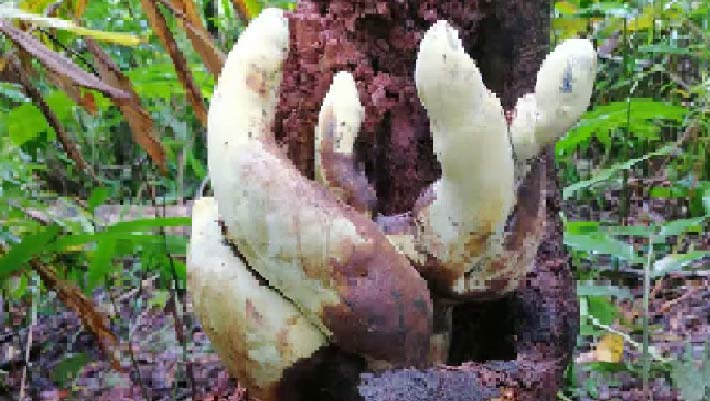
A pale yellow fungus growing from the base of dead trees in China’s Yunnan province has been identified as a member of a previously unknown fungal family. Named Dianjunus rex, the species produces fleshy, finger-like or palm-shaped fruiting structures that can reach 50 centimeters (20 inches) in height, and genetic evidence suggests that its lineage originated about 65 million years ago, near the mass extinction that ended the Cretaceous Period.
“This remarkable species represents a new fungal family and provides a valuable window into the evolution of extreme fungal morphology,” said Dr. Indunil Senanayake, a researcher at the Kunming Botanical Research Institute.
“This discovery shows how much undiscovered fungal biodiversity remains in East Asian forests.”
A giant fungus in East Asian forests
Dianjunus rex produces fruiting structures called stromata. The largest specimen measured up to 50 centimeters tall and weighed 2.2 kilograms (about 5 pounds). Fresh fruiting bodies are soft and dry quickly after harvesting.
“Fruit bodies towering over surrounding vegetation and debris may be better able to disseminate spores by wind in dense forests,” Dr. Senanayake said.
“However, such large-scale structures require significant energy investments, suggesting that this strategy was only likely to evolve if the environmental benefits outweighed the costs.”
Specimens were collected in 2024 and 2025 from three locations: the Xishuangbanna rainforest, a temperate forest near Kunming, and a forest near Lufeng. Most were found attached to the bases of oak trees.
“They grew on the woody roots of the Chinese cork oak that came out of the rhizosphere,” Dr. Senanayake said.
A new fungal family
Ascomycetes are the largest group of fungi, with more than 64,000 species. They do not produce true mushrooms in the usual sense; instead, they release spores from small, sac-like structures located inside or on the surface of their fruiting bodies.
Dianjunus rex belongs to Xylariales, an order that includes many fungi that decompose wood and typically form small, black, crusty growths.
Genetic analysis of four regions, together with whole-genome sequencing of three specimens, showed that the species represents a distinct evolutionary branch and is a sister lineage to the family Graphostromataceae.
Its pale, powdery surface, distinctive spore characteristics, and microscopic asexual stage distinguish it from related fungi. These features support the creation of a new family, Dianjunaceae.
A lineage dating to the end of the Cretaceous
By comparing the genomes of Dianjunus rex with those of fungal lineages whose ages have been calibrated, the researchers estimated that Dianjunaceae diverged about 65 million years ago.
This date places the origin of the family near the mass extinction at the end of the Cretaceous Period, an event that eliminated all non-avian dinosaurs.
“This timing presents interesting possibilities,” Dr. Senanayake said.
“After the mass extinction, forests experienced dramatic changes, including the sudden availability of large amounts of dead plant matter.”
“Such environmental disruption may have created new ecological opportunities for wood-associated decomposers.”
The findings are reported in a paper published in Frontiers in Fungal Biology.
Source: www.sci.news