


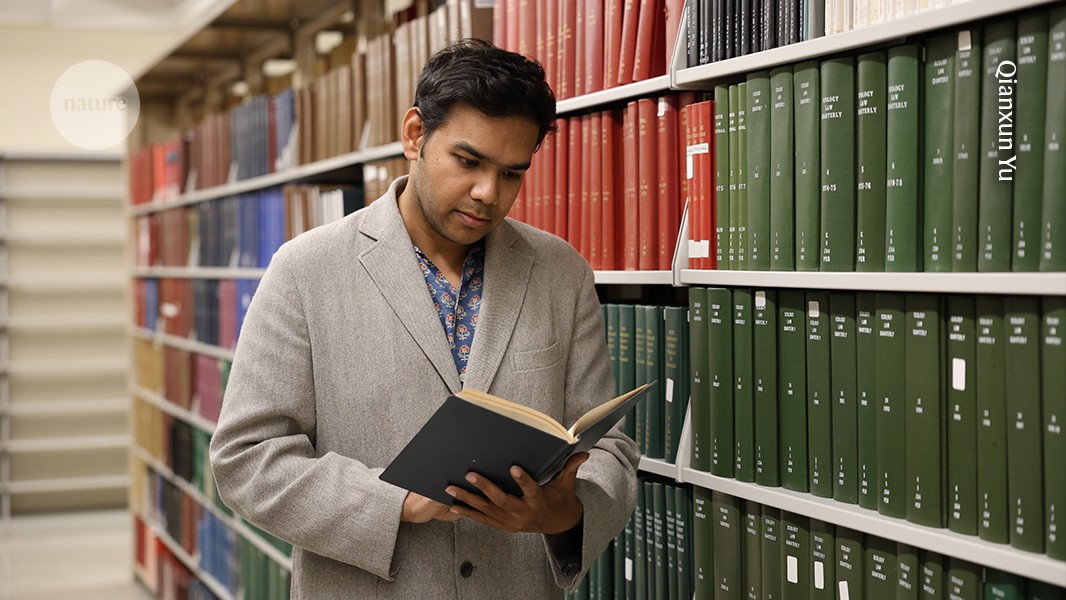
Tuhin Chakrabarty, a computer scientist at the State University of New York at Stony Brook, studies methods for detecting AI-generated text. His research gained international attention earlier this year after a journalist cited it as evidence concerning Daggermouth, a bestselling 2026 novel by H. M. Wolfe. Wolfe has denied using artificial intelligence to write the book. Chakrabarty spoke with Nature about his research, the challenges of identifying AI-generated prose and what the technology could mean for creativity.
How did you become interested in detecting AI-generated text?
I live in New York City and am surrounded by creative people. I understand why artists are furious about AI. It takes years to write a book, but an AI chatbot can produce one in 15 minutes. That got me interested in copyright and creativity.
As the use of AI expands, the future will become even more chaotic. What is copyrightable? If you co-create something with AI, how do you quantify the original human contribution? How can you distinguish between the two?
What counts as AI-written text?
Disclosure is important. Scientific conferences are increasingly requiring authors to disclose how AI was used, such as to refine writing or copy-edit a manuscript. Disclosure makes the work easier to assess.
Over time, one can imagine separate markets developing for purely human-written text, hybrid writing and mass-market AI-written prose. That might create better economic incentives for people who do not use AI, or who are morally opposed to using it.
Everyone’s process is different, and there is a huge range of ways to use AI. My moral concerns relate to people using AI and passing off prose generated by the technology as their own. That is the problem.
How can AI-generated prose be detected?
In a July preprint, my colleagues and I tracked relatively rare word sequences that appear verbatim in different books (T. Chakrabarty et al., preprint on arXiv, https://doi.org/rsp2; 2026). We wanted to measure the extent to which a book’s language was derived from previous books.
We compared the number of these unusual expressions in three groups of books sold on Amazon: 200 titles flagged by the AI-detection software Pangram as containing large amounts of AI-written text; 200 self-published bestsellers that were not flagged as containing AI-written text; and 200 award-winning or award-nominated literary novels. For each book, we identified every word sequence that appeared in a sample of hundreds of thousands of Google Books titles.
Literary fiction had the least overlap with existing books, self-published books had more overlap, and books identified as AI-written had the most.
This suggests that AI models find it easiest to automate more routine descriptions. Many self-published genre novels use metaphors, clichés and familiar formulas that AI can generate relatively easily. Literary fiction requires more originality and subtext.
In our ongoing work, we have divided books into narrative beats—individual events or plot points that make up a story. There, too, we found that AI-generated books copied certain beats from earlier books written by humans.
Why do AI-generated texts use words and expressions from existing books?
Large language models are trained on vast amounts of human text, including books, and certain linguistic sequences may reappear in the language they produce. We have also found AI-generated books containing expressions that appear in books written by other AIs.
That does not necessarily mean the model intentionally copied text from a particular book. Its output is a function of the material on which it was trained, and in some cases it produces unusually close overlaps.
Could human writers also repeat expressions from published books?
Absolutely. Genre novels, in particular, rely on formulas, so two writers working independently can easily produce overlaps of five or six words. However, the longer and more specific the expression, the harder it becomes to explain the coincidence.
Many of the expressions we found in genre novels were images, metaphors, clichés and platitudes. I can see why AI would be more likely to reproduce these. If you are writing romance or science fiction, you are also following genre conventions.
What do you think about your work being used to make a case about a particular book?
In our study, we chose not to disclose the authors’ names. As academics, we have little power. If someone filed a defamation lawsuit against me, an untenured faculty member, or the university where I work, it would be difficult to deal with.
But when journalists write about your work—especially something as explosive as this—they need to share the underlying data. The Atlantic shared it. I was happy about that because I trusted my results and trusted the reporters to do their due diligence.
H. M. Wolfe strongly denies using AI to write Daggermouth. Why do you stand by your analysis?
The book contained specific unusual expressions. One read: “They fell together, a tangle of sweaty, slimy limbs and pounding hearts.” The entire expression appears in another book. It is too long and too specific for the exact same wording to have arisen by chance. I found several such examples.
A check using the AI-detection tool Pangram also flagged more than half of the book as AI-generated. I do not believe the book was created entirely by AI, but I support the conclusion that it was substantially AI-powered.
H. M. Wolfe did not respond to a query from Nature. In a statement to The Atlantic through her lawyer, she said it was “wholly untrue” that she used generative AI to write Daggermouth. Both the US publisher Simon & Schuster and the UK publisher Tor Bramble stand by the author and the book.
Can AI be used creatively in literature?
Absolutely. Great writers are using AI. Vauhini Vara’s 2025 book Search is a fascinating example of nonfiction that incorporates AI-generated text. Vara uses AI responses in ways that raise questions about what the technology is doing.
Sheila Heti also experimented with AI in the 2023 New Yorker story “According to Alice”. Heti spoke with a customizable chatbot on the Chai AI platform, then deleted her questions and edited the answers into her published story.
I do not think there is necessarily a bias against using AI. There is a stigma around using AI and concealing it. Why not use AI in profound ways to add new meaning to literature and art? If a skilled writer uses it, discloses that use and creates something that impresses people, I am sure publishers will publish it.
Source: www.nature.com