


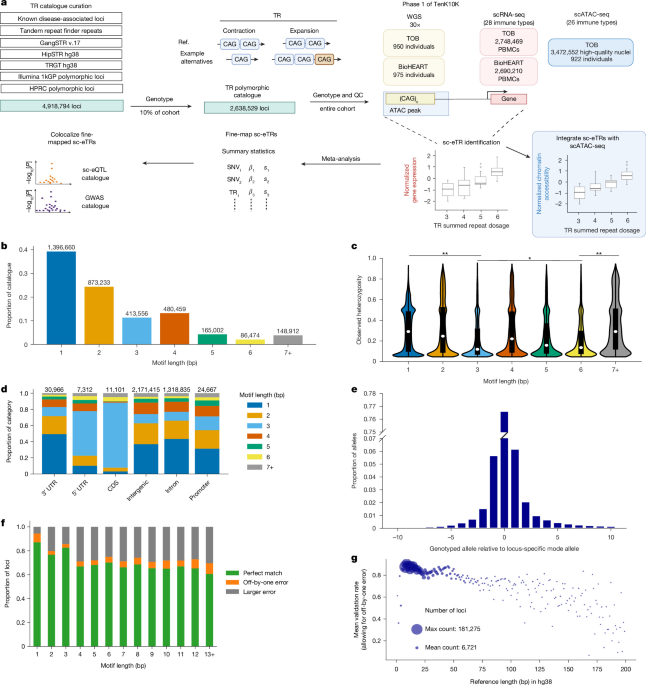
The supplied source is a bibliography for research on how short tandem repeat (STR) variation may influence gene regulation, particularly in immune cells. It brings together studies on STR sequencing, repeat expansion disorders, gene expression, DNA methylation, chromatin accessibility, disease risk and single-cell genomics. Because the source contains references but no main article text, it does not provide the study’s methods, results, quotations or conclusions beyond what can be inferred from the cited titles.
Why short tandem repeats matter
Short tandem repeats are DNA sequences in which a short motif is repeated several times. The number of repeats can vary between individuals and can change across generations or within tissues. A 2024 review by H. A. Tanudisastro, I. W. Deveson, H. Dashnow and D. G. MacArthur describes advances in sequencing and characterizing these regions in the human genome (Nature Reviews Genetics 25, 460–475, 2024). Earlier work established that STRs are abundant in human promoters and are associated with regulatory elements, while other studies showed that repeat variation can affect gene expression.
Research has also linked STRs to disease. Repeat expansions are implicated in a range of neurological disorders, and recurrent expansions have been identified in human cancer genomes. A 2025 study by R. E. Handsaker and colleagues examined long somatic DNA-repeat expansions in Huntington’s disease, while work by G. S. Erwin and colleagues reported recurrent repeat expansions in cancer genomes in Nature 613, 96–102 (2023).
STRs and gene regulation
Several cited studies describe mechanisms through which tandem repeats could alter gene activity. H. A. Fotsing and colleagues reported an impact of STR variation on gene expression in Nature Genetics 51, 1652–1659 (2019). M. D. Vinces, M. Legendre, M. Caldara, M. Hagihara and K. J. Verstrepen found that unstable tandem repeats in promoters can confer transcriptional evolvability in Science 324, 1213–1216 (2009).
Other work has examined epigenetic effects. A genome-wide study by A. Martin-Trujillo, P. Garg, N. Patel, B. Jadhav and A. J. Sharp evaluated how STR variation affects local DNA methylation in Genome Research 33, 184–196 (2023). Tandem repeats have also been associated with chromatin domain boundaries, nucleosome positioning and transcription-factor binding.
Connections to immune biology
The reference list places particular emphasis on immune-cell regulation. It cites studies of genetic control of gene expression in immune cells, including single-cell expression quantitative trait locus studies that identify cell-type-specific effects. Examples include S. Yazar and colleagues’ study of autoimmune-disease loci in Science 376, eabf3041 (2022), and A. Nathan and colleagues’ analysis of dynamic genetic regulation in T-cell states in Nature 606, 120–128 (2022).
The cited literature also covers the biology of dendritic cells, B cells, T cells, natural killer cells, monocytes and macrophages. These studies provide context for investigating whether STR variants influence immune responses differently in distinct cell types rather than producing the same effect across all cells.
Single-cell analysis
Single-cell sequencing allows researchers to measure gene activity in individual cells and separate signals that would be obscured in bulk tissue. The bibliography includes tools and methods such as STAR for RNA-sequence alignment, SCANPY for single-cell gene-expression analysis, scPred for cell-type classification, Vireo and Demuxafy for assigning cells to samples, and several methods for detecting doublets.
It also cites work on integrating multimodal single-cell data, harmonizing cell types across Human Cell Atlas datasets and optimizing expression quantitative trait locus mapping workflows. Together, these methods could help connect inherited STR variation with gene-expression differences in specific immune-cell populations.
Genetic variation and disease risk
The references connect regulatory variation to genome-wide association studies of asthma, inflammatory bowel disease, IgA nephropathy, rheumatoid arthritis, systemic lupus erythematosus, type 1 diabetes, breast cancer, lung cancer, prostate cancer, Alzheimer’s disease, multiple sclerosis, Parkinson’s disease and COVID-19 outcomes.
Several cited studies emphasize the value of analyzing multiple ancestries. For example, K. Tsuo and colleagues examined asthma across ancestries, Z. Liu and colleagues studied inflammatory bowel disease in East Asian and European populations, and K. Ishigaki and colleagues analyzed rheumatoid arthritis using multi-ancestry data. These studies illustrate why reference panels and association analyses that represent diverse populations are important when assessing the effects of genetic variants.
Tools for studying tandem repeats
The bibliography includes software for identifying and analyzing STRs, including Tandem Repeats Finder, ExpansionHunter, STRipy and TRTools. It also cites population reference panels and a 2024 study by E. Dolzhenko and colleagues on characterizing and visualizing tandem repeats at genome scale.
These resources address a longstanding technical challenge: repetitive DNA is difficult to align and genotype accurately with conventional sequencing approaches. Improved long-read sequencing, sequence-graph methods and population-scale reference datasets are making it easier to measure repeat length and sequence variation.
What the source establishes
Taken together, the references support the view that STRs are not merely passive or repetitive portions of the genome. Variation in these regions can affect transcription, methylation, chromatin organization and disease-associated biology. The cited work also supports combining repeat genotyping with single-cell measurements to investigate whether particular STR alleles influence gene expression in specific immune-cell types.
However, the supplied source does not include the underlying article’s experimental design or findings. It therefore does not establish which STRs were tested, how many samples or cells were analyzed, what statistical thresholds were used, or whether any observed associations were experimentally validated.
Selected references
- Tanudisastro, H. A., Deveson, I. W., Dashnow, H. & MacArthur, D. G. “Sequencing and characterizing short tandem repeats in the human genome.” Nature Reviews Genetics 25, 460–475 (2024). Article · PubMed
- Horton, C. A. et al. “Short tandem repeats bind transcription factors to tune eukaryotic gene expression.” Science 381, eadd1250 (2023). Article · PubMed
- Fotsing, S. F. et al. “The impact of short tandem repeat variation on gene expression.” Nature Genetics 51, 1652–1659 (2019). Article · PubMed
- Gymrek, M. et al. “Abundant contribution of short tandem repeats to gene expression variation in humans.” Nature Genetics 48, 22–29 (2016). Article · PubMed
- Cuomo, A. S. E. et al. “Rare and common genetic variants shape single-cell immune gene expression.” Nature (2026).
- Xue, A. et al. “Genetic variants shape single-cell chromatin accessibility and disease risk.” Nature (2026).
Source: www.nature.com