


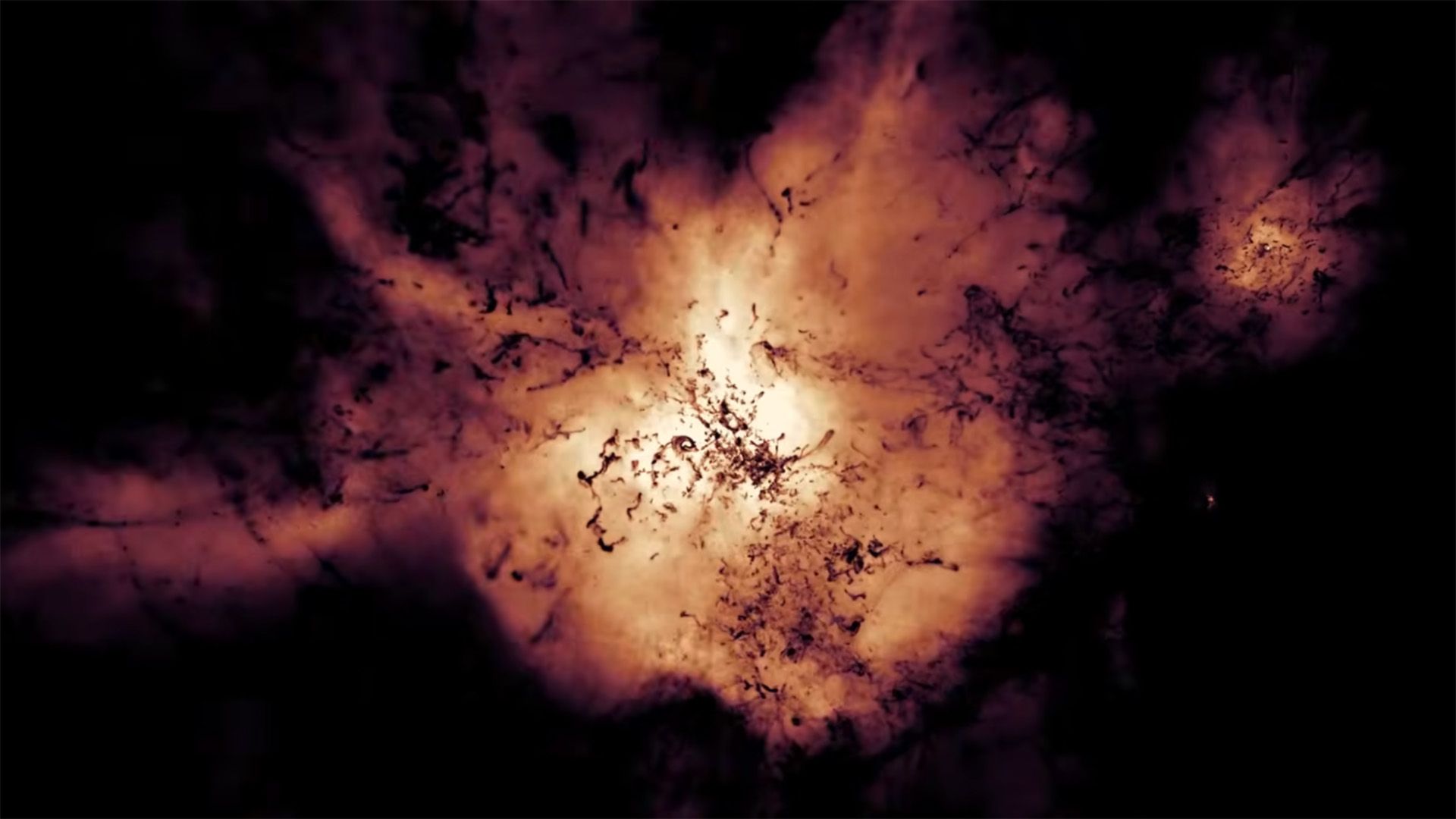
Scientists have used a new cosmological simulation called Lumina to trace a large portion of the universe’s early history, including the transition from the cosmic “Dark Ages” to the formation of the first galaxies. The simulation covers 2 billion years of cosmic time and follows how dark matter, gas, stars and radiation contributed to the return of visible light to the universe.
Lumina represents a significant span of the universe’s 13.8-billion-year history. The results were published on Monday, October 26, in Monthly Notices of the Royal Astronomical Society.
“No other simulation allows you to zoom in this far,” study co-author Mark Vogelsberger, a physics professor at the Massachusetts Institute of Technology, said in a statement. “The difference between the smallest and largest scales we simulate is greater than any other simulation.”
The researchers examined a simulated region about 1.6 billion light-years across to study how the universe’s components assembled into galaxies. A video released with the study shows the simulation beginning roughly 45 million years after the Big Bang and progressively zooming into a small region of the early universe.
Illuminating the cosmic Dark Ages
In the early universe, a fog of neutral hydrogen atoms gradually accumulated and blocked light from the first stars. This hydrogen acted as a shroud, preventing light from traveling freely until galaxies began to form. This period is known as the Dark Ages of the universe.
The Lumina video begins during this era and reveals a gaseous halo that eventually gives way to bright, young galaxies. The calculation includes dark matter, stars, gas and radiation, allowing researchers to follow how these ingredients contributed to the re-emergence of light.
“We can see that this is where the first galaxies formed,” lead author Oliver Geer, a former MIT postdoctoral fellow and computational astrophysicist now at Harvard University, said in a statement. “Then the first stars form within those first galaxies. Those stars then produce radiation. The simulation can track that radiation and zoom out to see how that radiation leaves the star and travels through space until at some point it ionizes neutral hydrogen.”
Lumina was designed to model two major events in the young universe: the reionization of hydrogen and the reionization of helium. Reionization describes the transformation of the intergalactic medium—the space between galaxies—from a neutral state to an ionized one.
According to the researchers, ultraviolet light from young stars and galaxies removed electrons from hydrogen, allowing light to pass through the cosmic fog. Helium reionization occurred later, when an energetic supermassive black hole disrupted neutral helium.
The researchers said Lumina could eventually help test observations of the early universe made by telescopes, particularly observations that map large numbers of galaxies at the same time. By modeling both the small-scale formation of stars and galaxies and the large-scale spread of radiation, the simulation may provide a way to compare those observations with predictions about how the first galaxies emerged.
Study details
Zier, O., Smith, A., Shen, X., Liu, R., Kannan, R., Koehler, S. M., Springel, V., Pakmor, R., Vogelsberger, M., Bulichi, T., and Hernquist, L. (2026). “Introducing the Lumina project: large-capacity radiation hydrodynamic simulations in the era of hydrogen and helium reionization.” Monthly Notices of the Royal Astronomical Society, 552(4).
Source: www.livescience.com