


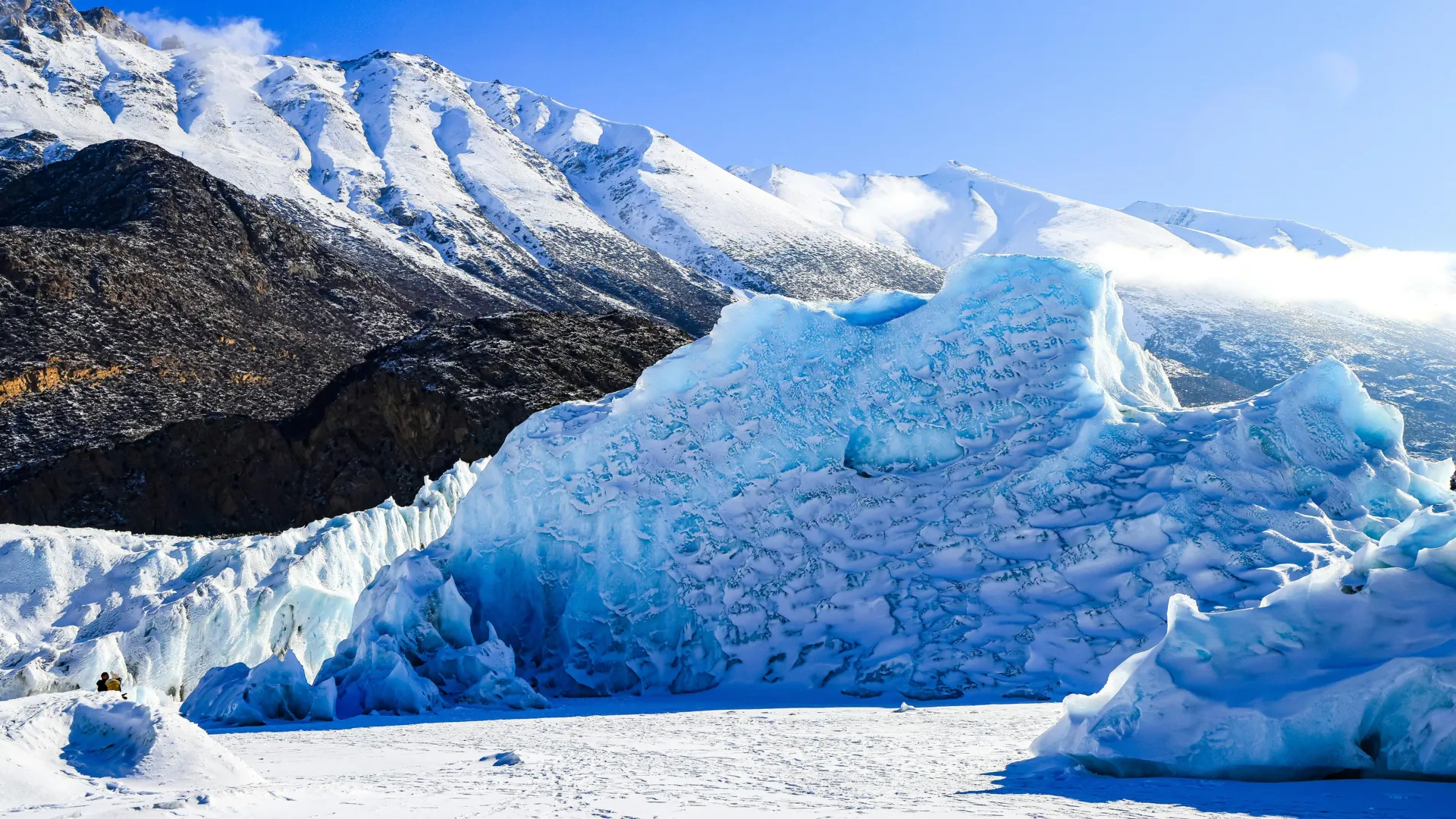
Scientists studying ice from the Guriya Plateau in northwestern Tibet have found evidence that some of the ice may be more than 128,000 years old. The finding suggests that high-altitude ice survived the last ice age and could offer an unusually long record of Earth’s ancient climate outside the polar regions.
The discovery extends the known record of glaciers in the region by more than 100,000 years. It also makes the Guriya cores the oldest ice cores recovered from this part of Tibet and provides rare evidence of how mountain glaciers endured major shifts in Earth’s climate.
Comparing ice cores collected decades apart
The researchers reached their conclusion by examining ice cores drilled from the Guriya Plateau in 1992 and 2015. Although the samples were collected 23 years apart, they contained remarkably similar oxygen-isotope patterns. Scientists use these patterns to reconstruct past environmental conditions.
The agreement between the two cores indicates that the ice preserves a reliable and reproducible record of climate history.
“Reproducibility of records within a particular ice sheet is extremely important,” said Lonnie Thompson, the study’s lead author, a professor of geosciences and senior research fellow at The Ohio State University’s Byrd Polar Research Center. “If we get the same records a quarter of a century later, we’ll learn a lot about the behavior of ice over time.”
How scientists dated the ancient Tibetan ice
Determining the age of ice that has remained frozen for tens of thousands of years is challenging. To establish a more accurate chronology, the international research team used advanced dating methods based on radioactive isotopes of beryllium and chlorine.
These naturally occurring radioactive elements decay at predictable rates, making them useful for identifying events in Earth’s environmental history. In this study, the researchers used them to search for evidence of the Reshan geomagnetic displacement, a major disturbance in Earth’s magnetic field that occurred more than 41,000 years ago and left distinctive chemical signatures in the ice.
The team also compared its results with oxygen-isotope records preserved in cave deposits elsewhere in Tibet. Taken together, the evidence suggests that the Guriya ice record may extend well beyond 128,000 years into the past.
“This is a really important discovery because outside of the polar regions, this is the only ice core taken from a mountaintop that goes that far,” Thompson said. “The Huascaran records only go back over 30,000 years, not over 100,000 years ago, which makes Guriya a very unique record.”
The research results were published in the journal Science Advances.
A record of climate during the last ice age
Ice cores are among scientists’ most valuable sources of information about ancient climate. As snow accumulates and gradually compresses into ice, it can preserve chemical clues about atmospheric and environmental conditions at the time. By examining successive layers, researchers can reconstruct climate changes over thousands of years.
Interpreting those records, however, requires knowing when each layer formed. Without a reliable timeline, even well-preserved ice cores can be difficult to understand.
This uncertainty complicated earlier interpretations of the Guriya ice sheet. Previous research suggested that its record extended only to the mid-Holocene, the geological epoch that began about 12,000 years ago after the last ice age.
The new evidence indicates that at least some of the ice is considerably older than the Holocene. It also has implications for understanding whether large ice masses remained in Tibet as the region emerged from the last ice age.
“If Tibet only had Holocene ice, it would mean that the large ice sheets from the last ice age did not remain until the early Holocene,” Thompson said. “But the evidence shows that it happened.”
What the discovery reveals about Earth’s glaciers
The unusual topography of the Guriya ice sheet may help explain why it preserved such an exceptionally old climate record. Its high altitude and surrounding terrain likely created conditions that allowed ancient ice to remain in place through major environmental changes.
Beyond establishing the age of the glacier, a more precise chronology could help researchers investigate fundamental questions about the history of Earth’s ice. Knowing when major ice ages began, how long they lasted and when the ice retreated is essential for reconstructing the planet’s natural climate cycles.
“When did ice start forming on Earth? And what was its natural ice loss process?” Thompson said. “We need to know about them, and the only way we can really demonstrate that is by showing the exact time scales in these records.”
The revised timeline also creates opportunities to study the Guriya core in greater detail. Researchers plan to analyze additional samples to determine how other indicators of past climate and environmental conditions fit into this much longer history.
Future analyses may reveal information that was previously overlooked or interpreted differently because the age of the ice was not fully understood.
For Thompson, one of the most encouraging aspects of the finding is that different measurements consistently support the same interpretation.
“The big picture is that our results tell a very consistent story,” he said. “If you get the science right, it’s consistent. What we need to catch up to is our understanding of what the science is trying to tell us.”
The research was supported by the National Science Foundation. Co-authors from Ohio State University include Mary Davis and Ellen Moseley Thompson. Other contributors were Juerg Beer from the Swiss Federal Institute of Fisheries Science and Technology; Christoph Wockenhuber and Markus Kristol of ETH Zurich, Switzerland; Tandong Yao of the Chinese Academy of Sciences; and Ninglian Wang and Ling Fang of Northwestern University, China.
Source: www.sciencedaily.com