


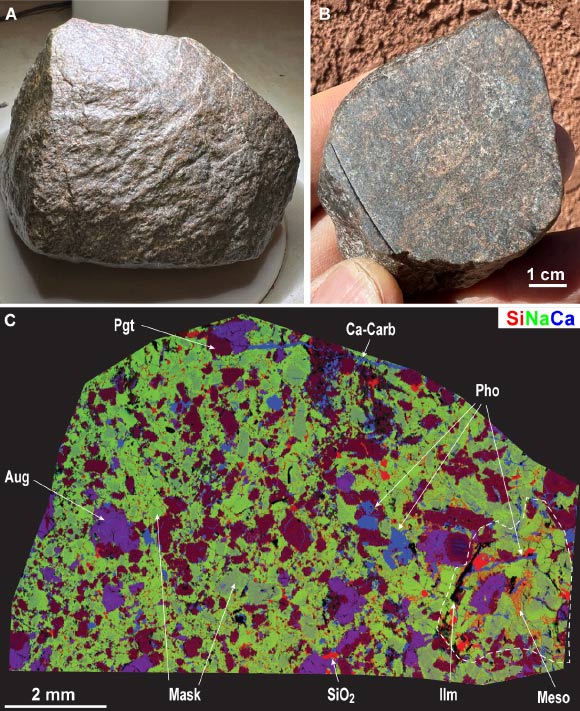
A meteorite found in Mali’s Sahara desert may be a sample of Mars’ primitive crust, formed at least 4.1 billion years ago, according to a new paper published in Science. Known as Tegaza 001, the meteorite is an unusually well-preserved, water-altered igneous rock that may have come from the northwestern region of Mars’ Hellas impact basin.
Tegaza 001 consists of eight pieces with a combined mass of 798.5 grams. The largest fragment weighs 442 grams and is approximately 10 centimeters in diameter.
“It wasn’t until we started looking at it carefully that we realized that this meteorite was truly unique,” said Dr. Yang Liu, a researcher at NASA’s Jet Propulsion Laboratory.
“One of the paper’s reviewers called it the Rosetta Stone of Mars.”
An unusually ancient Martian rock
Nearly all of the approximately 300 known Martian meteorites are much younger than the planet’s surface, which is dominated by terrain more than 3 billion years old.
The three major groups of Martian meteorites—shergottites, nakhlites and chassignites—formed less than 2.4 billion years ago.
Only two older examples or groups have previously been identified. Allan Hills 84001 is a crystallized rock approximately 4.1 billion years old. The other is a group of breccias, or debris-filled rocks, that includes Northwest Africa 7034, some fragments of which are more than 4.3 billion years old.
According to the study’s authors, Tegaza 001 differs from both. It is a coarse-grained igneous rock known as plagioclase-rich gabbro. Its internal structure suggests that it cooled slowly beneath the Martian surface.
The researchers used uranium-lead dating to determine the age of zircon crystals in the meteorite, estimating that they formed approximately 4.11 billion years ago.
A separate rubidium-strontium analysis produced a less precise but consistent age of approximately 4.24 billion years.
That older date may record a period when hot, mineral-rich water circulated through the rock. It may not represent the moment when the rock solidified, but rather an event shortly after its crystals formed.
In either case, Tegaza 001 formed during the earliest period of Martian geological history, no later than about 4.1 billion years ago.
Dr. Carl Agee, director and curator of the Meteorite Research Institute at the University of New Mexico, said: “There are parts of Black Beauty that are of that age, but the meteorite as a whole is a collection of many different types of rocks.”
“This was a big surprise because Tegaza 001 is just one type of pure rock and is more than 4.1 billion years old.”
“This is the oldest igneous rock ever discovered, and in addition, its composition appears to contain clues that suggest it was in an environment with flowing liquids or water.”
Evidence of ancient water
Tegaza 001 also contains evidence that water affected the rock. Its oxygen isotopes are heavier than those found in other Martian meteorites, which the researchers attribute to interaction with oxygen-18-rich fluids in the Martian crust or directly with magma.
The minerals in the meteorite underwent chemical changes on Mars long before the rock was ejected into space.
By comparing the meteorite’s chemistry with measurements made from orbit, the researchers identified Mars’ southern highlands—specifically the northwestern region of the Hellas impact basin—as the most likely source area.
“This is not very common, so not only is it ancient and samples a different type of environment from a different era on Mars, but there are no other samples like it,” Agee said.
“The chances of getting something like this again anytime soon are very low to almost impossible.”
Yang Liu et al., “Mars’ early crust and mantle have been collected from meteorites that formed about 4.1 billion years ago,” Science, published online October 29, 2026. doi: 10.1126/science.adz5646
Source: www.sci.news