


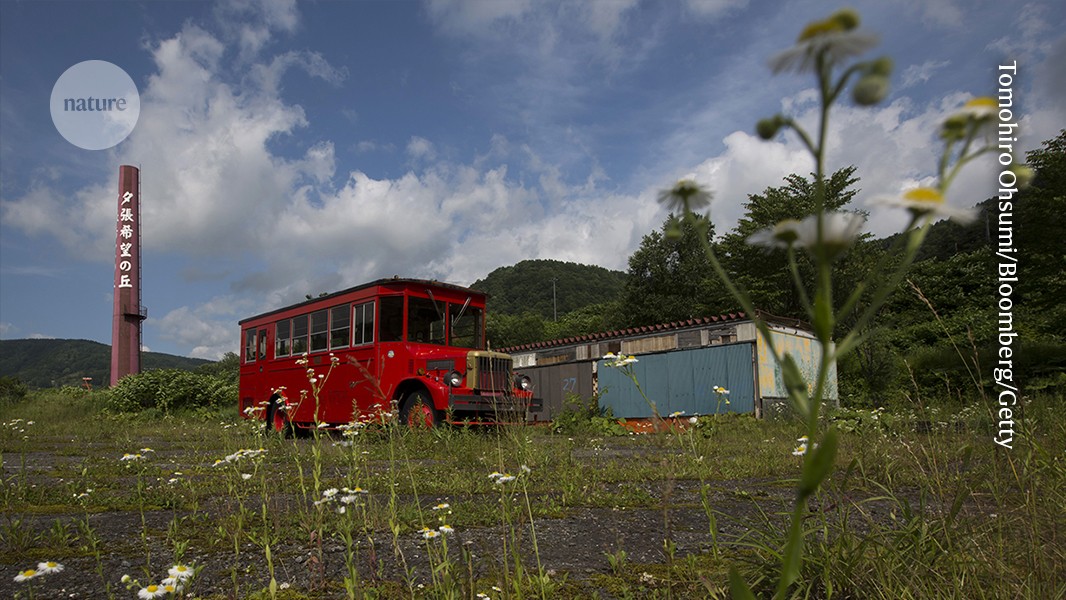
Japan’s abandoned villages are changing their ecosystems. Studies have found that biodiversity is decreasing in places that people have left behind. Credit: Tomohiro Osumi/Bloomberg/Getty
Humanity has never been completely separate from the rest of the planet. For much of human history, people have actively shaped the landscapes now described as wilderness, and their stewardship often created habitats for a wide range of species. As rural populations decline and traditional land management disappears, however, some ecosystems are losing the conditions that support their biodiversity. Conservation efforts will therefore need to include carefully managed human activity, alongside protected areas.
People have long shaped ecosystems
The belief that humans are cut off from nature is persistent but false. For most of human history, people have managed landscapes that European settlers later classified as wilderness.1 Examples include the wildflower-rich oak savannahs of North America and Australia’s fire-maintained ecosystems.
Traditional agricultural practices, some of them thousands of years old,2 created ecological niches that support insects, amphibians, birds and plants. Many of these species co-evolved with human-managed environments.
People have always cultivated some land, but the scale of land conversion has been unprecedented since industrialization began in the mid-18th century, particularly with the rise of industrial agriculture. Intensive conversion of land is the largest cause of biodiversity loss. It is a central reason that countries agreed four years ago to protect 30% of their land and water habitats by 2030, a goal known as the 30 × 30 target.
Abandoned land does not always recover naturally
The 30 × 30 target was not intended to turn protected areas into places where humans are prohibited.3 Evidence reported by Nature suggests that biodiversity does not necessarily flourish when people leave an area entirely.
In Japan, entire villages are being abandoned as rural populations decline. The loss of traditional rice cultivation and forest management is reducing habitat for birds, insects and plants that depend on rice paddies, field margins and open-canopy forests.
These examples show why some protected areas will require active management. Necessary work can include environmentally sensitive forestry, water management, the use of grazing animals and prescribed burning to reduce the risk of catastrophic fires like those increasingly occurring around the world. The United States, Europe and Australia will need thousands of trained fire professionals in the coming decades.
Land stewardship can also involve traditional foraging and planting, the construction of clam gardens along coasts, and the removal of trees and shrubs to thin forests and encourage new growth. Such work should be informed by modern ecology and conservation biology while incorporating ecological knowledge developed through, in some cases, thousands of years of practical experience.
Funding a new conservation workforce
These practices require funding. Traditional farming and land-management methods are more labor-intensive and expensive than industrial farming, which uses less labor and produces high yields. If societies want to maintain this longstanding relationship between people, the Earth and biodiversity, governments will need to provide direct subsidies.
Some support already exists through farmer subsidies and agrobiodiversity programmes, but countries should consider more comprehensive assistance. One possible model is the U.S. Civilian Conservation Corps, established during the Great Depression in the 1930s. Any modern version would need updated standards to improve diversity and equity, and its activities would need to be guided by evidence.
At a time of mass private-sector unemployment, the Corps provided publicly funded jobs for 3 million young people. From 1933 to 1942, its teams planted trees, built terraces, roads and trails, erected fire towers and carried out other work to protect the United States’ natural resources.
Artificial intelligence is raising concerns about more than its environmental impact.4 It could also contribute to a new period of high unemployment. Governments seeking ways to protect workers from job losses caused by technological change should consider investing in the relationship between people and land, water and biodiversity. Such an approach could benefit both workers and the ecosystems in which people live.
Source: www.nature.com