


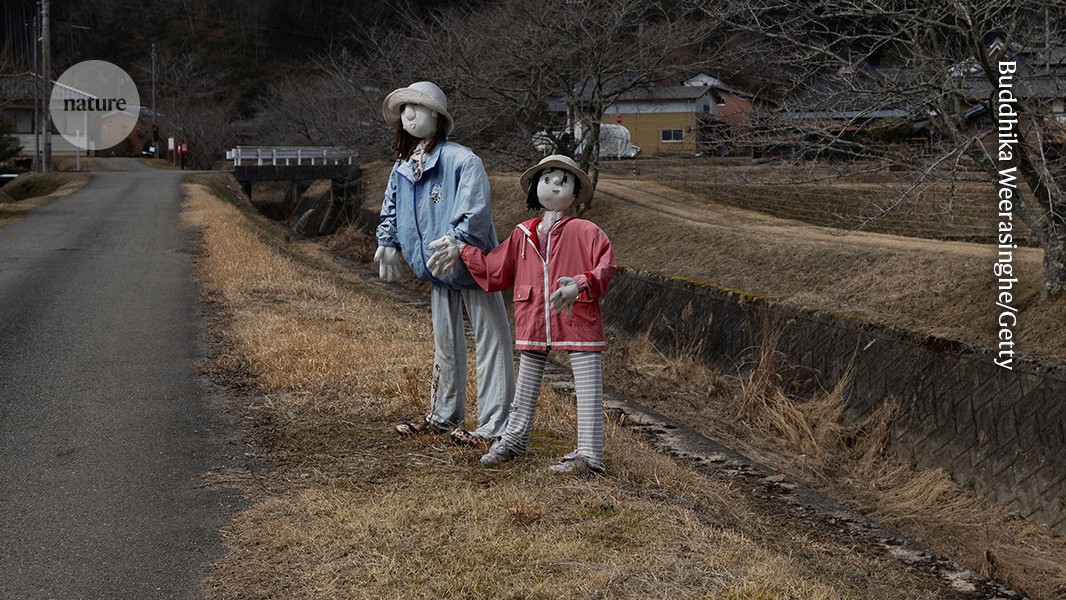
Rural depopulation is often expected to benefit nature, but research in Japan and elsewhere suggests the opposite can happen. Many species depend on the low-intensity farming, grazing, forest thinning and seasonal flooding maintained by people. When rural communities disappear, those habitats can become overgrown, dry out or be replaced by intensive agriculture, causing biodiversity to decline. Conservationists are therefore exploring ways to keep people—and carefully managed human activity—in landscapes where wildlife depends on them.
Less than an hour by train from central Tokyo, ecologist Kei Uchida walks through groves of wild cherry trees and grasslands filled with elephant-tall pampas grass. At the roadside, he stops beside a knee-high ball of intertwined grass stalks: a nest belonging to a Eurasian harvest mouse (Micromys minutus), a species that is declining in the region and is a target for conservation.
Volunteers saved this area around Mount Tenran from development 30 years ago. They now monitor its plants and animals, thin the forest, and plant and harvest rice—all in the name of biodiversity. Small fish swim in the shallow rice fields, dragonflies mate just above the water and, at dusk, fireflies dance over the fields.
Uchida, an environmental scientist at Tokyo City University in Yokohama, and his colleagues included the site in a study of thousands of species across more than 150 forests, farmlands and “peri-urban” landscapes in Japan.1 As expected, they found that the diversity and abundance of most species declined where human populations were growing. But biodiversity also declined where populations were shrinking. The finding, along with similar results from other parts of the world, challenges the assumption that nature always thrives when people leave.

Japan and many other countries are seeing rural areas emptied as people move to cities. The resulting changes create challenges beyond establishing and managing protected areas: conservationists must also consider whether, and how, to recruit, train and support people who can become a permanent part of some ecosystems.2
The landscape around Mount Tenran is an example of satoyama, a Japanese term combining words for village and mountain. It describes a setting in which agriculture and wildlife coexist. “Agriculture and living things can coexist,” Uchida says. But Japan’s satoyama landscapes are being lost through population decline and urbanization.
For centuries, people in the area cut trees for fuel and removed fallen leaves to use as fertilizer. These activities opened the forest canopy and benefited certain plants and insects. Once they stopped, the forest grew denser and became more closed. “We’ve been using forests for 1,000 years, but we haven’t been using them recently,” Uchida says. Young students are now given small handsaws and taught traditional techniques for thinning the forest.
Tsubasa Kojima, a volunteer who studies nature, points out locations where fireflies are counted at night. The area has two types. Small Heike fireflies (Luciola lateralis) prefer rice fields, whereas the larger, brighter Genji fireflies (Luciola cruciata) are associated with running streams. “You rarely see both at the same time,” Kojima says. He counted 60 fireflies in one rice field four days earlier.
Often, he is joined by urban residents who come to admire the countryside’s fireflies at dusk. After the display, however, they board a train and return to brightly lit Tokyo.
Missing people
Many Japanese people now have to travel to see fireflies, although the insects were once common outside homes. The same pattern is occurring around the world. In 1950, almost 40% of the global population lived in rural areas. United Nations data show that only 19% of the world’s 8.2 billion people now live in rural areas, and the rural population is expected to peak in the 2040s before beginning to decline.
In some countries, the decline is already advanced. Japan’s total population fell by 4 million people between 2015 and 2025, while its rural population declined even more rapidly. In 2025, just 8.6% of the population was classified as rural.
Peter Matanle, an independent environmental and social scientist who worked with Uchida on the biodiversity research, describes Japan as an “avant-garde country” from which other nations can learn about population decline. Data from the European Union show that rural Europe lost 0.2% of its population each year between 2015 and 2024. Rural populations also tend to be older than urban populations, suggesting that further decline may follow.
Uchida and his co-authors examined data on 464 species of birds, butterflies, fireflies and frogs, as well as about 3,000 plant species. The data came from landscapes across Japan and covered periods of five to 17 years beginning in 2004.
Biodiversity declined where landscape destruction was greater. That destruction occurred both when people moved into an area and built infrastructure, and when agricultural intensification replaced small family farms with corporate operations.
The researchers also recorded biodiversity declines in areas abandoned by people. Although that result might seem paradoxical, amphibians and many insects cannot reproduce when irrigation stops. Other ecological niches disappear, too. Dry, abandoned landscapes can become too fragmented for many species to recolonize. “Nobody is going to benefit if we leave it alone,” Matanle says.
A similar relationship between rural population decline and biodiversity has been documented in Europe. A study of 70 sites in Albania, Bulgaria, Croatia and Greece found that rural abandonment “consistently has negative impacts on bird communities”.2 The species most affected were those living in agricultural areas. A European Commission monitoring system found that European agricultural-bird populations declined by 58% between 1980 and 2024 as agriculture intensified in some places and moved away from others.
Birds are not the only animals that have benefited from human-managed environments. In Sweden, “semi-natural grasslands” cleared by people and kept open by livestock are the main habitat for one-third of the country’s endangered species. They can support up to 40 plant species per square metre.3
After the Second World War, the total area of grassland fell by more than 90% in some Swedish regions as people left the countryside and land use changed.4 In many cases, the removal of grazing animals allowed land to become row crops or forest, either through natural tree growth or the deliberate planting of timber. Both types of forest have lower biodiversity than the semi-natural grasslands they replaced.
In Spain, Francisco Lloret, an ecologist at the Autonomous University of Barcelona, says biodiversity declines when people leave the countryside because some species lose habitat while others lose food. Vultures and other scavengers, for example, have depended on livestock for centuries, but that food source is disappearing.
Wooded and herbaceous areas at field edges are also declining. In Mediterranean countries such as Spain, fields are often bordered by strips of vegetation or dry-stone walls that shelter many vertebrates and invertebrates. When the walls are removed to create larger fields for modern farming systems that require fewer workers, those organisms are lost.
The reasons species thrive in low-intensity agricultural environments vary. Some organisms need the standing water of rice fields; others depend on grasslands kept open by mowing or livestock, or on forest edges. The broader pattern is that many species rely on the regular, moderate disturbance that maintains a mosaic of habitats through seasonal flooding, grazing, burning, thinning and patchy logging. Landscapes inhabited and managed by people can therefore contain more species than large areas of undisturbed forest.
These are the Arcadian landscapes depicted by Romantic poets, as well as in works such as The Wind in the Willows (1908) and My Neighbor Totoro. They are culturally beloved ecosystems that have supported a range of species since at least the Iron Age. “Biodiversity has evolved together with people and human activities over the past millennia,” Lloret says.
Some species might even have evolved to be better suited to human landscapes, but Lloret cautions that there are no universal rules. Context matters. In some places, biodiversity could increase as populations decline: top predators such as wolves often do well in unoccupied areas. In the tropics, the most biodiverse places on Earth, few countries are experiencing population decline, making habitat loss a greater concern.
How does nature need humans?
In response to biodiversity loss associated with rural depopulation, conservation researchers from the Czech Republic and Poland have called for small-scale farming to be used as a tool to conserve farmland birds.5 They also argue that such rural areas would have “high aesthetic and heritage value”.
Uchida and his colleagues propose a “new interventionist rewilding” approach to complement rewilding efforts that seek to let nature function on its own. Some European Union schemes aim to support farmers and biodiversity, although they have been criticized as ineffective.6
As Uchida and the volunteers finished their walk and emerged from the forest, rain began to fall. In a nearby bakery, over curry bread, a question remained: who will create habitat for endangered species in the countryside of the future?
Source: www.nature.com