


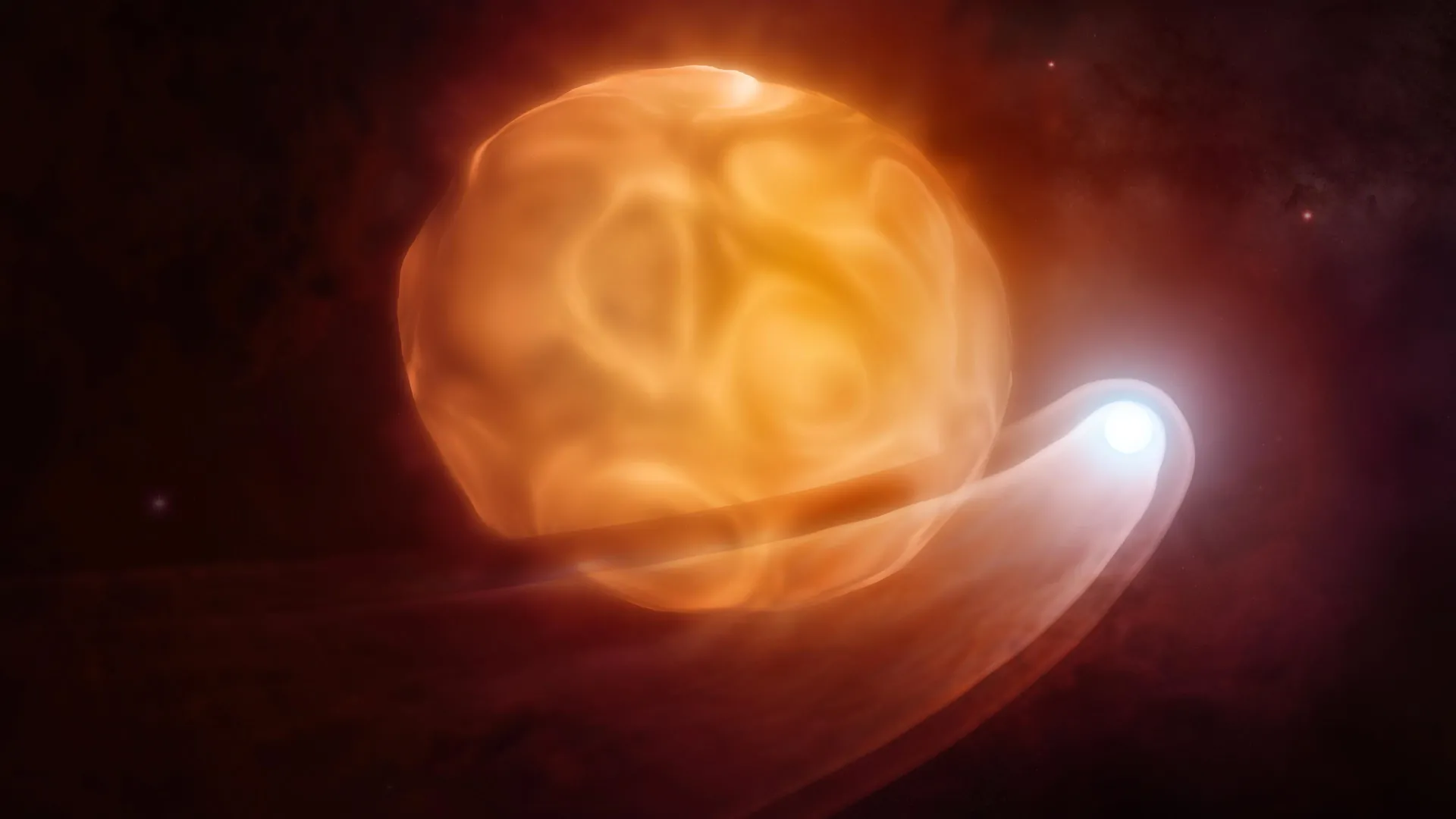
New observations suggest that Siwala, a recently discovered companion star, may be moving through Betelgeuse’s vast outer atmosphere and disturbing the gas around the red supergiant. Data from the National Science Foundation’s Carl G. Jansky Very Large Array (NSF VLA) and the Atacama Large Millimeter/Submillimeter Array (ALMA) also show that Betelgeuse’s atmosphere has largely recovered from its unusual dimming in late 2019 and early 2020, while revealing an unexpectedly cold layer near the star’s surface.
Betelgeuse is a huge red supergiant in the constellation Orion, where it forms the Hunter’s Shoulder. The star has fascinated astronomers for generations, but it drew worldwide attention when its brightness fell unexpectedly to its lowest recorded level in more than 100 years. The event, known as the Great Fainting, raised questions about the internal processes of aging stars.
The research was led by Dr. Lynn D. Matthews, principal investigator and deputy director of the MIT Haystack Observatory, in collaboration with scientists at the Center for Astrophysics | Harvard & Smithsonian, the University of Manchester and the European Southern Observatory. The team analyzed observations collected at seven radio frequencies, ranging from 22 GHz to 485 GHz, between 2021 and 2026.
Different radio frequencies allow astronomers to probe different depths in a star’s atmosphere. By combining observations from the NSF VLA and ALMA, the researchers reconstructed the structure of Betelgeuse’s outer layer, which extends from just above the visible surface to several times the star’s radius.
“The combination of amazing data from NSF VLA and ALMA gave us compelling results here,” Matthews said. “The fact that we can actually use these facilities to unravel the disks of nearby stars is amazing.”
Betelgeuse recovers from its mysterious dimming
The latest measurements may help scientists understand how Betelgeuse changed during and after its unusual dimming episode. Months before the Great Fainting, early investigations led by Matthews detected unusually low temperatures in the star’s atmosphere at radio wavelengths.
During the event, Betelgeuse ejected 1 billion tons of solar material, partially obscuring the view from Earth. Researchers suggested that turbulent convection deep within the star could have generated shock waves that traveled outward and disrupted the surrounding gas. The disturbance may have triggered the ejection of material that later formed dust and blocked some of the star’s light.
New observations show that the atmosphere has since warmed to temperatures more typical of Betelgeuse. At a distance of about 2.7 times the star’s radius, the gas has a measured brightness temperature of about 3,500 kelvin, equivalent to the temperature of Betelgeuse’s surface.
A surprisingly cold atmospheric layer
The researchers also confirmed a region of unusually cold gas between Betelgeuse’s visible surface and its upper atmospheric layer, known as the chromosphere. Scientists had long suspected that this region existed.
Using ALMA at the highest frequencies in the study, the team probed closer to the star’s surface than previous radio measurements had allowed. They found that the temperature fell to about 2,200 kelvin—more than 1,000 degrees cooler than the temperature of the visible surface, or photosphere.
This cold region corresponds to the “MOLsphere,” a layer of molecular gas previously identified mainly through infrared observations. The new radio measurements provide a more direct view of this elusive part of Betelgeuse’s atmosphere and confirm the long-suspected presence of a minimum-temperature region.
A hidden companion may be distorting Betelgeuse
One of the study’s most intriguing findings concerns Siwala, a small star thought to orbit very close to Betelgeuse. Astronomers first proposed the existence of a companion in 2024. They suggested that it could explain Betelgeuse’s mysterious periodicity, in which the star’s brightness changes roughly every 2,100 days. Subsequent direct-imaging and spectroscopic observations provided further support for the companion’s existence.
The name Siwala reflects the relationship with Betelgeuse. The name Betelgeuse comes from an Arabic expression meaning “hand of al-Jawza,” while Siwala means “her bracelet.”
Unlike planets and stars that orbit far from their host stars, Siwala is thought to follow a trajectory directly through Betelgeuse’s atmosphere. Its estimated orbital distance is only about twice the radius of the red supergiant.
“This companion star orbits so close to the star that it actually passes through our atmosphere,” Matthews explained.
As Siwala moves along its trajectory, it could cut through the surrounding gas like a speedboat moving through water. The resulting wake would disturb the atmosphere and create changes that astronomers can detect, even though the small star itself is invisible in the radio observations.
The researchers calculated that Siwala could be tens to hundreds of times fainter than the level that could be directly detected in the radio measurements they collected. Instead, they searched for indirect evidence of the companion by studying the shape of Betelgeuse’s atmosphere.
Betelgeuse’s changing shape offers clues
Betelgeuse does not always appear perfectly round at radio wavelengths. Its atmosphere sometimes takes on a slightly stretched, elliptical shape, and the timing of these changes appears to coincide with Siwala’s expected location.
To investigate the possible link, the researchers measured the atmosphere’s deviation from circularity, or ellipticity, in observations taken at different times.
They found that Betelgeuse tends to appear more elongated when Siwala is expected to be apparently farthest from the giant star. When the companion is predicted to pass in front of or behind Betelgeuse from Earth’s perspective, the atmosphere appears rounder.
This relationship provides evidence that a small companion could influence the shape of Betelgeuse’s outer layer through gravity and its physical passage through the surrounding gas.
The effect is similar to seeing ripples in a pond without immediately knowing what caused them. Although the disturbances are too faint to be directly resolved at radio wavelengths, changes in the shape of Betelgeuse’s atmosphere could reveal the companion’s movement around the larger star.
Further observations could test the explanation
Astronomers stress that additional observations are needed to confirm the relationship between Siwala’s orbit and the distortions in Betelgeuse’s atmosphere. Measurements covering more of the companion’s orbital period, particularly at radio frequencies that have not yet been extensively studied, could show how strongly the small star influences Betelgeuse.
More advanced instruments may eventually produce clearer images. The Next Generation Very Large Array, an observatory currently under development, is expected to make detailed studies of nearby stars and their atmospheres easier.
Such observations could reveal not only how a companion affects its massive neighbor, but also how aging red supergiants lose material as they approach the ends of their lives. Understanding these interactions may help astronomers explain the complex processes that shape the evolution of massive stars such as Betelgeuse.
The survey results are reported in Astronomical Journal in a paper titled “New spatially resolved observations of Betelgeuse from VLA and ALMA: Evidence for atmospheric perturbations from a nearby companion.”
Source: www.sciencedaily.com