


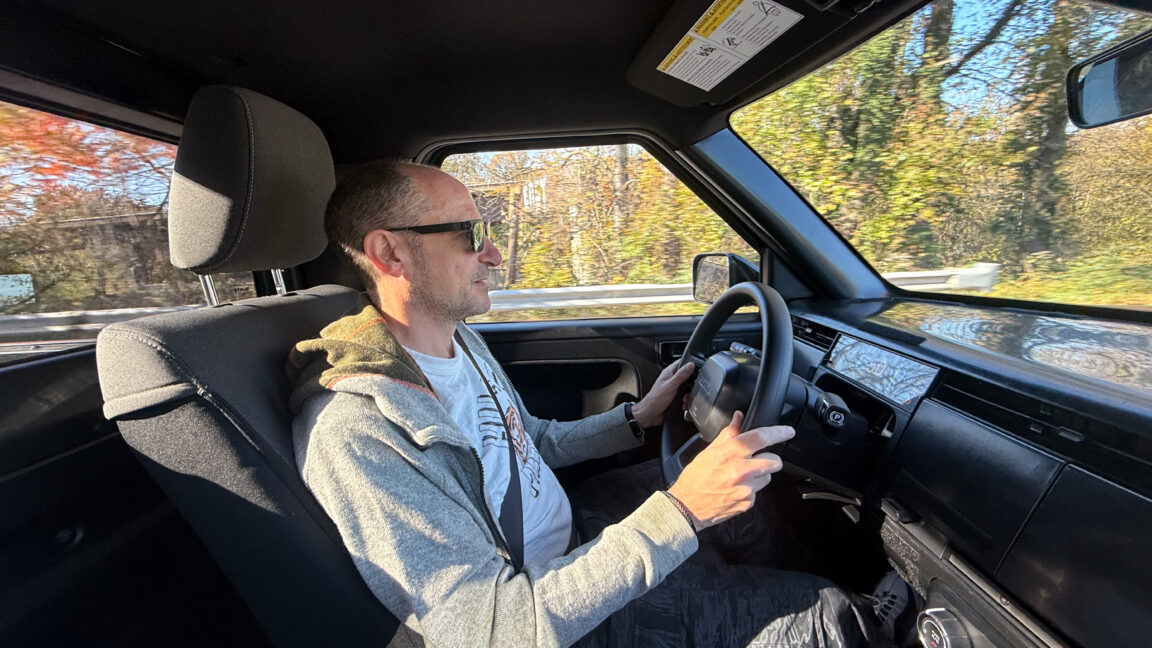
A 45-minute drive from Southwest DC to Rockville, Maryland, offered an early look at how Slate Auto’s minimalist electric pickup might perform in everyday use. The prototype already showed approximately 6,000 miles (9,656 km), and while its cabin layout represented the planned production vehicle, its materials still reflected its development status. Even so, the truck was straightforward to operate, with manual controls, good visibility, and a driving position that felt higher than a sedan’s.
A well-used prototype
Slate Auto brought one of its prototype trucks to the area for a test drive. The vehicle had already seen substantial use, with a small, minimalist digital display showing approximately 6,000 miles (9,656 km), along with the vehicle’s speed and, when reversing, a backup-camera view.
The cabin’s layout was representative of the production version, but its surfaces were not. The prototype used a considerable amount of hard, glossy black plastic, and Velcro strips remained in several places from efforts to conceal the interior when the truck was displayed publicly.
Simple controls and easy adjustments
Getting familiar with the Slate was surprisingly easy. Its Morris Marina-like door handles operated with a pleasing mechanical motion. Both the seat and steering column were manually adjustable, but they offered enough range to accommodate drivers in ways that many lower-priced vehicles omit to reduce costs.
After plugging the key fob into the dashboard and turning the vehicle on, the column-mounted shifter provided settings for Drive, Neutral, Park, and Reverse. The mirrors were adjusted by hand before setting off.
A deliberately minimalist interior
The two-seat cabin provided good visibility. Although the Slate is relatively small, it stands 68 inches (1.7 meters) tall—about the same height as many crossovers—so occupants sit noticeably higher than they would in a sedan.
The truck uses manual window winders, a feature that was still familiar. Three dashboard dials control the cabin temperature and airflow, offering a direct and uncomplicated way to make the interior hotter, colder, or more ventilated.
For navigation, a phone mounted on the dashboard would have been sufficient. The area now known as North Bethesda was familiar territory, and my past life was science policy, so the route was mostly where I remembered it being. That made it possible to focus on the drive rather than navigation.
Source: arstechnica.com