


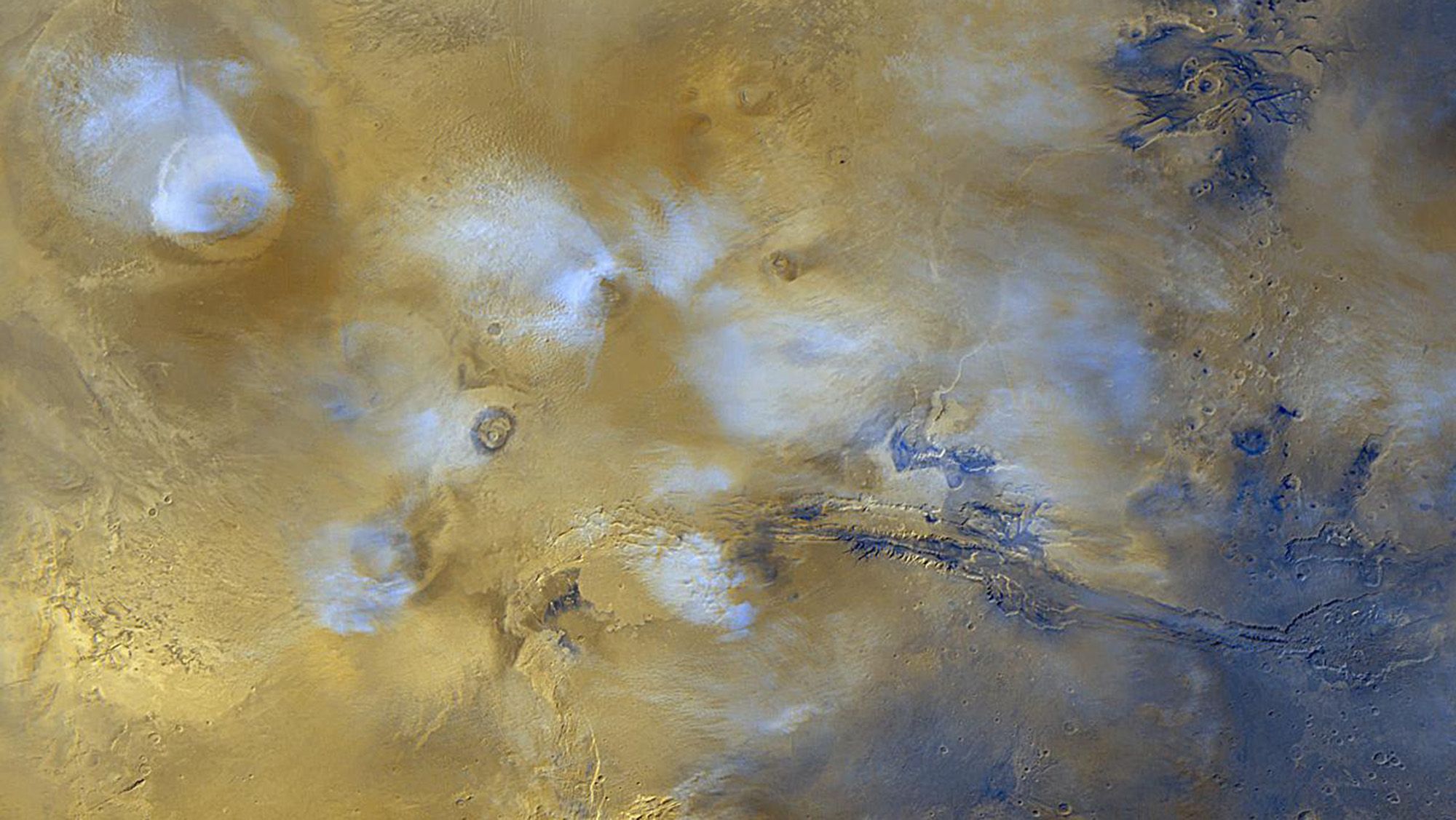
Toxic gas detected above Mars may be escaping through cracks from magma beneath the planet’s surface, according to a new study. Observations by the European Space Agency’s ExoMars Trace Gas Orbiter (TGO) point to a possible source near Alba Mons, Mars’ largest volcano by surface area, and suggest that the region could have conditions resembling Earth’s hydrothermal environments. However, the researchers emphasize that the volcanic explanation remains uncertain.
A possible volcanic source for hydrogen chloride
TGO detected a signal that may indicate hydrogen chloride gas leaking from a fissure in the Alba Mons region. Scientists interpret the gas as a possible release from hot magma beneath the Martian regolith.
Although more research is needed to confirm the emissions, the researchers suggested that Mount Alba may have an environment similar to Earth’s hydrothermal vents, places where life may have first arisen and continues to thrive today.
Research published in Science Advances on Wednesday (Nov. 4) is not the first evidence that magma may be flowing beneath Mars. NASA’s InSight lander detected signals that researchers interpreted as evidence of subsurface magma through seismic observations and modeling earlier this year.
But the new finding may be the strongest evidence yet that gas is being released from dormant Martian volcanoes, said the study’s first author, Alexander Trokhimovsky of the Russian Space Research Institute.
“Our study provides a complementary and potentially independent body of evidence [of Martian magma]: Atmospheric observations revealed possible traces of outgassing from the underground magma system,” Trokhimovsky wrote in an email.
A puzzling seasonal signal
TGO first detected hydrogen chloride in the Martian atmosphere in 2021, but scientists were initially hesitant to connect it with volcanic activity. The gas appeared to be seasonal, its distribution was not concentrated around volcanic regions as might be expected, and the spacecraft detected no accompanying volcanic gases such as sulfur, the study’s co-authors said.
“Kevin Olson, a visiting researcher at the University of Oxford who studies gases on Mars, told Live Science in a separate email that further research indicated the gas was not limited to the warm spring and summer months in Mars’ southern hemisphere. It also appeared during winter in the Northern Hemisphere.
“In the first year of the Mars mission, we were able to successfully capture two observations from the onset of northern winter, and one observation the following year,” Olson said. Because of Mars’ wider orbit, one Martian year is closer to two Earth years.
“These out-of-season measurements were close in location and time in both years, which was rather surprising. We then set out to create a special measurement campaign targeting this time and location.”
The activity lasted for two years on Mars, or about four years on Earth. That raised the possibility that scientists were observing an “injection” of hydrogen chloride into the atmosphere from vents adjacent to the volcano, Olson said.
Scientists confirmed the unseasonal observations in the Northern Hemisphere and found a “clear and significant signal” that later weakened and fell below the spacecraft’s detection threshold.
“This discrepancy suggests that a puff of gas entered the atmosphere rather than a normal atmospheric chemical reaction,” Olson said. “This connection is still hypothetical, but over four years of observations of Mars, we have found that this gas appears locally and nowhere else.”
Evidence from the surface and atmosphere
Co-author Daniel Mage, a professor of planetary geology at the Polish Academy of Sciences, identified cracks where the gas could be escaping. He said that combining evidence from InSight on the ground with observations from TGO in orbit could strengthen the study’s conclusions: InSight detected activity within Mars’ crust, while TGO detected emissions in the atmosphere.
Magma activity itself is not evidence of life. However, Mage noted that the earliest life on Earth may have emerged in environments such as hydrothermal systems, where matter and energy interact in ways that could be similar to conditions around potential vents on Mars.
He cautioned that any such environment would need to remain favorable for at least several million years for life to emerge.
“If these requirements are met at the local scale, at the scale of pervasive structures, then life may be waiting for us to discover,” he told Live Science via email. “But it’s not clear that it remains stable for such a long time on a very local scale.”
Source: www.livescience.com