


New Drywood Termite Treatment Targets Molting and Could Reduce Whole-Structure Fumigation
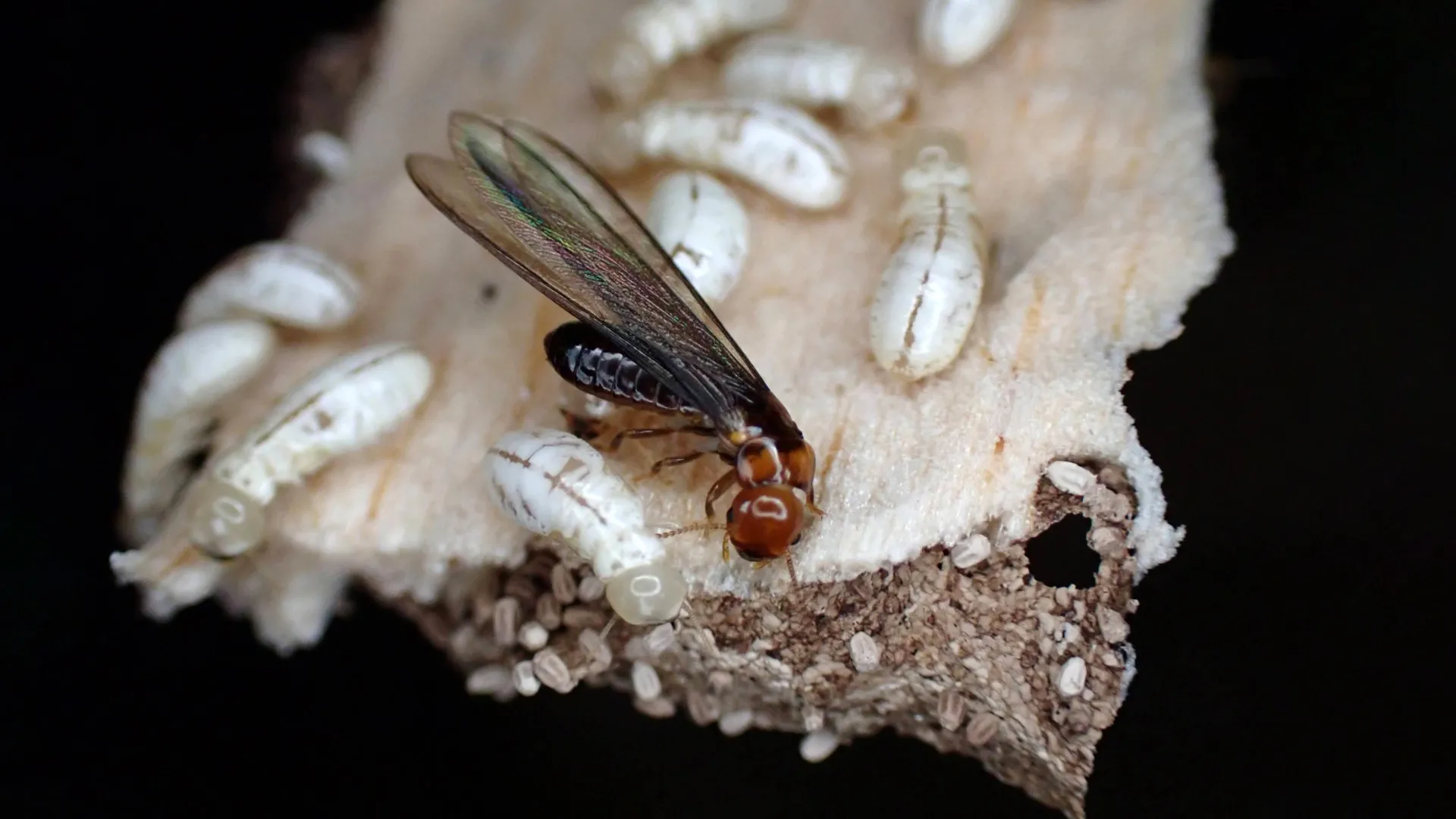
Western drywood termites are remarkably good at disappearing into the material they destroy. Instead of building obvious nests, they can spend nearly their entire lives hidden inside beams, framing, furniture, and other dry wood while slowly carving out galleries as the colony grows.
That hidden existence makes drywood termites difficult to find and eliminate. Researchers at the University of California, Riverside, however, have identified a biological weakness the insects cannot avoid: they have to molt.
A study published in 2025 in the Journal of Economic Entomology found that bistrifluron, an insect growth regulator that interferes with formation of a new exoskeleton, can kill western drywood termites with remarkable efficiency. In controlled laboratory experiments, the chemical caused 95.7 percent mortality when termites could choose between treated and untreated wood, and approximately 99 percent mortality when they were continuously exposed to treated wood.
How Bistrifluron Turns Termite Molting Into a Weakness
“This chemical is more environmentally friendly than ones traditionally used for drywood termite infestations,” said Nicholas Poulos, corresponding author of the study and a doctoral student in UCR’s Department of Entomology. “It’s specific to insects and can’t harm humans.”
Bistrifluron’s selectivity comes from the biology it targets. Humans and other mammals have internal skeletons, but insects rely on a rigid outer covering called an exoskeleton. One of its most important ingredients is chitin, a durable natural material that provides structure and strength.
Chitin is common in nature. It helps form insect exoskeletons, fungal cell walls, fish scales, and structures such as squid beaks.
For termites, chitin provides protective armor and creates sturdy attachment points for muscles. But an insect’s armor cannot stretch indefinitely as it grows. Western drywood termites molt approximately seven times during their lives, shedding the old exoskeleton and replacing it with a larger one.
Bistrifluron turns that unavoidable process into a vulnerability. It belongs to a group of compounds known as chitin synthesis inhibitors. Rather than acting like a conventional fast-acting poison, it disrupts the insect’s ability to produce enough chitin for its next exoskeleton.
“Once the termites reach a certain stage, they have to molt. They cannot avoid that,” said Dong-Hwan Choe, a UCR entomology professor and senior author of the paper. “With a lethal dose of this chemical, they’ll try to shed their old exoskeleton but won’t have a new one ready to protect them.”
Bistrifluron Kills Drywood Termites Slowly but Efficiently
The treatment’s biological mechanism also explains why bistrifluron works relatively slowly. Researchers first observed reductions in termite activity and feeding. The insects continued progressing toward their next molt, but eventually failed to complete it and died.
The research team compared three chitin synthesis inhibitors: bistrifluron, chlorfluazuron, and noviflumuron. Bistrifluron produced the fastest mortality at the concentrations tested.
In one experiment, termites had no untreated alternative. The 0.1 percent bistrifluron treatment produced approximately 99 percent mortality after 60 days. When termites could choose between treated and untreated wood, the same concentration produced roughly 96 percent mortality.
These results are significant because drywood termites are particularly challenging targets. Unlike subterranean termites, which maintain colonies connected to the soil, drywood termites can live entirely inside pieces of wood.
“It’s been successfully used on subterranean termites, which are also important structural pests,” Choe said. “But native western drywood termites are also important, especially in California.”
Only a Few Exposed Termites May Spread the Treatment
One of the study’s most intriguing findings involved what happened after only part of a termite group encountered bistrifluron.
Termites are social insects that routinely exchange food and other material. To study whether the chemical could move through a colony, researchers exposed some termites to bistrifluron and then placed them with untreated members of the same colony. They used colored food to track material moving between individuals.
Within 24 to 48 hours, material from exposed termites had reached previously untreated nestmates. Even more strikingly, groups in which only 5 percent of the termites initially encountered bistrifluron eventually reached 100 percent mortality by day 90.
Groups that began with 50 percent of the termites exposed showed a broadly similar survival pattern. The findings suggest that a small number of termites may retain enough bistrifluron to carry an effective dose deeper into the group.
Later observations from the UCR team provided an unusually close look at the social behavior that may help substances move through concealed colonies. In 2026, researchers highlighted images and video of western drywood termites performing proctodeal trophallaxis, a feeding behavior in which one termite receives material from another termite’s hindgut.
This exchange transfers nutrients and gut microbes that help termites digest wood. Normally, such intense social cooperation helps a colony survive. For pest control, however, the same behavior could help a treatment reach termites that never directly encounter treated wood.
Could Localized Treatment Become an Alternative to Fumigation?
Bistrifluron’s slow action may be useful rather than simply a drawback. A chemical that kills immediately could eliminate exposed termites before they have much opportunity to interact with nestmates. A delayed treatment gives contaminated individuals more time to move through the colony and exchange material.
“We believe this method of spot treatment can kill a larger colony and spread more easily than current termite control methods,” Choe said. “You don’t have to apply too much to get a very good result. The chitin synthesis inhibitors show promise as localized treatment for drywood termites.”
That approach could eventually offer homeowners another option when a drywood termite infestation is localized and accessible.
Structural fumigation remains one of the most effective methods for eliminating drywood termite infestations throughout an entire building. However, it is disruptive. Residents must leave, food must be protected or removed, and fumigation does not provide lasting protection against termites that arrive later.
The 2025 study also identifies cost and the lack of residual protection as important disadvantages of whole-structure fumigation.
“Low-impact strategies like this one will become an attractive option in many cases. Furthermore, the chemical may stay active in the wood for some time, potentially providing protection from future infestations,” Choe said.
Laboratory results do not yet mean that treating a house with bistrifluron will automatically produce the same mortality rates. The experiments used small groups of termites under controlled conditions, and the researchers described the findings as support for developing bistrifluron further as a localized treatment or possible bait ingredient.
Pinene May Help Lure Termites Toward Insecticide
Bistrifluron is only one part of UCR’s effort to make targeted drywood termite control more effective.
The same laboratory has investigated pinene, a fragrant chemical naturally released by many trees. To a western drywood termite living inside wood, that scent can act as a signal pointing toward a potentially attractive part of its environment.
Researchers tested whether pinene could lure termites away from the areas where they were clustered and toward localized insecticide deposits. Earlier experiments found that the approach improved the performance of an aqueous fipronil treatment.
“We saw significant differences in the death rates using insecticide alone versus the insecticide plus pinene,” Choe said. “Without pinene, we got about 70% mortality. When we added it in, it was over 95%.”
The idea has since moved another step toward potential practical use. A University of California patent application filed in April 2025 and published in October 2025 describes adding alpha-pinene or beta-pinene to localized insecticide injections for western drywood termites.
The application proposes that attracting termites toward treated areas could potentially allow technicians to space treatment holes farther apart while reducing labor and possibly the amount of insecticide required. Those possibilities remain part of the proposed application, not proof that the approach has replaced existing termite treatment methods.
Researchers Still Need a Practical Bistrifluron Formulation
Bistrifluron faces a practical obstacle before the laboratory treatment can be easily adapted for use in homes.
In the study, researchers dissolved the chemical in acetone and applied it to pieces of wood. The solvent was allowed to evaporate before termites were introduced. Acetone is useful in an experiment, but its flammability and strong odor make it poorly suited to routine household treatment.
“We are working to make it more feasible for practical application in real-life scenarios,” Poulos said.
Developing a practical formulation could make a major difference because controlling drywood termites requires more than an insecticide that kills them. Technicians must also determine whether termites are still present and where the active colony is located inside a structure.
Termite Droppings Could Reveal Whether an Infestation Is Active
That detection problem has become another focus of the UCR researchers.
Drywood termites eject tiny, hard fecal pellets from their wooden galleries. These piles can alert homeowners to an infestation, but old pellets may remain long after termites have disappeared. Simply finding droppings does not necessarily prove that termites are currently active.
Research published after the bistrifluron study found that microbes inside the pellets may provide a kind of biological clock.
Poulos and his colleagues examined fresh western drywood termite pellets and samples aged for three months, six months, and one year. They found that bacterial DNA declined dramatically as the pellets aged.
In pellets produced by termites feeding on natural hardwood, the estimated amount of bacterial DNA fell as much as 190-fold between fresh samples and samples aged for one year. A similarly large decline occurred in pellets from termites fed Douglas fir, a wood commonly used for house framing.
The types of bacteria changed as well. Some bacterial groups associated with fresh pellets disappeared as the samples aged. Researchers identified five bacterial families consistently found in fresh Douglas fir-derived pellets but absent after certain periods of aging.
The team hopes these microbial signatures could eventually form the basis of a simple diagnostic tool to help pest professionals determine whether termite evidence is recent enough to justify treatment.
Such a tool could complement treatments such as bistrifluron. One strategy would help technicians determine where an infestation is still active, while the other would attempt to eliminate the termites with a more localized treatment.
Western Drywood Termites Spread Inside Wood Products
Better detection and more targeted treatments could become increasingly valuable because western drywood termites are not confined to one small region.
The species is native to parts of the southwestern United States and northwestern Mexico and is particularly important as a structural pest in California. Human movement of lumber, furniture, and other wood products has also transported it far beyond its original range.
Researchers have documented introduced populations in locations including Hawaii, New York, Florida, Canada, China, Japan, Korea, and Australia.
The termites’ lifestyle makes that spread particularly difficult to control. A colony can remain concealed inside a piece of wood, with winged reproductive termites representing one of the few life stages that routinely venture outside.
Climate conditions also influence whether transported termites can establish themselves after arriving somewhere new. As suitable conditions shift, researchers are concerned that the insects could become a problem in additional regions.
“As we move lumber around the world, the termites are constantly transported to new locations. If they find the climate there acceptable, the problem will spread,” Choe said. “In areas where these termites are common, it’s just a matter of time before homes are infested, so this study is a good initial step toward alternative strategies for controlling them.”
Using Termite Biology to Improve Pest Control
Taken together, the research points toward a different style of drywood termite control. Instead of relying only on treating an entire structure, researchers are trying to exploit the insects’ biology, social behavior, feeding habits, and even their microbial traces.
For termites that spend almost their entire lives hidden from view, those biological clues may ultimately make them much harder to hide.
Source: www.sciencedaily.com