


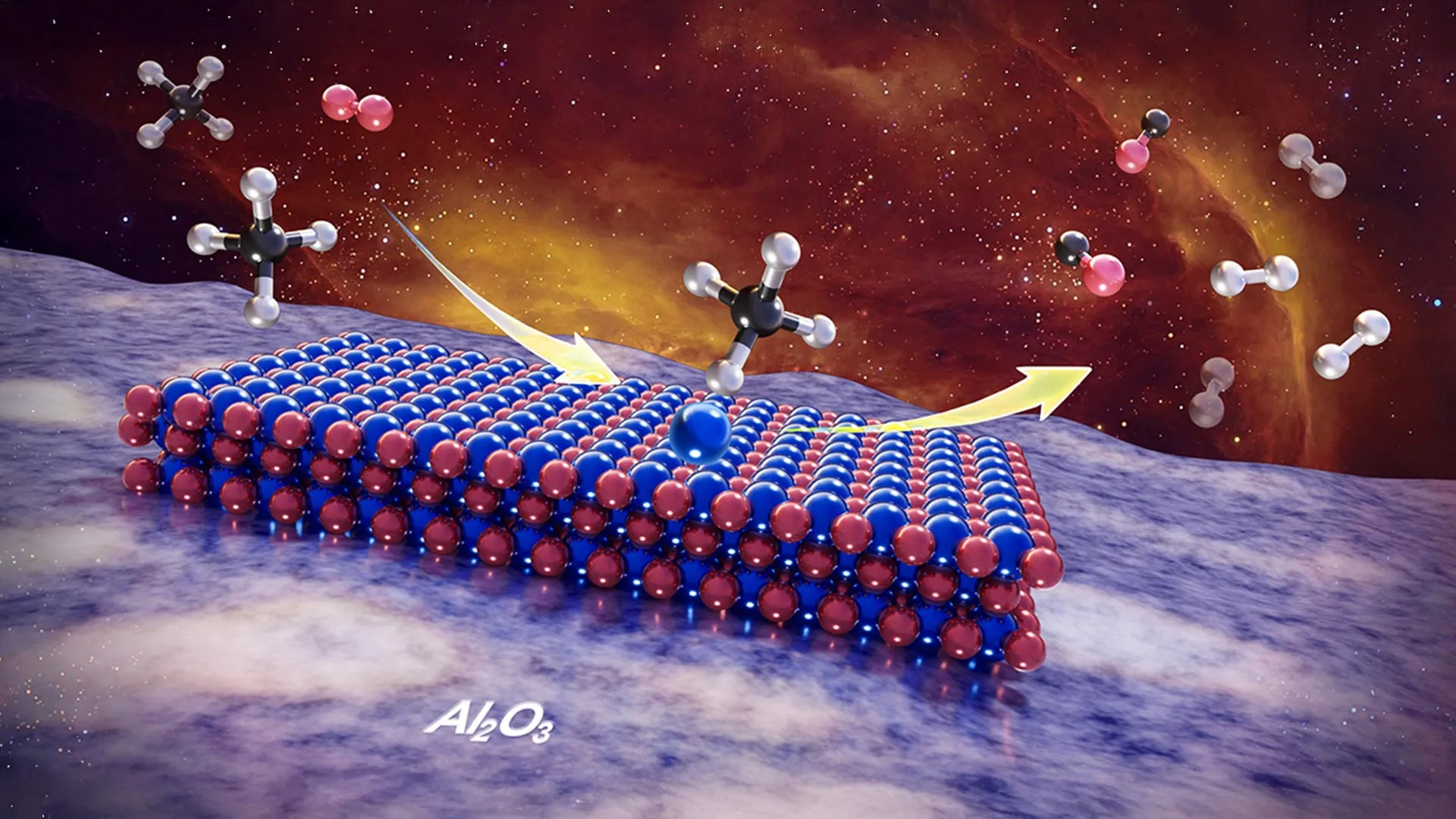
Partial oxidation of methane (POM) is a promising industrial process for producing synthesis gas, or syngas—a mixture of carbon monoxide (CO) and hydrogen (H2) used to manufacture fuels and chemicals. Metallic nickel (Ni) nanoparticles have long been considered the primary active sites for this reaction. However, researchers have questioned whether the metallic Ni observed after catalysis is a true active species or simply forms when nickel oxide is reduced by syngas at high temperatures.
Under the high-temperature redox conditions of POM, nickel can change both its oxidation state and atomic structure. Until now, it has been difficult to monitor these transformations in detail, making it challenging to identify the actual catalytic structure responsible for methane activation.
Dynamic active structures form during methane conversion
In a recent study published in Nature Catalysis, researchers discovered that highly active structures form in situ when the surface of NiO undergoes atomic rearrangement during POM. The findings reveal the atomic-scale origin of the catalyst’s activity and demonstrate the importance of studying catalysts under realistic operating conditions.
The research was led by Professors Tao Zhang, Aiqin Wang, and Xiaoyan Liu of the Dalian Institute of Chemical Physics (DICP), Chinese Academy of Sciences (CAS), together with Professor Wei Liu of DICP, Professor Tao Yang of Xi’an Jiaotong University, and Professor Graham J. Hutchings of Cardiff University.
To investigate the reaction, the team prepared a Ni/Al2O3 catalyst containing only 0.8 wt% nickel using a microemulsion method. Despite its low nickel loading, the catalyst delivered excellent POM performance, achieving 92% methane conversion and 87.0% syngas selectivity. The H2/CO molar ratio remained stable at approximately 2.0.
High catalytic performance with substantially less nickel
One of the most notable findings was that almost no metallic Ni was detected in the catalyst after the reaction. Nevertheless, its overall performance was comparable to that of an 8.0 wt% Ni/Al2O3 catalyst prepared by impregnation, even though it contained 10 times less nickel.
The low-loading catalyst also performed far better than a 0.8 wt% Ni/Al2O3 material prepared using the same impregnation method. Under identical reaction conditions, the impregnated catalyst was ineffective for POM and primarily promoted the combustion of methane.
The researchers observed that metallic Ni nanoparticles present at the beginning of the reaction were rapidly oxidized to NiO under POM conditions. However, NiO alone was not sufficient to drive syngas production. A catalyst containing preformed, pure-phase NiO showed no POM activity and instead catalyzed the complete oxidation of methane.
Atomic rearrangement reveals the true active site
Detailed analysis showed that the catalyst surface underwent a dynamic structural transformation during the reaction. The researchers captured the in situ formation of a reconstituted [Ni1O4Ni4] structural unit on the NiO(100) surface.
Density functional theory (DFT) calculations showed that this newly formed motif significantly facilitated C–H bond cleavage in methane, one of the key steps in methane activation. The calculated activation barrier was just 12.5 kcal·mol-1.
This barrier was substantially lower than the value calculated for the intact NiO(100) surface, 38.5 kcal·mol-1, and below the 15.7 kcal·mol-1 barrier calculated for the metallic Ni(111) surface. This significant kinetic advantage strongly supports the conclusion that the rearranged structure is the true active center responsible for POM.
Together, experimental observations and theoretical calculations demonstrate that catalytic activity does not arise simply from metallic nickel or conventional nickel oxide. Instead, it originates from specific atomic structures that form dynamically under reaction conditions.
“Our study highlights the important role of in situ characterization in identifying dynamically active structures under reaction conditions,” said Professor Liu. “Dynamic reconfiguration enables low-loading catalysts to achieve high performance, creating new opportunities for the rational design of efficient catalysts while reducing reliance on high metal loadings.”
Source: www.sciencedaily.com