


The supplied material is a bibliography of 83 studies covering ribosomal frameshifting, translation quality control, mRNA stability, nutrient stress and cancer biology. Together, the references trace how researchers have moved from studying programmed frameshifting in viruses and yeast to examining its roles in human gene regulation, disease, tumour immunity and potential therapeutic applications.
How ribosomes recode genetic messages
Ribosomes normally translate messenger RNA (mRNA) in three-nucleotide units called codons. Programmed ribosomal frameshifting changes that reading frame, allowing one mRNA to produce alternative protein products. Reviews by Hill and Brierley (2023), Caliskan, Peske and Rodnina (2015), and Rodnina (2023) describe the structural and functional basis of this process, including programmed −1 frameshifting and other forms of mRNA recoding.
Earlier work established that frameshifting can be guided by RNA structures such as pseudoknots. Tu, Tzeng and Bruenn reported in 1992 that ribosomal movement can be impeded at a pseudoknot required for frameshifting, while Namy and colleagues proposed a mechanical explanation for RNA pseudoknot function in Nature in 2006. Later studies showed that frameshifting can follow multiple dynamic pathways, including ribosome excursions during mRNA translocation and kinetic partitioning when translocation is impeded.
Research in yeast retrotransposons provided some of the earliest detailed examples. Belcourt and Farabaugh (1990) described tRNA-induced slippage at a seven-nucleotide site in the yeast retrotransposon Ty. Kawakami and colleagues (1993) identified a rare tRNA-Arg(CCU) that regulates Ty1 element ribosomal frameshifting and is essential for Ty1 retrotransposition in Saccharomyces cerevisiae. Work on the Ty3 retrotransposon subsequently described a programmed frameshift that expresses the POL3 gene without tRNA slippage.
Frameshifting, stress and quality control
Frameshifting is not limited to viruses or retrotransposons. The references describe it as part of a broader network that monitors translation accuracy and responds to cellular stress. Ribosome collisions can trigger quality-control pathways, and Simms and colleagues reported in 2019 that such collisions can result in +1 frameshifting in the absence of no-go decay.
Ribosome-associated quality control helps cells detect stalled or collided ribosomes and prevent the production of harmful proteins. Studies have examined the roles of ZNF598, RACK1, EDF1 and other components in sensing collisions, modifying ribosomal subunits and coordinating cellular responses. Failure of this machinery can cause protein aggregation and proteotoxic stress, according to Choe and colleagues in a 2016 Nature study.
Other references connect translation control with mRNA surveillance. Programmed −1 frameshift signals can act as cis-acting elements that destabilize mRNA, and endogenous frameshift signals in yeast can promote mRNA decay through at least two molecular pathways. The bibliography also includes work on nonsense-mediated mRNA decay, noncoding translation mitigation and mechanisms that limit readthrough of stop codons.
Roles in human biology and disease
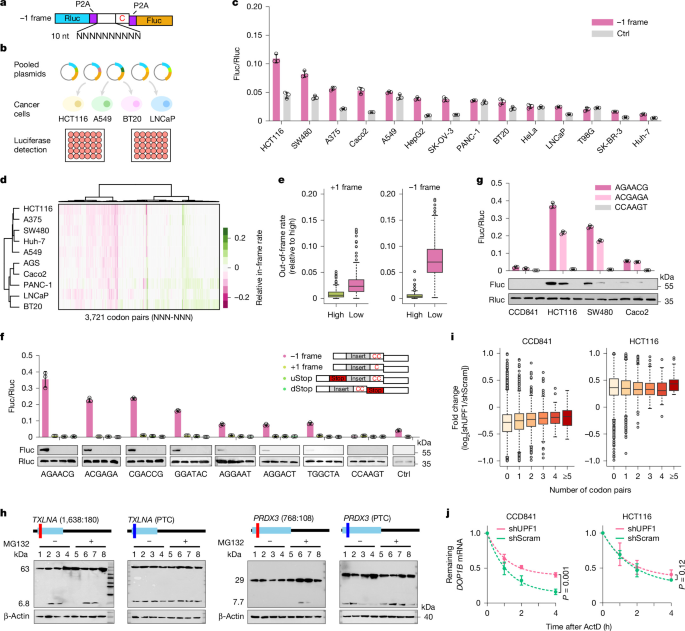
Several studies in the collection suggest that ribosomal recoding contributes to normal human gene regulation. Ren and colleagues reported in 2024 that frameshifting at normal codon repeats can produce functional chimeric proteins in humans. Mao and colleagues found that start-codon-associated ribosomal frameshifting mediates adaptation to nutrient stress, while Zhang and colleagues reported in 2025 that ribosomes can affect transcriptome abundance through generalized frameshifting and out-of-frame mRNA decay.
Frameshifting has also been investigated in specific diseases. Belew and colleagues reported in 2014 that frameshifting in the CCR5 mRNA is regulated by microRNAs and the nonsense-mediated mRNA-decay pathway; the reference list records a retraction in 2026. Carmody and colleagues reported in 2024 that ribosomal frameshifting can selectively influence the assembly, function and pharmacological rescue of a misfolded CFTR variant.
The bibliography also includes studies of translation during cellular stress, including changes in tRNA abundance and modification status, codon usage and translational dynamics in macrophages. These processes may influence which proteins are produced when nutrients are scarce or when cells are exposed to inflammatory or disease-related conditions.
Connections to cancer and tumour immunity
A substantial part of the reference collection examines translation dysregulation in cancer. Studies have linked altered translation to oncogene activity, nutrient availability, drug resistance and the production of tumour-specific antigens. Bartok and colleagues reported in 2021 that anti-tumour immunity can induce aberrant peptide presentation in melanoma, while Weller and colleagues described translation dysregulation as a source of targetable antigens in a 2025 Cancer Cell study.
Other work has focused on cancer metabolism and signalling. The references cover the roles of mTOR and RAS signalling, ribosomal protein S6 phosphorylation, codon-biased aberrant protein production following chemotherapy or leucine deprivation, and tumour-specific vulnerabilities associated with differential codon reading. Studies of pancreatic cancer address carcinogenesis, early epithelial–mesenchymal transition, tumour dissemination and site-specific immune regulation in metastatic disease.
The collection also includes research into immune-based cancer treatments. Studies have examined gasdermin D and gasdermin E, inflammatory cell death, immune checkpoint therapy, and small-molecule activation of gasdermin D to stimulate anti-tumour immunity. A 2025 study described rewiring endogenous genes in CAR T cells for tumour-restricted payload delivery, while a 2026 report examined mRNA lipid-nanoparticle-mediated mitochondrial apoptosis as an approach to augment adoptive T-cell immunotherapy.
Methods and resources
The references include methods used to study translation and RNA biology at scale. These include high-throughput assays for programmed frameshifting in human cells, dual gene-expression reporters, ribosome profiling, RNA sequencing, tRNA sequencing and quantitative proteomics. Computational tools cited in the collection include Cutadapt, STAR, Bowtie 2 and DIA-NN.
Loughran and colleagues published guidelines in 2025 for the minimum reporting requirements, design and interpretation of experiments using eukaryotic dual gene-expression reporters. The bibliography also cites work on genome-wide RNA stability, mammalian gene-expression control and modified tRNA fragments.
Selected references
- Hill, C. H. & Brierley, I. “Structural and functional insights into viral programmed ribosomal frameshifting.” Annu. Rev. Virol. 10, 217–242 (2023). Article
- Caliskan, N., Peske, F. & Rodnina, M. V. “Changed in translation: mRNA recoding by −1 programmed ribosomal frameshifting.” Trends Biochem. Sci. 40, 265–274 (2015). Article
- Rodnina, M. V. “Decoding and recoding of mRNA sequences by the ribosome.” Annu. Rev. Biophys. 52, 161–182 (2023). Article
- Chen, J. et al. “Dynamic pathways of –1 translational frameshifting.” Nature 512, 328–332 (2014). Article
- Filbeck, S., Cerullo, F., Pfeffer, S. & Joazeiro, C. A. “Ribosome-associated quality-control mechanisms from bacteria to humans.” Mol. Cell 82, 1451–1466 (2022). Article
- Weller, C. et al. “Translation dysregulation in cancer as a source for targetable antigens.” Cancer Cell 43, 823–840 (2025). Article
- Mikl, M., Pilpel, Y. & Segal, E. “High-throughput interrogation of programmed ribosomal frameshifting in human cells.” Nat. Commun. 11, 3061 (2020). Article
- Loughran, G. et al. “Guidelines for minimal reporting requirements, design and interpretation of experiments involving the use of eukaryotic dual gene expression reporters (MINDR).” Nat. Struct. Mol. Biol. 32, 418–430 (2025). Article
Source: www.nature.com