


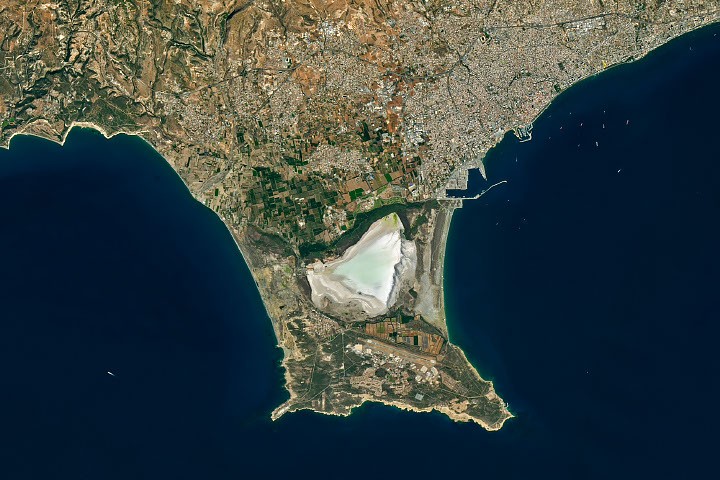
Cyprus is the exposed result of ancient seafloor processes, tectonic uplift and sediment accumulation. Its dark Troodos ophiolite rocks record the island’s oceanic origins, while sediment deposited around a smaller southern island eventually formed the Akrotiri Peninsula. A Landsat 8 image captured on October 10, 2026, shows the peninsula, its salt lake and the land bridges that connect it to Cyprus—a landscape also associated with flamingos, snakes and a large population of cats.
From oceanic crust to island
Cyprus began forming about 90 million years ago, during the Late Cretaceous. Molten rock flowed from the ocean floor, cooled and hardened into new oceanic crust. Over time, crustal deformation pushed parts of this rock upward, eventually producing a rugged island made largely of ophiolite—a type of rock with a green, mottled appearance often compared with snakeskin.
Remnants of that ancient oceanic island remain in the dark rocks of the Troodos Mountains.
How the Akrotiri Peninsula formed
During the Miocene, chalk, limestone, marl and other relatively young sedimentary rocks accumulated around Cyprus. Geological uplift later helped create a second, smaller island to the south.
Sediment carried by rivers into the channel between the two islands combined with marine sediment to form a delta. Over time, this process produced two land bridges, or tombolos. The resulting landmass is the Akrotiri Peninsula, now the southernmost tip of Cyprus.
The Akrotiri Salt Lake, a coastal lagoon that was once part of the Mediterranean Sea, lies between the two tombolos. The western Couris River tombolo formed first, from gravel and sand deposited by the river about 50,000 years ago. The eastern tombolos extend south from Cyprus and, according to geologists, have cut off the lake from the Mediterranean within the past 2,000 years.
A seasonal habitat for flamingos
The lake’s water level changes substantially with the seasons. It typically fills during late autumn and winter before drying during the summer. Historically, winter inflows have attracted large numbers of flamingos, with an average of about 4,000 birds.
That number has declined in recent years. A 2025 report said the wintering population was expected to fall to 30 birds. Flamingos visit the lakes to feed on fairy shrimp and other food sources rich in carotenoids, the colorful compounds that help produce the birds’ familiar pink color.
Snakes, cats and an old legend
Snakes are another animal closely associated with Cyprus. In antiquity, the island was known as Ofiusa, or “land of snakes,” possibly because of its large population of blunt-nosed vipers.
According to legend, a severe drought in the fourth century created such a problem with poisonous reptiles that Helena, the mother of Constantine the Great, ordered cats to be transported from Egypt to control them. The first imported cats were released in a particularly snake-infested area of the southeastern Akrotiri Peninsula, which became known as Cape Gata—Greek for “Cat Cape.”
The Monastery of St. Nicholas of the Cats still stands on the cape. Legend says that a monk encouraged the newly arrived Egyptian cats to hunt snakes there. Cyprus now has an estimated 1 million cats—roughly as many cats as people, according to the Associated Press. The few nuns who live at the convent continue to care for hundreds of cats, according to the St. Nicholas Center.
Story by Adam Voiland.
Source: science.nasa.gov