


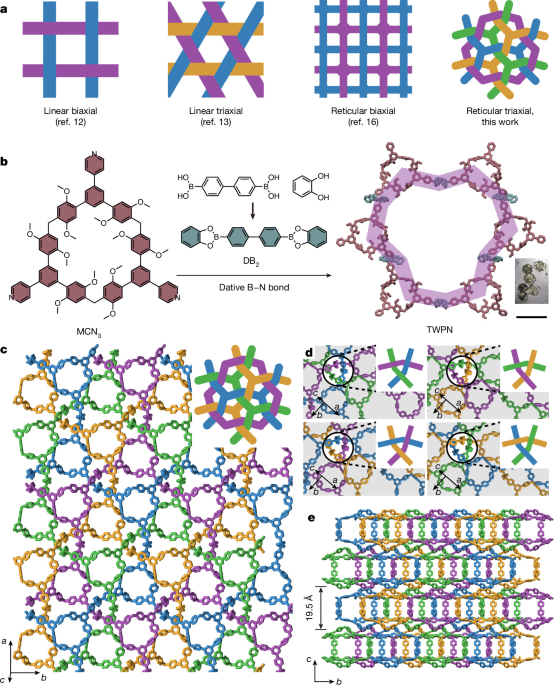
The supplied material is a bibliography rather than a narrative article. Its 47 references trace the development of woven structures across archaeology, electronic textiles, supramolecular chemistry, covalent organic frameworks, molecular knots, crystal mechanics and chemical separations. The list begins with 30,000-year-old wild flax fibers and progresses to research published through 2026 on woven molecular fabrics, dynamic boron–nitrogen chemistry and porous materials for separating water isotopes.
Textiles and woven materials
- Kvavadze, E. et al. “30,000-year-old wild flax fibers.” Science 325, 1359 (2009). Article · PubMed
- Shi, X. et al. “Large area display textile integrated with functional system.” Nature 591, 240–245 (2021). Article · PubMed
- Ran, L. et al. “Woven organic crystals.” Nature Communications 14, 7582 (2023). Article · PubMed · PubMed Central
- Lee, S. et al. “Truly form-factor-free industrially scalable system integration for electronic textile architectures with multifunctional fiber devices.” Science Advances 9, eadf4049 (2023). Article · PubMed · PubMed Central
Molecular weaving and network structures
- “The geometry of periodic knots, polycatenanes and weaving from a chemical perspective: a library for reticular chemistry.” Chemical Society Reviews 47, 4642–4664 (2018). Article
- Zhang, Z.-H., Andreassen, B.J., August, D.P., Leigh, D.A. and Zhang, L. “Molecular weaving.” Nature Materials 21, 275–283 (2022). Article · PubMed
- Zhang, X.-L. et al. “Formation of two (6,3) networks exhibiting structural diversity, Borromean topology, and conformational chirality within the same crystal.” Chemical Communications 41, 4242–4244 (2007). Article
- Zhang, X.-L. et al. “Discrete chiral single-crystal microtubes assembled with honeycomb coordination networks showing structural diversity and Borromean topology in one single crystal.” Chemistry of Materials 19, 4630–4632 (2007). Article
- Xiao, D. et al. “Porous molecular woven fabrics for dynamic separation of water isotopes.” Nature Synthesis 5, 180–188 (2026). Article
- Liu, Y. et al. “Molecular interweaving of covalent organic frameworks for adaptive guest inclusion.” Journal of the American Chemical Society 140, 16015–16019 (2018). Article · PubMed
- Zhao, Y. et al. “Synthetic routes for woven crystals, uniform nanocrystals, and thin films of imine covalent organic frameworks.” Journal of the American Chemical Society 139, 13166–13172 (2017). Article · PubMed
- Liu, Y. et al. “Weaving organic threads into a crystalline covalent organic framework.” Science 351, 365–369 (2016). Article · PubMed
- Lewandowska, U. et al. “Triaxial supramolecular weaving.” Nature Chemistry 9, 1068–1072 (2017). Article · PubMed
- Thorpe Greenwood, F.L., Crack, A.N. and Hardy, M.J. “M’s Endless Chain Mail6L6: A metallacycle featuring multiple Borromean links.” Nature Chemistry 7, 526–531 (2015). Article · PubMed
- Guo, X. et al. “Rational construction of boromean-bonded crystalline organic polymers.” Angewandte Chemie International Edition 60, 2974–2979 (2021). Article
- Yang, Y. et al. “Single-crystal two-dimensional covalently bonded organic framework elastic film.” Nature 630, 878–883 (2024). Article · PubMed
- “Interwoven metal–organic framework on a periodic minimal surface with extra-large pores.” Science 291, 1021–1023 (2001). Article · PubMed
Boron–nitrogen chemistry and mechanically linked molecules
- Sheepwash, E. et al. “Supramolecular polymers based on boron-nitrogen coordination bonds.” Chemical Communications 48, 7808–7810 (2012). Article
- Christinat, N., Scopeliti, R. and Severin, K. “Multicomponent assemblies of boron-based dendritic nanostructures.” Journal of Organic Chemistry 72, 2192–2200 (2007). Article · PubMed
- Vidal, F., Gomezcoello, J., Lalancette, R.A. and Jäkle, F. “Lewis Pair as highly tunable dynamic crosslinks in transient polymer networks.” Journal of the American Chemical Society 141, 15963–15971 (2019). Article · PubMed
- Liang, Y. et al. “Hierarchical metal-organic frameworks and cages containing organic macrocycles: Design, structure, and applications.” Chemical Society Reviews 51, 8378–8405 (2022). Article · PubMed
- Struts, N.L. et al. “Introduction of A1/A2 bifunctionalized pillars[5] incorporated into a metal-organic framework.” Journal of the American Chemical Society 134, 17436–17439 (2012). Article · PubMed
- Zhao, Y. et al. “Macrocycles with equatorial coordination sites offer new opportunities for structurally diverse metallurgy.” Molecules 28, 2537 (2023). Article · PubMed · PubMed Central
- Kojima, Satoshi, Nishida, J.-I., Tokito, S. and Yamashita, Y. “Development of organic electronic devices using boronic acid esters and related heterocycles.” Chemistry Letters 37, 1122–1123 (2008). Article
- Taylor, R.C. and Cluff, C.L. “Vibrational frequencies associated with boron-nitrogen coordination bonds in amineboranes.” Nature 182, 390–391 (1958). Article
- Frateroleto, F. et al. “Dynamic chemistry of boron-nitrogen bonds.” Chemical Science 17, 2582–2591 (2026). Article
- Xiao, X. et al. “Formation of polyrotaxane crystals driven by boron-nitrogen coordination bonds.” Science Advances 9, eadi1169 (2023). Article · PubMed · PubMed Central
Molecular knots, topology and chirality
- Dietrich-Buchecker, C.O. and Sauvage, J.-P. “Synthetic molecular trefoil knot.” Angewandte Chemie International Edition 28, 189–192 (1989). Article
- Ponnuswamy, N., Cougnon, F.B.L., Pantoş, G.D. and Sanders, J.K.M. “Homochiral; meso- figure 8 knot and Solomon link.” Journal of the American Chemical Society 136, 8243–8251 (2014). Article · PubMed
- Danone, J.J. et al. “Molecular knots with 8 intersections.” Science 355, 159–162 (2017). Article · PubMed
- Goldup, S.M. “The end of the beginning of mechanical stereochemistry.” Accounts of Chemical Research 57, 1696–1708 (2024). Article · PubMed · PubMed Central
- Jędrzejewska, H. and Szumna, A. “Making the right or left choice: Chiral self-classification as a tool for forming discrete complex structures.” Chemical Reviews 117, 4863–4899 (2017). Article · PubMed
- Ashbridge, Z. et al. “Vernier template synthesis of molecular knots.” Science 375, 1035–1041 (2022). Article · PubMed
- Alexander, J.W. and Briggs, G.B. “On types of knotted curves.” Annals of Mathematics 28, 562–586 (1926). Article · MathSciNet
Mechanical properties and applications
- “Nanoindentation in crystal engineering: Quantifying mechanical properties of molecular crystals.” Angewandte Chemie International Edition 52, 2701–2712 (2013). Article
- Carotou, D.P. et al. “Comprehensive analysis of mechanical properties of organic crystals.” Angewandte Chemie International Edition 61, e202113988 (2022). Article
- Wang, C. and Sun, C.C. “Overview of mechanical properties of molecular crystals.” CrystEngComm 22, 1149–1153 (2020). Article
- Thompson, A.J. “The origin of elasticity in other molecular materials.” Nature Materials 24, 356–360 (2025). Article · PubMed
- Gaillac, R., Pullumbi, P. and Coudert, F.-X. “ELATE: An open-source online application for analysis and visualization of elastic tensors.” Journal of Physics: Condensed Matter 28, 275201 (2016). Article · PubMed
- Miekel, E.G. et al. “Enhanced elastic stability of topologically disordered crystalline metal-organic frameworks.” Nature Materials 23, 1245–1251 (2024). Article · PubMed · PubMed Central
Covalent organic frameworks and chemical separations
- Feriante, C.H. et al. “Rapidly synthesize high surface area imine-linked 2D covalent organic frameworks by avoiding pore collapse during isolation.” Advanced Materials 32, 1905776 (2020). Article
- Zhao, C. et al. “Urea-linked covalent organic frameworks.” Journal of the American Chemical Society 140, 16438–16441 (2018). Article · PubMed
- Sick, T. et al. “Turning interlayer correlation and porosity on and off in 2D covalent organic frameworks.” Journal of the American Chemical Society 141, 12570–12581 (2019). Article · PubMed
- Sholl, D.S. and Lively, R.P. “7 chemical separations that will change the world.” Nature 532, 435–437 (2016). Article · PubMed
- Yang, S. et al. “Separation of multicomponent aromatic/aliphatic mixtures by simulated moving bed adsorption: Modeling and experiments.” AIChE Journal 67, e17375 (2021). Article
The references therefore connect traditional fiber-making and modern textile electronics with molecular-scale weaving. They also document how coordination chemistry, covalent frameworks and topological design have been used to create linked crystals, elastic films, porous fabrics and molecular knots, while highlighting potential applications in electronics, mechanical materials and chemical separation.
Source: www.nature.com