


AMD reported record third-quarter sales of $13.4 billion on Tuesday, up 45% from the same period a year earlier. The results were driven by a near doubling of data center revenue, while the company’s gaming business contracted sharply. AMD is forecasting approximately $17 billion in fourth-quarter revenue, which could put its sales ahead of Intel’s for the first time if both companies meet their projections.
Data center revenue nearly doubles
AMD Chief Financial Officer Jean Hu said, “We expect revenue to be approximately $17 billion, plus or minus 3%. The midpoint of our guidance represents approximately 66% year-over-year revenue growth, primarily due to acceleration in our data center segment.”
AMD’s fourth-quarter forecast is about 27% higher than its third-quarter revenue. Tom’s Hardware reported that Intel’s fourth-quarter revenue guidance is between $15 billion and $16 billion. If both companies perform as expected, AMD’s fourth-quarter sales would exceed Intel’s for the first time.
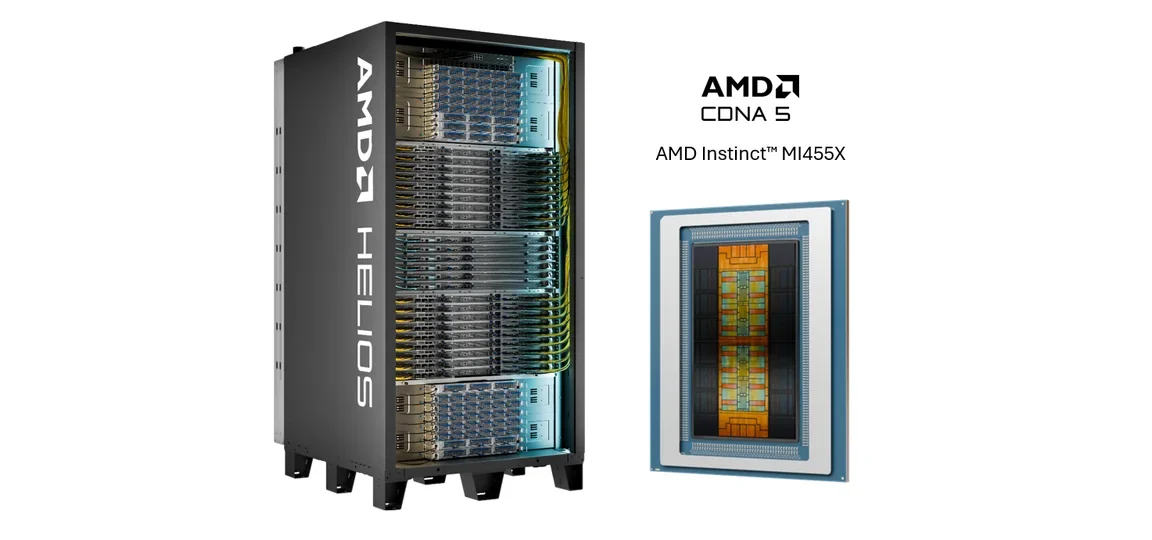
AMD’s data center division grew 97% year over year to a record $8.5 billion. The company attributed the increase to demand for its EPYC server processors and the introduction of its Instinct MI450 Series GPUs.
AMD also reported growth in its client business, which includes desktop Ryzen processors. Revenue in the segment rose 7% year over year to $2.95 billion, supported by sales of AMD Ryzen mobile chips.
Gaming revenue falls 40%
AMD’s gaming revenue fell 40% to $773 million. The company attributed the decline to “lower semi-custom and graphics revenue.”
Despite the decline in gaming, profitability in the data center business improved. Operating margins expanded from 25% to 34%, while operating income increased 168% to $2.88 billion.
Embedded business continues to grow
Embedded segment revenue increased 29% to $1.1 billion. The segment includes system-on-chip products, or SoCs, FPGAs, and AMD-owned boards integrated into other hardware.
AMD said growth in the embedded business came from gains in the “aerospace and defense, automotive, communications, and industrial end markets.”
Source: arstechnica.com