


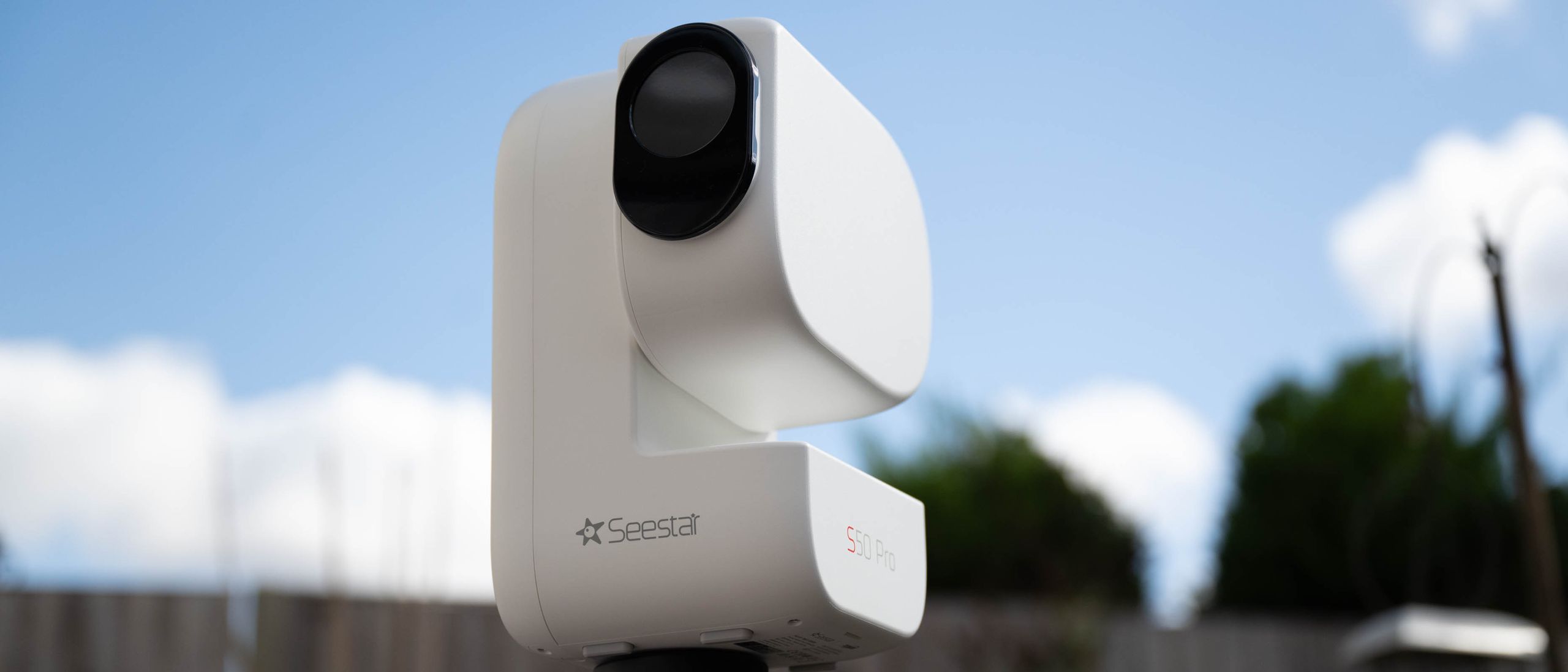
The ZWO Seestar S50 Pro is a smart telescope released on Aug. 25, 2026. Designed for beginners and experienced observers alike, it includes the essential accessories for astronomical viewing, astrophotography and solar observation, so you can start exploring the night sky without purchasing additional equipment.
The Seestar S50 Pro is controlled through the Seestar smartphone app. It can automatically locate, slew to and focus on galaxies, nebulae, star clusters and other celestial targets. During testing, we found that some objects needed minor manual adjustments with the app’s on-screen joystick for precise centering.
As the successor to the original Seestar S50, the Pro model costs more. At $999, it is $450 more expensive than the previous version. In return, the S50 Pro offers twice the internal storage, increasing capacity from 64GB to 128GB, and a higher-resolution 4K sensor instead of Full HD. ZWO also claims up to nine hours of battery life, although we could not independently verify that figure because the app update responsible for the increase from the original seven-hour estimate was not available during testing.
The key question is whether the S50 Pro’s larger aperture, 4K resolution, expanded storage and upgraded tracking system justify the higher price.
ZWO Seestar S50 Pro review: A powerful all-in-one smart telescope
ZWO Seestar S50 Pro design and portability
- Compact and easy to transport
- Includes a protective carry case and carbon-fiber tripod
- Dual-lens system with simple two-button controls
- Push-on solar filter included
The Seestar S50 Pro has the familiar rounded design associated with ZWO’s smart telescope range. Its glossy white plastic housing protects the optical and electronic components, while the minimalist exterior keeps operation straightforward. The telescope has only two physical controls: a large illuminated power button on the side and a smaller reset button on the underside.
ZWO Seestar S50 Pro specifications
Image resolution: 8.3MP (3840 x 2160)
Aperture: 50mm (1.96 inches)
Focal length: 260mm
Internal storage: 128GB
Field of view: 2.8 degrees telephoto / 63 degrees wide-angle
Mount: Motorized alt-azimuth with equatorial mode
Battery life: Up to nine hours, not independently tested
Weight: 6 pounds (2.72kg)
The included carry case is one of the S50 Pro’s strongest design features. Its rigid construction, secure latches and retractable red handle make it feel more like a premium drone case than a basic telescope bag. The telescope, tripod and solar filter fit securely inside, making the complete system easier and safer to transport.
The Seestar S50 Pro includes a compact tripod and protective carry case.
(Image credit: Jase Parnell-Brookes)
The telescope itself weighs 6 pounds (2.7kg), while the fully packed system weighs approximately 8.6 pounds (3.9kg). We measured the S50 Pro at 5.7 x 10.6 x 5.4 inches (146 x 270 x 138mm), including its rubber feet. Because the telescope can sit securely on a flat surface, using the included tripod is optional.
A standard 3/8-inch tripod thread is built into the base, allowing the S50 Pro to be mounted on many photographic tripods. We used a taller carbon-fiber tripod during testing because the included tripod is very short. If you use a camera tripod, remove the tripod head first, as the telescope is not designed to attach directly to a standard 1/4-inch camera plate.
ZWO Seestar S50 Pro performance
- Automatically aligns and tracks celestial targets
- Live stacking brings out detail in faint deep-sky objects
- Captures solar images, videos and timelapses
- Produces detailed 4K images with an 8.3MP sensor
The Seestar S50 Pro’s live-stacking feature is central to its performance. Within minutes, the telescope combines multiple exposures to improve detail and reduce image noise. This makes it possible to capture bright, colorful views of deep-sky targets that would otherwise be difficult to see through a compact 50mm telescope.
The Dumbbell Nebula, or M27, was one of our favorite targets. After an exposure of 10 minutes and 20 seconds, the final image showed a vivid green-blue central region surrounded by red and orange hydrogen-alpha, sulfur and nitrogen emissions.
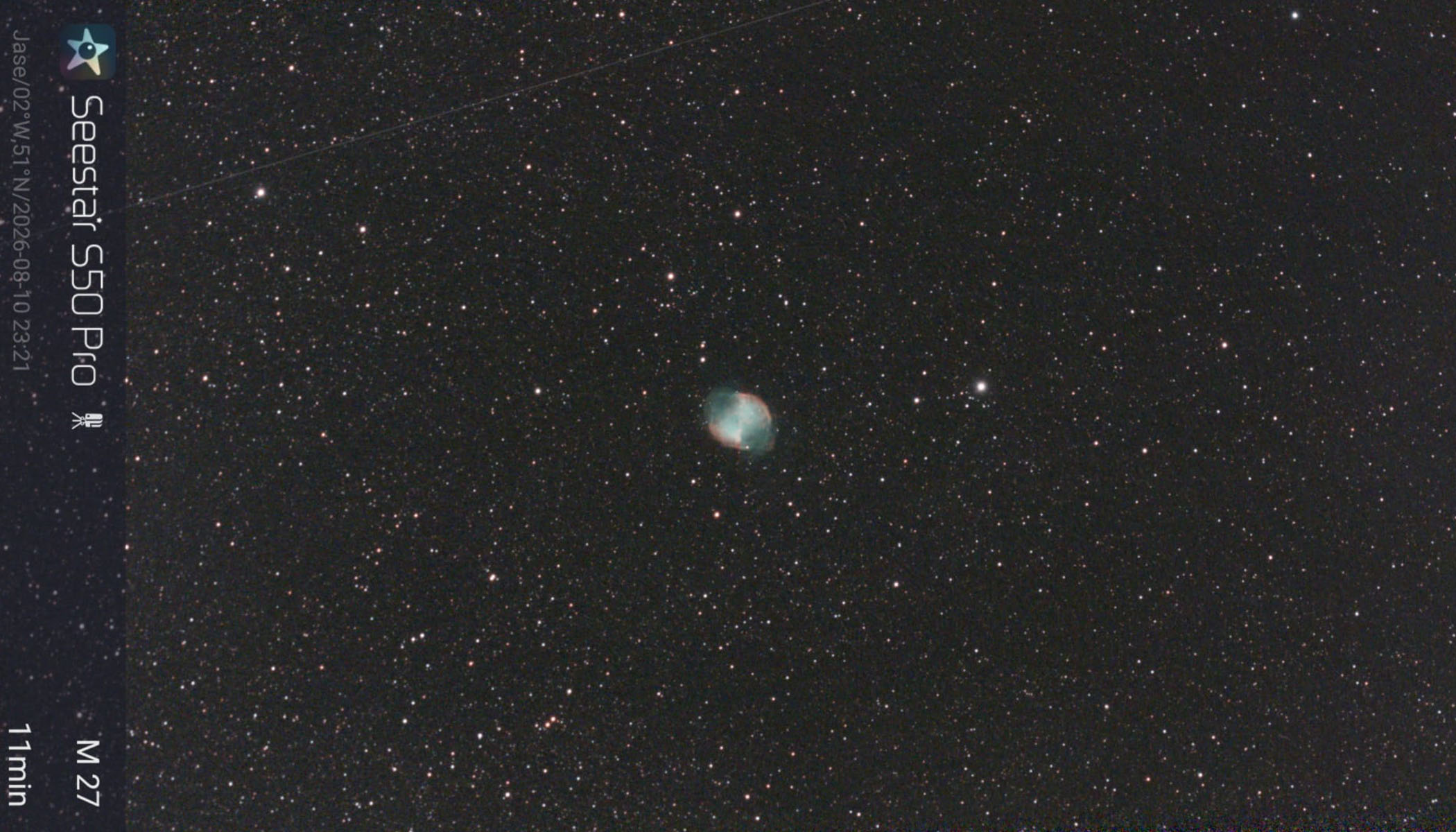
The Seestar S50 Pro captures impressive color and detail in the Dumbbell Nebula.
(Image credit: Jase Parnell-Brookes)
The Andromeda Galaxy, or M31, also looked clear and well defined after a nine-minute exposure. Its size and shape filled the frame effectively for an 8.3MP camera. The S50 Pro’s field of view is also wide enough to capture M81, Bode’s Galaxy, and M82, the Cigar Galaxy, together. After approximately six minutes and 30 seconds, we could see the spiral structure of M81 and the fragmented detail and color of M82.
The included solar filter makes the S50 Pro suitable for daytime solar observation. During testing around the Aug. 12, 2026 solar eclipse, sunspots were clearly visible and appeared with a warm orange tone. However, the telescope did not reveal much fine surface detail, such as granulation or faculae, which is understandable given its aperture and price.
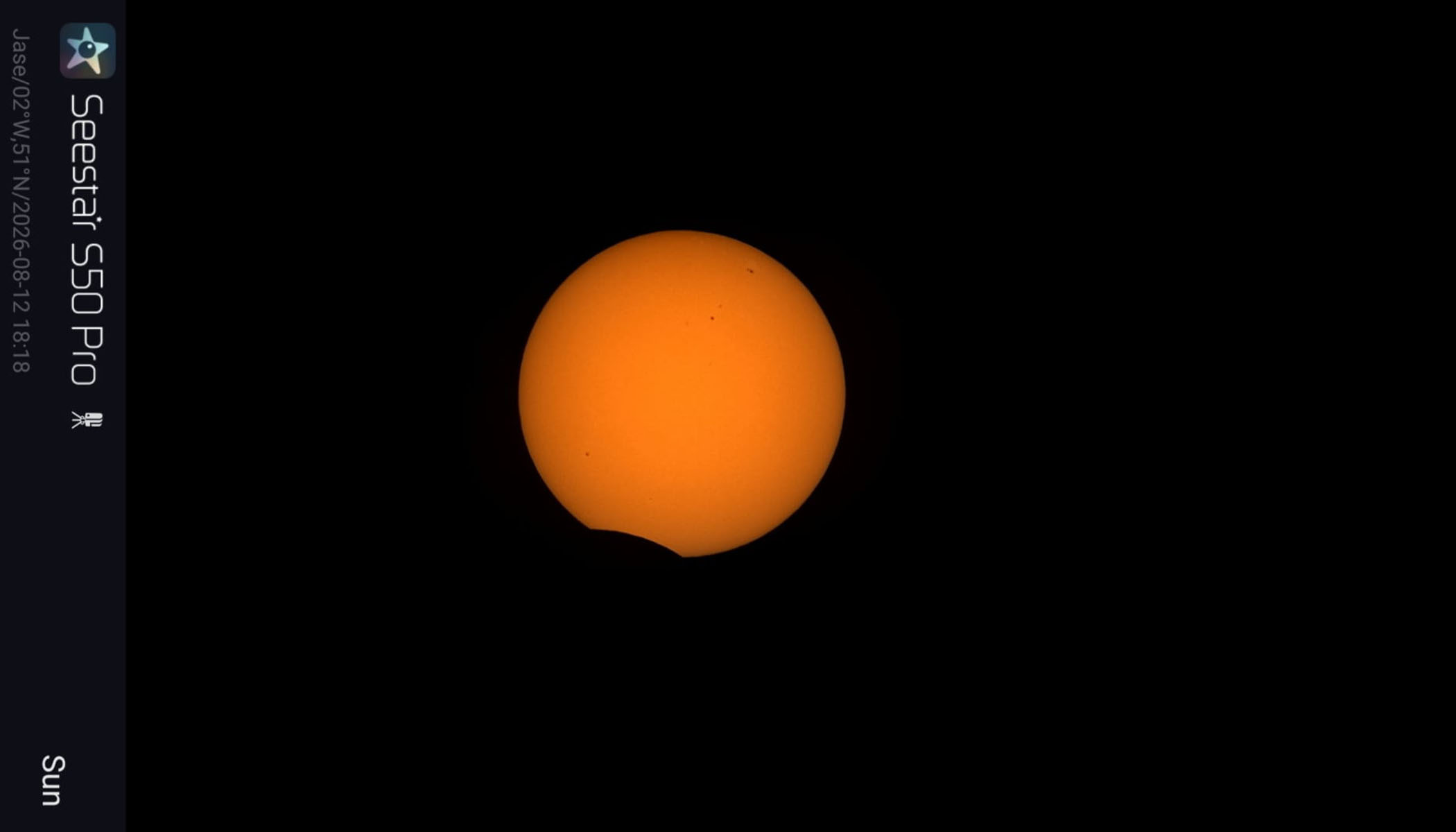
The included solar filter produces a warm orange tone and clearly shows sunspots.
(Image credit: Jase Parnell-Brookes)
Automatic exposure metering was less impressive during solar testing. The sun was frequently overexposed, and exposure levels changed as the moon moved across the solar disk or clouds passed overhead. As a result, the eclipse timelapse was enjoyable to share but lacked the consistency needed for more serious imaging.
The short tripod can also be vulnerable to obstructions and movement. During one nighttime session, wind caused a nearby tree to enter the frame during a long exposure. A taller, more stable photographic tripod is a worthwhile upgrade for extended astrophotography sessions.
ZWO Seestar S50 Pro app and features
Setting up the Seestar S50 Pro is generally straightforward. With a stable connection or the telescope’s NFC feature, the initial setup should take around five minutes. We experienced synchronization problems during testing, however, and had to restart and reinstall the app before the telescope appeared as an available device. The complete setup took approximately 30 minutes.
Once connected, the Seestar app is easy to navigate. The telescope can automatically identify targets, slew to selected objects, focus the optics and use plate-solving to determine its position in the night sky. Users can also switch to equatorial mode for improved tracking during longer exposures.
The S50 Pro uses a zero-backlash motor instead of the internally geared stepper motor found in the S30 Pro. This design is intended to improve tracking precision and reduce the effect of wind movement. Images captured during testing were sharp, although testing took place in relatively calm conditions, so more observations are needed to determine how much of an advantage the motor provides in typical use.
We also encountered a few software quirks. On one occasion, the app identified the sun as the moon, and a prompt included the typo “in the fram.” The Seestar mascot also remained visible on screen during some long exposures. None of these issues prevented us from using the telescope, but they are the kinds of details ZWO should address through future app updates.
Should you buy the ZWO Seestar S50 Pro?
Buy it if:
✅ You want the extra light-gathering power of a 50mm aperture
✅ You want a complete smart telescope system with a solar filter and carry case
✅ You plan to capture detailed deep-sky images and 4K video
✅ You are comfortable spending close to $1,000
Don’t buy it if:
❌ You want the smallest and lightest smart telescope available
❌ You prefer traditional, eyepiece-based astronomy
❌ You are looking for a budget-friendly smart telescope
❌ You need reliable automatic exposure for solar timelapses
The ZWO Seestar S50 Pro is an excellent all-in-one smart telescope for anyone who wants to photograph galaxies, nebulae, star clusters and the sun with minimal setup. Its 50mm aperture, 8.3MP resolution, 128GB storage, automatic alignment and live-stacking features make it the most capable telescope in ZWO’s current Seestar lineup.
The price is the main drawback. At $999, the S50 Pro is significantly more expensive than the original S50 and costs $300 more than the Seestar S30 Pro, which shares many of the same features. Unless you need the larger aperture, additional storage and 4K resolution, the S30 Pro may offer better value for casual backyard observing.
If the ZWO Seestar S50 Pro isn’t for you
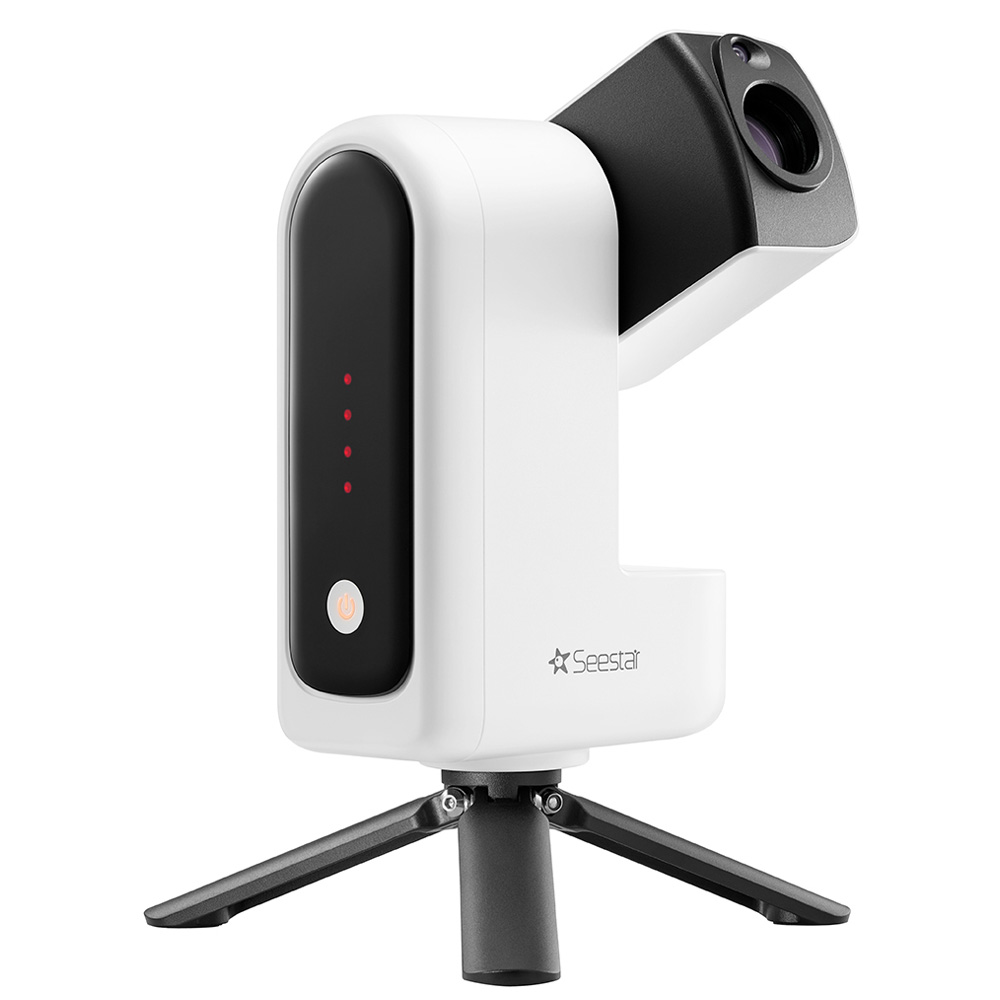
If you want something cheaper
ZWO Seestar S30 Pro: Save $300 and get many of the same smart telescope features and the same resolution in a more affordable package. Its smaller 30mm aperture gathers less light than the S50 Pro, but it remains a strong choice for occasional backyard observers.
Read our full ZWO Seestar S30 Pro review.
If you want something bigger
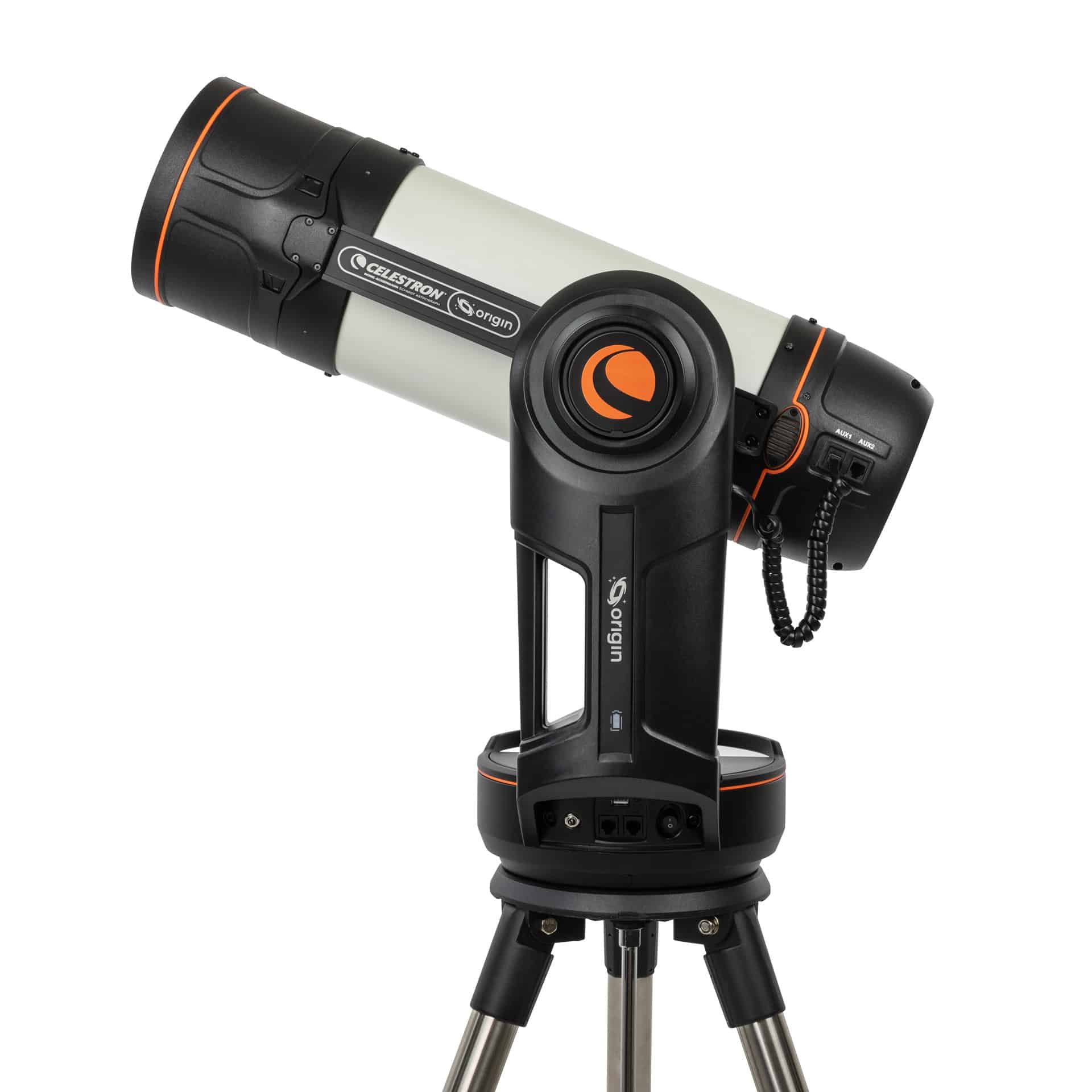
Celestron Origin Intelligent Home Observatory: This larger and heavier reflector-style smart telescope is better suited to backyard use and dedicated astronomy trips. The newer Celestron Origin II also matches the S50 Pro’s 8.3MP resolution.
Read our full Celestron Origin review.
Source: www.livescience.com