


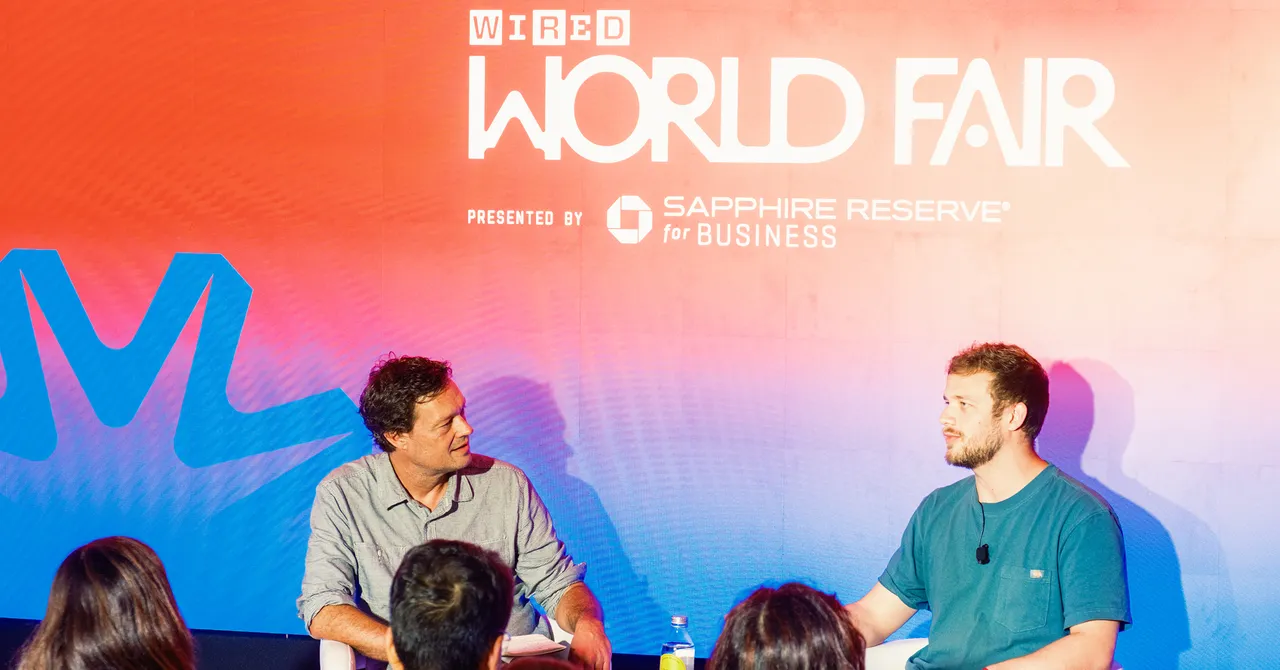
OpenAI, Anthropic and xAI have reportedly expressed interest in working with comedian and creator Matt Husk, whose deadpan videos exposing the limitations of AI chatbots have attracted nearly 2 million followers. Husk discussed the attention, his viral experiments and his interactions with OpenAI at Wednesday’s WIRED World Fair.
Matt Husk’s AI videos attract industry attention
Husk told the WIRED World Fair audience that “all the big AI companies” had asked about working with him, including Elon Musk’s xAI. He said he would give Tesla a week if he created a video specifically for the company.
Husk became popular by posting videos of himself making deliberately simple, deadpan requests to voice models on ChatGPT, such as asking them to count to 100 or beatbox for him. The models often fail at these tasks or shift between excessive flattery and responses Husk describes as gaslighting. The videos earned him a contract with talent agency Unicorn and inspired the description “Sam Altman’s Worst Nightmare.”
In April, Altman acknowledged on a technology podcast that ChatGPT’s inability to set an accurate timer was a “known issue.” Husk said the problem could persist for another year. In one video, he asked ChatGPT to time a one-mile run, but the model treated a range of seconds as lasting “approximately 10 minutes.” When Husk replied, “I swear, I was faster,” the model responded sympathetically: “It might feel faster at that moment.”
OpenAI declined cooperation with Husk
During an interview at the WIRED World Fair, podcast host Evan Ratliff said OpenAI would give Husk early access to a patch for the timer issue if he shared his account, according to Husk. He refused.
Husk also said OpenAI had previously emailed him about cooperating on videos. “They offered me the lowest amount,” he said. “I was like, ‘No.’” The company later offered to send him a gift and asked for his home address. Husk said he refused that offer as well.
OpenAI, Anthropic and xAI did not respond to requests for comment.
AI companies promote assistants for everyday tasks
AI companies are increasingly presenting their products as capable of handling routine personal tasks. On Tuesday, OpenAI announced that its model had received a “very high” score on a benchmark designed to assess how well AI can help with personal activities, including preparing meals and enrolling children in kindergarten.
“Their way of advertising is ‘anything goes,’” Husk said. “So I’m going to test it. Let’s see if I can order bread.” In one video, he asked an AI model to help negotiate the price of bread on Craigslist from $10,000 to $5. He said the model used for the test costs $400.
How Husk began testing chatbots
Husk began publicly trolling chatbots about a year ago. He told WIRED contributor Ratliff that he had previously enjoyed making TikToks in which he asked people questions. However, while working in landscaping, he was often away from other people and began running out of ideas.
He eventually recorded himself telling ChatGPT that a nuclear bomb had exploded. Husk said the model’s “I’m rooting for you” responses and advice to evacuate were “totally unhelpful.”
“I thought it was a pretty bad video,” he told Ratliff. “Then the next morning, it had 100,000 views, so I thought, ‘Let’s pretend I got hit by a train.’”
Brand partnerships and a human-focused series
Husk has since secured brand partnerships with CeraVe and Ninja. He also has an original series planned with The Onion, in which he will learn complex skills such as pantomime over Zoom.
“We’re spending too much time talking to AI, so we’re going to branch out and learn something from humans,” Husk said.
Although Husk often talks to AI while narrowing down ideas for videos, he said he does not “really use it in a creative sense,” such as generating concepts. The ideas produced by AI are “too similar,” he said.
“I want my worst ideas to at least look like this,” Husk said. “It’s not an AI idea for video, it’s an idea.”
Source: www.wired.com