


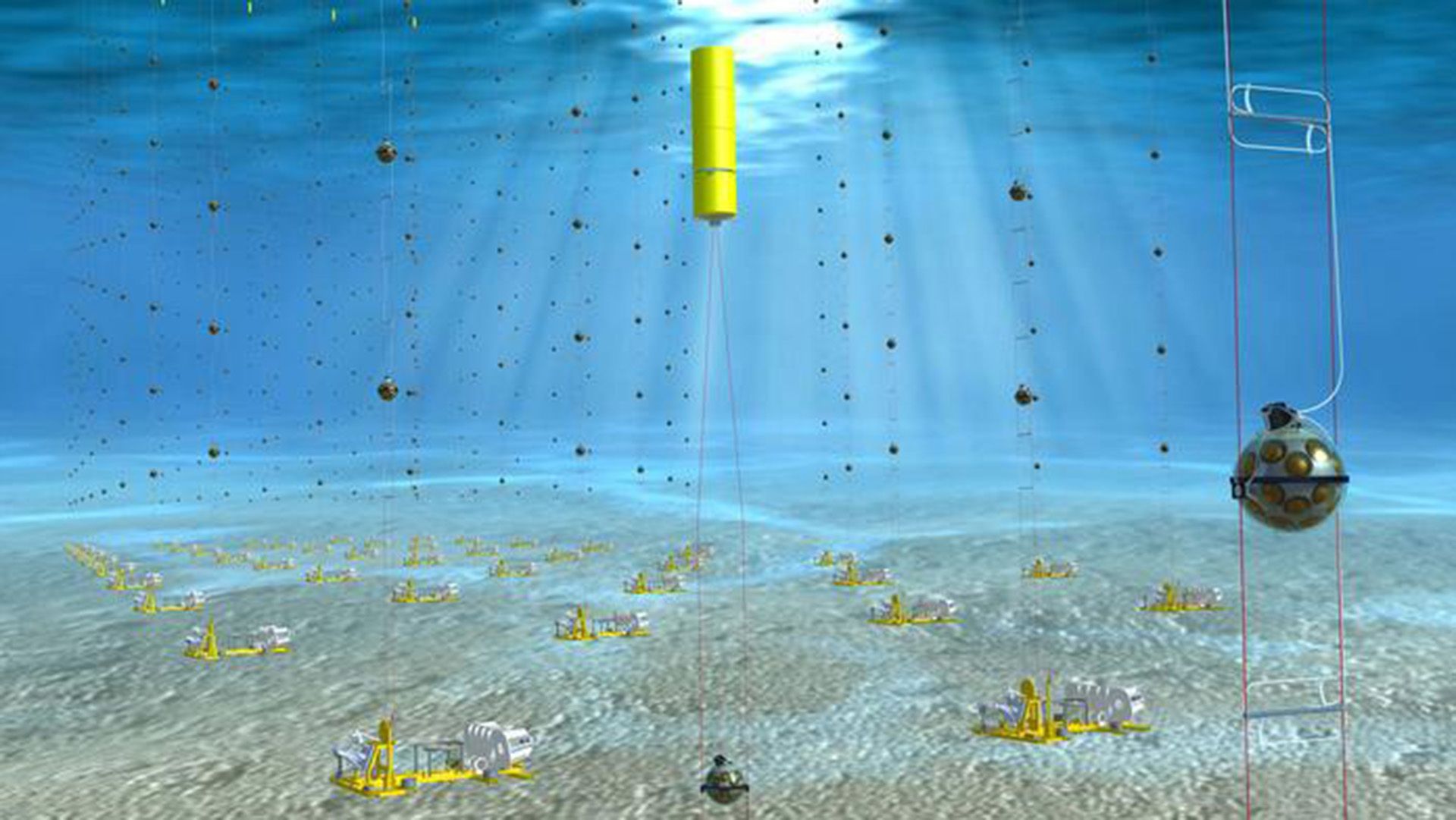
Image credit: Edward Berbee/Nikhef
A neutrino telescope sunk about 1.5 miles (2.4 kilometers) beneath the Mediterranean Sea has found no evidence that Einstein’s theory of relativity breaks down. Data from the first six detection units of the KM3NeT/ORCA experiment placed stringent limits on possible violations of Lorentz invariance, a principle stating that the laws of nature should appear the same regardless of an observer’s orientation or speed.
The results, announced Wednesday, November 4, were published in the Journal of Cosmology and Astroparticle Physics. Although the detector was operating with only a fraction of its planned size, the researchers said its measurements already compete with results from larger, longer-running experiments.
Testing a fundamental principle
Modern physics rests on two highly successful theories. General relativity, developed by Albert Einstein more than 100 years ago, describes gravity and the universe on cosmic scales. The Standard Model of particle physics describes subatomic particles and their behavior.
“General relativity describes the universe well at the cosmic scale, and the Standard Model of particle physics describes the microscopic scale, in fact single particles, and how they behave,” said study co-author Lucas Hennig, a PhD student in advanced physics at the University of Erlangen-Nuremberg.
Both theories assume that Lorentz invariance is valid. However, the theories do not fit together under the extreme conditions of the earliest moments after the Big Bang. That mismatch has driven decades of research into quantum gravity, a theory that could reconcile gravity with quantum physics.
Some proposed theories, including versions of string theory and loop quantum gravity, suggest that space-time may have an underlying structure at the smallest scales. If so, that structure could produce tiny violations of Lorentz invariance. “Such violations might be caused by ‘particles’ hidden in spacetime at the smallest scales,” Hennig said, “which could violate Lorentz invariance, one of the most fundamental assumptions we make about the universe.”
Any violation is expected to be extremely small. Physicists therefore need particles that can travel long distances while interacting very little with their surroundings. Neutrinos are well suited to that task.
Neutrinos as probes of space-time
Neutrinos are nearly massless, electrically neutral particles that pass through Earth in enormous numbers. They come in three types, or flavors: electron neutrinos, muon neutrinos and tau neutrinos. As they travel, they change from one flavor to another in a regular process known as neutrino oscillation.
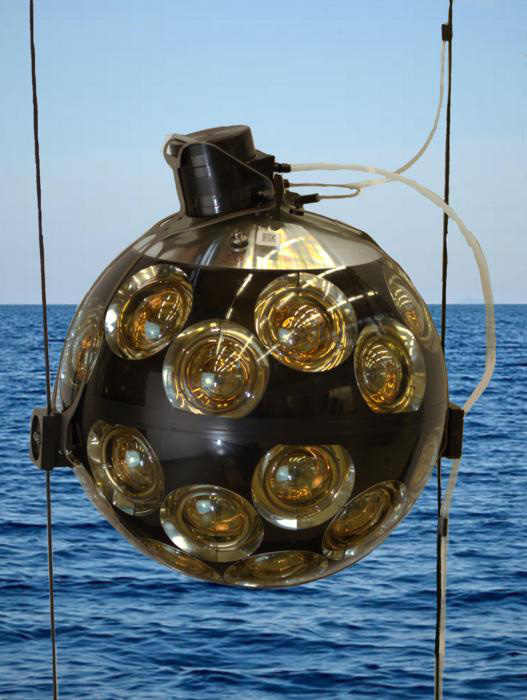
Image credit: KM3NeT collaboration
If Lorentz invariance is violated, neutrino oscillations would change. The effect should become more pronounced the farther a neutrino travels, allowing researchers to search for deviations from the expected pattern.
The ORCA detector — the Oscillation Research with Cosmics in the Abyss — is part of the KM3NeT Neutrino Telescope. Its detection units are anchored to the seafloor and equipped with 18 glass bulbs, each containing 31 light sensors. When a neutrino collides with a particle in the water, the interaction can produce a faint blue flash called Cherenkov light. The sensors record the flash and help determine the neutrino’s direction.
The neutrinos used in the study were produced when cosmic rays struck Earth’s atmosphere. Some traveled through the planet before reaching the detector, crossing its full width of about 7,900 miles (12,700 kilometers). Earth acts as a filter: by selecting particles moving upward through the planet, researchers can reject much of the atmospheric background. “Only neutrinos can pass through,” Hennig said.
ORCA’s use of seawater differs from the IceCube detector, which is embedded in Antarctic ice. “Ice scatters more light than water, but on the other hand, water absorbs more light than ice,” said Alba Domi, a researcher who helped build the underwater telescope as a doctoral student. Those differences affect how the two collaborations reconstruct a neutrino’s energy and path.
Results from six detection units
The team analyzed 5,828 neutrinos collected over approximately 17 months between 2020 and 2021. Their oscillations matched the predictions of standard physics, meaning that any Lorentz-violating effect must be weaker than the limit established by the study.
These limits can rule out theoretical models. If a model predicts Lorentz-invariance violations stronger than the new limits, the data excludes that model. “In that case, the model is almost certainly incorrect,” Hennig said.
The researchers also set the first direct limits on some violations that would affect muon and tau neutrinos differently.
The result is notable because the detector was still at an early stage. Japan’s Super-Kamiokande detector used 12 years of data for some key measurements, while IceCube used two years of data from its complete array.
“We were surprised that we were able to get competitive results with just six detection units,” Hennig said. KM3NeT currently has 44 underwater units, and the collaboration plans to bring 108 units into operation by 2030.
A larger search ahead
The strongest future tests may come from neutrinos produced by distant cosmic sources. Because potential Lorentz-violating effects should grow with both travel distance and energy, these high-energy particles could provide especially sensitive probes. “Neutrinos from distant cosmic sources are actually perfect candidates for doing this kind of research,” Domi said.
The team plans to repeat the search using ORCA’s sister detector, ARCA — the Astroparticle Research with Cosmics in the Abyss — located off the coast of Sicily and designed to detect high-energy particles arriving from space.
If space-time contains the kinds of hidden particles suggested by some quantum-gravity theories, those particles could be among the first signs of a departure from Lorentz invariance.
Adriani et al. (2026), “Atmospheric neutrino constraints on Lorentz invariance violations by the first six detection units of KM3NET/ORCA,” Journal of Cosmology and Astroparticle Physics.
Source: www.livescience.com