


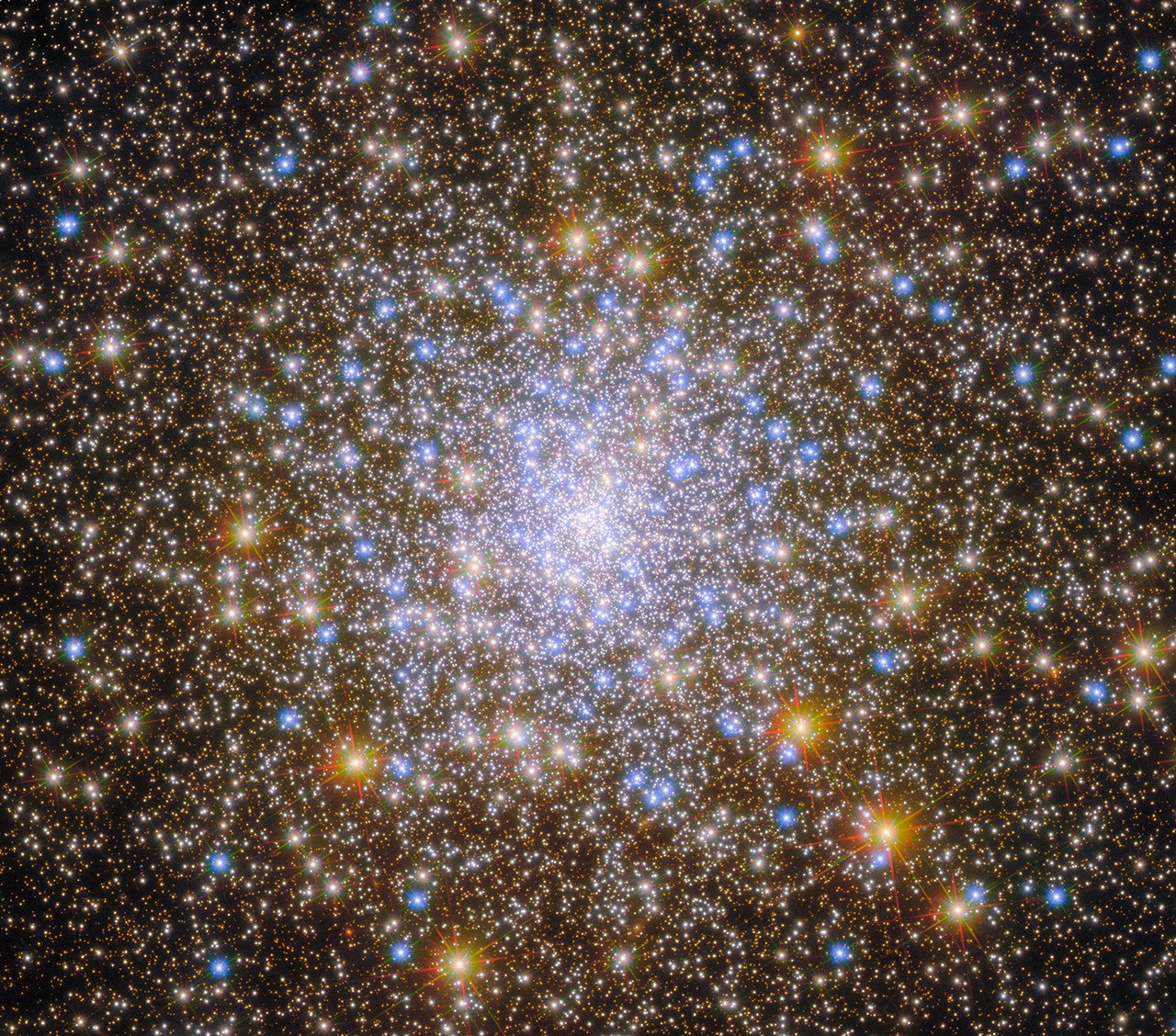
The NASA/ESA Hubble Space Telescope’s latest view of the globular cluster Messier 30 (M30) offers insights into both the history of the Milky Way and the evolution of the stars within it. Located about 27,500 light-years away in the constellation Capricornus, M30 was cataloged by French astronomer Charles Messier, who recorded diffuse objects that could be mistaken for comets through the early telescopes of his time.
A stellar archive of the Milky Way
M30 is a globular cluster: a roughly spherical collection containing tens to millions of stars. Such clusters generally occupy the outskirts of galaxies, orbiting within vast, diffuse regions known as halos—much like a swarm of moths around a light bulb.
Our Milky Way contains at least 150 globular clusters, the closest of which is about 6,000 light-years away. These clusters are remarkably old. Astronomers estimate their ages at between 11.5 and 13.5 billion years, meaning some may be nearly as old as the universe itself.
Globular clusters have played an important role in understanding galaxies for more than a century. Astronomer Harlow Shapley used observations of particular types of variable stars to determine the positions and distances of dozens of globular clusters in the Milky Way. His work showed that the Sun is not at the center of the galaxy and that the galactic center lies in the direction of Sagittarius. His distance measurements were inaccurate, however, leading him to conclude that the Milky Way was about twice as large as it actually is.
Astronomers still study globular clusters to investigate how galaxies formed and developed. Because these clusters are so old, they preserve clues about the distant past. Clusters that formed within the Milky Way act as time capsules, retaining the original chemical structure of the young galaxy.
Possible visitors from beyond the Milky Way
Not every globular cluster now orbiting the Milky Way necessarily formed here. Researchers have found that M30 and many other globular clusters orbit in the direction opposite to the rotation of the galaxy. This may indicate that they did not form within the Milky Way and could instead have been captured by it in the distant past.
Hubble’s repeated observations of M30
Hubble has observed M30 multiple times. Earlier images included data from Hubble’s Altitude Survey Camera (ACS), collected through observation program 10775 (PI: Sarajedini). That program examined dozens of Milky Way globular clusters in red and near-infrared light, revealing stars with as little as 20% of the Sun’s mass.
More recent observations from program 13297 (PI: Piot) revisited M30 and other globular clusters using Hubble’s Wide Field Camera 3 and three filters designed to capture bluer light. The data support studies of unusual objects such as “blue stragglers” and investigations into the multiple stellar populations that can exist within a single globular cluster.
Hubble’s ACS has more recently observed many of these globular clusters again. These observations were part of program 16298 (PI: Libralato), which investigated how different stellar populations in globular clusters have moved during the 15 years since Hubble first observed them. This work is possible because of Hubble’s long operational lifetime and its ability to distinguish extremely small details in distant objects.
The image combines data from all three observation programs and spans the full range of wavelengths Hubble can observe: ultraviolet, visible and near-infrared light. Each wavelength provides different information about how these stellar groups formed and evolved.
Text credit: ESA/Hubble
Media contact:
Claire Andreoli
NASA’s Goddard Space Flight Center, Greenbelt, Maryland
[email protected]
Source: science.nasa.gov