


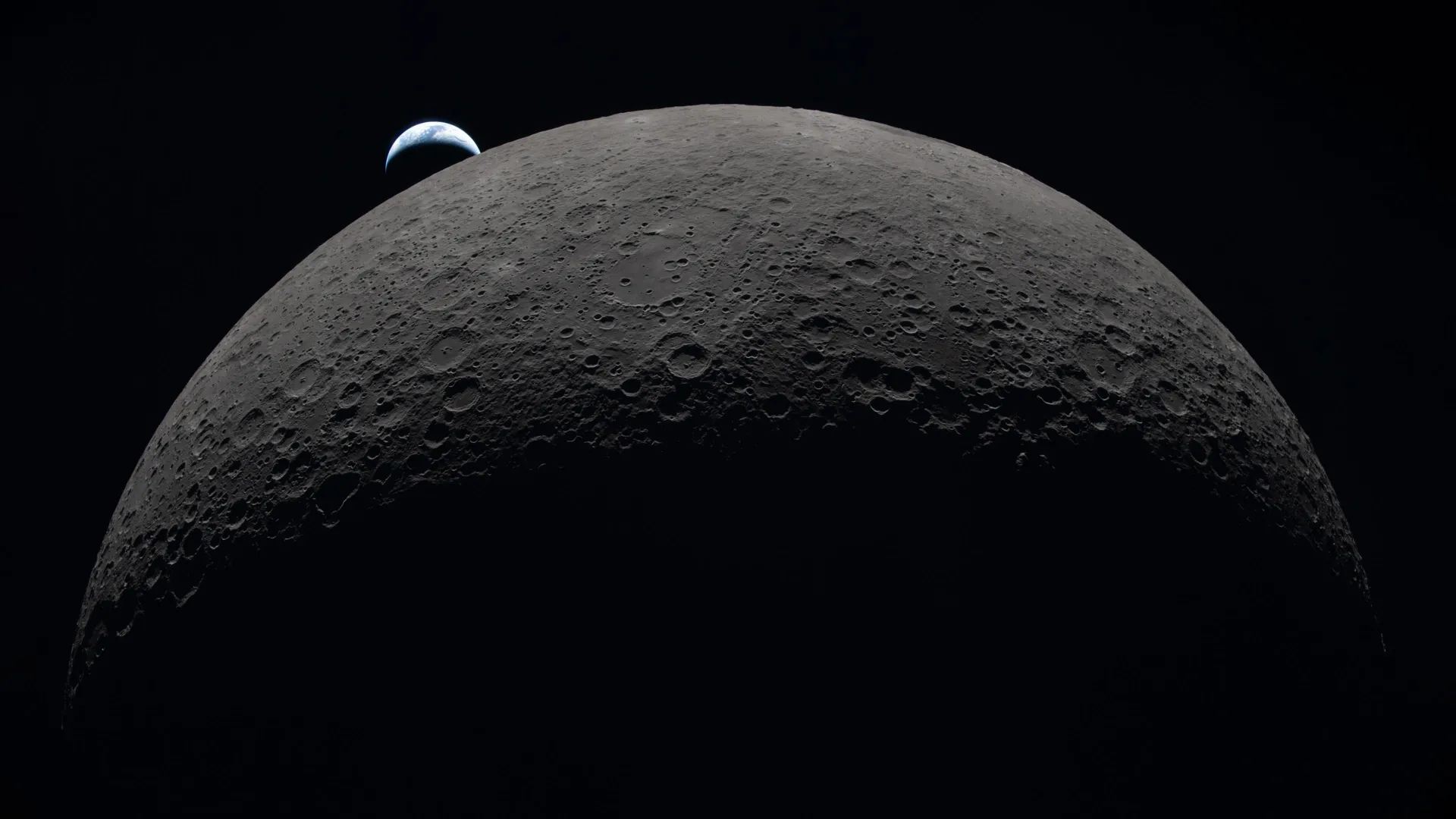
NASA scientists say some microbes carried into space by human explorers could survive in shadowed areas near the Moon’s south pole, raising new concerns about lunar contamination and future searches for life beyond Earth.
The findings were published on August 19, 2026. This scientific progress highlights the importance of understanding how long Earth-based microorganisms can survive in the Moon’s extreme environment. As nations and private companies work toward establishing a permanent lunar presence, contamination from astronauts could make it more difficult for scientists to distinguish ancient lunar chemicals from materials introduced by humans. Researchers say the same concerns will be critical for future missions searching for signs of life on Mars.
“Humans are natural explorers, and they have voices, memories, and microbes attached to them,” said Prabal Saxena, a planetary scientist at NASA’s Goddard Space Flight Center in Greenbelt, Maryland, who led the study. “For some scientists, including myself, that reality can be unsettling. But it also creates an opportunity to turn an imperfect situation into a useful experiment.”
Microbial hitchhikers are unavoidable during human spaceflight
Humans inevitably carry microorganisms with them. A small area of skin about the size of a pencil eraser can contain an average of approximately 1 million bacteria. Some of these organisms can escape from spacesuits, spacecraft, and habitats into the surrounding environment.
This creates a challenge for scientists studying chemical evidence connected to the Moon’s ancient geology and potential biological history. At the same time, researchers say the Moon could serve as a valuable natural laboratory. Monitoring shadowed regions near the lunar south pole may allow scientists to test the limits of microbial survival in conditions that are extremely difficult to reproduce on Earth.
Before such experiments can begin, however, researchers must establish a clear baseline of the contaminants humans could introduce to the lunar surface.
“We need to understand what came before us,” said study co-author Andrew Needham, a lunar sample contamination-control scientist based at NASA Goddard. “When we go to Mars and search for signs of life beyond Earth, we will want to make sure those signs are not something we brought with us.”
Some Earth microorganisms can withstand extreme conditions
Even strict sterilization procedures cannot remove every hardy microorganism. One example is black aspergillus, a fungus commonly found in warm, humid environments, including bathrooms and heating, ventilation, and air-conditioning systems.
Astronauts have collected samples of this microorganism aboard the International Space Station, and previous experiments have shown that it can survive outside the station. Black aspergillus was one of five microorganisms examined in the new study because of its demonstrated resilience during spaceflight.
Scientists were surprised to find that these microbes could survive exposure to the space environment. Unlike organisms known as extremophiles, which are adapted to survive conditions such as space vacuum, these microorganisms are not typically classified as extreme-environment specialists, said Aaron Regberg, a geomicrobiologist at NASA’s Johnson Space Center in Houston.
“We expected these microbes to be dry,” said Regberg, who studies bacteria aboard the space station and contributed to the study.
NASA can reduce biological contamination on robotic spacecraft by heating them to temperatures above 400 degrees Fahrenheit. This method would not be practical for crewed missions, making microbial contamination a more complex issue when astronauts explore the Moon’s south polar region.
Why shadowed lunar regions matter
To identify places where microbes might survive, researchers first examined how sunlight reaches the Moon’s polar regions. In this study, survival means that a microorganism remains alive for at least one Earth day. It does not mean that the organism can grow or reproduce.
The Moon has only a slight axial tilt. As a result, observers at the lunar poles would see the Sun close to the horizon, with sunlight spreading across the surface much like a flashlight lying flat on a table.
This low angle allows crater rims, mountains, ridges, and even small changes in the terrain to block sunlight from reaching lower areas. The result is a patchwork of permanently or temporarily shadowed regions that can remain extremely cold, preserve water, and shield molecules and microorganisms from damaging radiation.
Researchers model microbial survival near the lunar south pole
Using this environment as a guide, the research team investigated which Earth microorganisms might survive conditions near the Moon’s south pole.
The scientists selected organisms found in spaceflight environments as well as microorganisms commonly associated with humans. Along with black aspergillus, the group included Bacillus subtilis, Staphylococcus aureus, Deinococcus radiodurans, and several species of Fusarium.
The team determined how much heat and ultraviolet (UV) radiation each organism could tolerate by analyzing results from previous studies.
Researchers then modeled conditions at three locations near the lunar south pole: the Nobile Rim, the Connecting Ridge, and the de Gerlache Rim. The simulation used detailed elevation and temperature maps created from data collected by instruments aboard NASA’s Lunar Reconnaissance Orbiter, along with models showing how radiation reaches the lunar surface.
Microbial survival zones could be as large as craters or as small as boot prints
The resulting map identified a “viable niche” ranging from the floor of a crater several miles wide to an area no larger than an astronaut’s footprint.
Black aspergillus appeared particularly resilient. Because the fungus showed the greatest resistance to UV radiation, it may be able to survive in areas that receive limited sunlight. UV light is deadly to many microorganisms, which is why hospitals routinely use it for disinfection.
“When you think about the Moon, you don’t usually think about biology,” said NASA Goddard co-author Heather Graham, who is helping develop tools and techniques for detecting biological activity unlike anything found on Earth. “But the Moon is a place where cells may survive. Early exploration of these sites should therefore pay close attention to microbial hitchhikers and carefully document the Moon’s chemistry before human activity changes what we find.”
Researchers emphasize that survival and growth are not the same. Although some microbes may remain dormant in protected areas near the lunar south pole and potentially complicate future scientific investigations, there is no evidence that the Moon offers the conditions required for microorganisms to grow and reproduce.
One major missing ingredient is liquid water, which generally depends on an atmosphere and temperatures that are more moderate than those found on the lunar surface.
Source: www.sciencedaily.com