


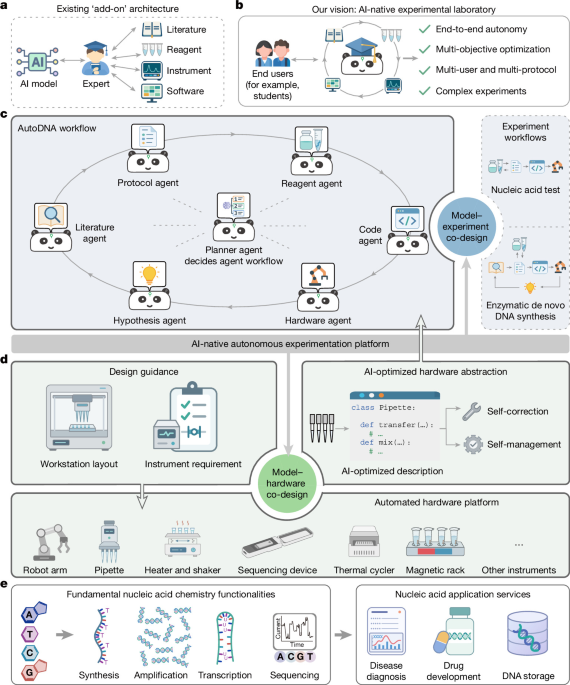
The source is a bibliography of 53 works tracing the development of autonomous scientific research. It covers mobile and robotic chemists, self-driving laboratories, large language models and AI agents, automated DNA synthesis and data storage, molecular computing, and multi-agent systems for scientific discovery, with publications dated from 1982 through 2026.
Autonomous chemistry and robotic laboratories
- Berger, B. et al. “Mobile robot chemist.” Nature 583, 237–241 (2020). Article · PubMed · Google Scholar
- Steiner, S. et al. “Organic synthesis in modular robotic systems driven by chemical programming languages.” Science 363, eaav2211 (2019). Article · PubMed · Google Scholar
- Mehr, SHM, Craven, M., Leonov, AI, Keenan, G. & Cronin, L. “A versatile system for digitization and automated execution of chemical synthesis literature.” Science 370, 101–108 (2020). Article · PubMed · Google Scholar
- Dai, T. et al. “Autonomous mobile robots for exploratory synthetic chemistry.” Nature 635, 890–897 (2024). Article · PubMed · PubMed Central · Google Scholar
- Ha, T. et al. “An AI-powered robotic chemist that autonomously synthesizes organic molecules.” Science Advances 9, eadj0461 (2023). Article · PubMed · PubMed Central · Google Scholar
- Zhang, Z. et al. “A multimodal robotic platform for multi-element electrocatalyst discovery.” Nature 647, 390–396 (2025). Article · PubMed · Google Scholar
- Jia, Y. et al. “Robot-assisted mapping of hyperspace and networks of chemical reactions.” Nature 645, 922–931 (2025). Article · PubMed · PubMed Central · Google Scholar
- Abolhasani, M. & Kumacheva, E. “The rise of self-driving laboratories in chemistry and materials science.” Nature Synthesis 2, 483–492 (2023). Article · Google Scholar
- Seifrid, M. et al. “Autonomous chemical experiments: Challenges and prospects for establishing self-driving laboratories.” Accounts of Chemical Research 55, 2454–2466 (2022). Article · PubMed · PubMed Central · Google Scholar
- Darvish, K. et al. “ORGANA: A robotic assistant for automated chemical experiments and characterization.” Matter 8, 101897 (2025). Article · Google Scholar
- Bayley, O., Savino, E., Slattery, A. & Noël, T. “Autonomous chemistry: Navigating self-driving labs in chemistry and materials science.” Matter 7, 2382–2398 (2024). Article · Google Scholar
Language models and AI agents in science
- Boiko, D.A., MacKnight, R., Kline, B. & Gomes, G. “Autonomous chemical research using large-scale language models.” Nature 624, 570–578 (2023). Article · PubMed · PubMed Central · Google Scholar
- Brun, AM et al. “Extending large-scale language models using chemical tools.” Nature Machine Intelligence 6, 525–535 (2024). Article · Google Scholar
- Luan, Y. et al. “An automated end-to-end chemical synthesis development platform leveraging large-scale language models.” Nature Communications 15, 10160 (2024). Article · PubMed · PubMed Central · Google Scholar
- Song, T. et al. “Multi-agent-driven robotic AI chemist enables autonomous chemical research on demand.” Journal of the American Chemical Society 147, 12534–12545 (2025). Article · PubMed · Google Scholar
- Gao, S. et al. “Powering biomedical discovery with AI agents.” Cell 187, 6125–6151 (2024). Article · PubMed · Google Scholar
- Ramos, MC, Collison, CJ & White, AD. “A review of large-scale language models and autonomous agents in chemistry.” Chemical Science 16, 2514–2572 (2025). Article · PubMed · Google Scholar
- Swanson, K., Wu, W., Bulaong, NL, Pak, JE & Zou, J. “A virtual lab of AI agents designs new SARS-CoV-2 nanobodies.” Nature 646, 716–723 (2025). Article · PubMed · Google Scholar
- Gottweis, J. et al. “Accelerate scientific discovery with collaborators.” Nature 655, 487–496 (2026). Article · PubMed · PubMed Central · Google Scholar
- Gharib, AE et al. “Multi-agent systems for automating scientific discovery.” Nature 655, 497–505 (2026). Article · PubMed · PubMed Central · Google Scholar
- Yao, S. et al. “ReAct: Synergizing inference and action in language models.” In Proceedings of the 11th International Conference on Learning Representations (2023).
- Skarlinski, MD et al. “Linguistic agents achieve superhuman synthesis of scientific knowledge.” Preprint in arXiv (2024). arXiv
Language-model foundations and chemistry applications
- Touvron, H. et al. “LLaMA: An open and efficient basic language model.” Preprint in arXiv (2023). arXiv
- “Introducing ChatGPT.” OpenAI (2022). OpenAI
- Guo, D. et al. “DeepSeek-R1 facilitates inference in LLM through reinforcement learning.” Nature 645, 633–638 (2025). Article · PubMed · PubMed Central · Google Scholar
- “Introduction to Claude 3.5 Sonnet.” Anthropic (2024). Anthropic
- Brown, TB et al. “Language models are trained a few times.” In Advances in Neural Information Processing Systems, Vol. 33 (Larochelle, H. et al., eds.), 1877–1901 (Curran Associates, 2020).
- “Learn how to reason with LLM.” OpenAI (2024). OpenAI
- Ouyang, L. et al. “Train language models to follow instructions from human feedback.” In Advances in Neural Information Processing Systems, Vol. 35 (Koyejo, S. et al., eds.), 27730–27744 (Curran Associates, 2022).
- Wang, L., Zhang, X., Su, H. & Zhu, J. “A comprehensive survey of continuous learning: Theory, methods, and applications.” IEEE Transactions on Pattern Analysis and Machine Intelligence 46, 5362–5383 (2024). Article · PubMed · Google Scholar
- Jablonka, KM, Schwaller, P., Ortega-Guerrero, A. & Smit, B. “Leveraging large-scale language models for predictive chemistry.” Nature Machine Intelligence 6, 161–169 (2024). Article · Google Scholar
- Antunes, LM, Butler, KT & Grau-Crespo, R. “Generation of crystal structures by autoregressive large-scale language modeling.” Nature Communications 15, 10570 (2024). Article · PubMed · PubMed Central · Google Scholar
- North Carolina Frye et al. “Neural scaling of deep chemical models.” Nature Machine Intelligence 5, 1297–1305 (2023). Article · Google Scholar
- Yu, B., Baker, F.N., Chen, Z., Ning, X. & Sun, H. “LlaSMol: Advances in large-scale language models for chemistry using large, comprehensive, high-quality instruction coordination datasets.” In 1st Conference on Procedural Language Modeling (2024).
- Lewis, P. et al. “Search extension generation for knowledge-intensive NLP tasks.” In Advances in Neural Information Processing Systems, Vol. 33 (Larochelle, H. et al., eds.), 9459–9474 (Curran Associates, 2020).
- Balandat, M. et al. “BoTorch: A framework for efficient Monte Carlo Bayesian optimization.” In Advances in Neural Information Processing Systems, Vol. 33 (Larochelle, H. et al., eds.), 21524–21538 (Curran Associates, 2020).
DNA synthesis, storage and molecular computing
- Lu, X. et al. “Enzymatic DNA synthesis by engineering terminal deoxynucleotidyl transferases.” ACS Catalysis 12, 2988–2997 (2022). Article · Google Scholar
- Miser, LC et al. “Reading and writing digital data in DNA.” Nature Protocols 15, 86–101 (2020). Article · PubMed · Google Scholar
- Tanaka, T. & Letsinger, R.L. “A syringe method for stepwise chemical synthesis of oligonucleotides.” Nucleic Acids Research 10, 3249–3259 (1982). Article · PubMed · PubMed Central · Google Scholar
- Hoose, A., Vellacott, R., Storch, M., Freemont, PS & Ryadnov, MG. “DNA synthesis techniques to fill the gene writing gap.” Nature Reviews Chemistry 7, 144–161 (2023). Article · PubMed · PubMed Central · Google Scholar
- Lee, H. et al. “Photon-directed multienzyme DNA synthesis for molecular digital data storage.” Nature Communications 11, 5246 (2020). Article · PubMed · PubMed Central · Google Scholar
- Lee, K. et al. “The highly ordered DNA framework interface enables efficient enzymatic oligonucleotide synthesis.” Advanced Science 12, e05868 (2025). Article · Google Scholar
- Lee, K. et al. “DNA-DISK: Automated end-to-end data storage by enzymatic single-nucleotide DNA synthesis and sequencing on digital microfluidics.” Proceedings of the National Academy of Sciences of the United States of America 121, e2410164121 (2024). Article · PubMed · PubMed Central · Google Scholar
- Takahashi, C.N., Nguyen, B.H., Strauss, K. & Ceze, L. “Demonstration of end-to-end automation of DNA data storage.” Scientific Reports 9, 4998 (2019). Article · PubMed · PubMed Central · Google Scholar
- Zhirnov, V., Zadegan, RM, Sandhu, GS, Church, GM & Hughes, WL. “Nucleic acid memory.” Nature Materials 15, 366–370 (2016). Article · PubMed · PubMed Central · Google Scholar
- Church, GM, Gao, Y. & Kosuri, S. “Next generation digital information storage in DNA.” Science 337, 1628 (2012). Article · PubMed · Google Scholar
- Cherry, KM & Qian, L. “Supervised learning in DNA neural networks.” Nature 645, 639–647 (2025). Article · PubMed · PubMed Central · Google Scholar
- Zhang, C. et al. “Parallel molecular data storage by printing epigenetic bits on DNA.” Nature 634, 824–832 (2024). Article · PubMed · PubMed Central · Google Scholar
- Yang, S. et al. “DNA as a universal chemical substrate for computing and data storage.” Nature Reviews Chemistry 8, 179–194 (2024). Article · PubMed · Google Scholar
- National Security Council for Emerging Biotechnologies. Drawing the future of biotechnology (2025). Report
- Daher, RK, Stewart, G., Boissinot, M. & Bergeron, MG. “Recombinase polymerase amplification for diagnostic applications.” Clinical Chemistry 62, 947–958 (2016). Article · PubMed · PubMed Central · Google Scholar
Perspectives and related research
- Wang, D. “Awards should recognize machines’ contributions to discovery.” Nature 646, 261 (2025). Article · PubMed · Google Scholar
- “A virtual lab of AI agents designs new SARS-CoV-2 nanobodies” is also discussed in the source bibliography under AI-enabled biomedical discovery.
- Ramos, MC, Collison, CJ & White, AD. “A review of large-scale language models and autonomous agents in chemistry.” Chemical Science 16, 2514–2572 (2025). Article · PubMed
- “Accelerate scientific discovery with collaborators.” Nature 655, 487–496 (2026). Article
- “Multi-agent systems for automating scientific discovery.” Nature 655, 497–505 (2026). Article
- Wu, M. et al. “AutoDNA code and data for autonomous biomolecular manipulation.” Zenodo (2026). Zenodo
Source: www.nature.com