


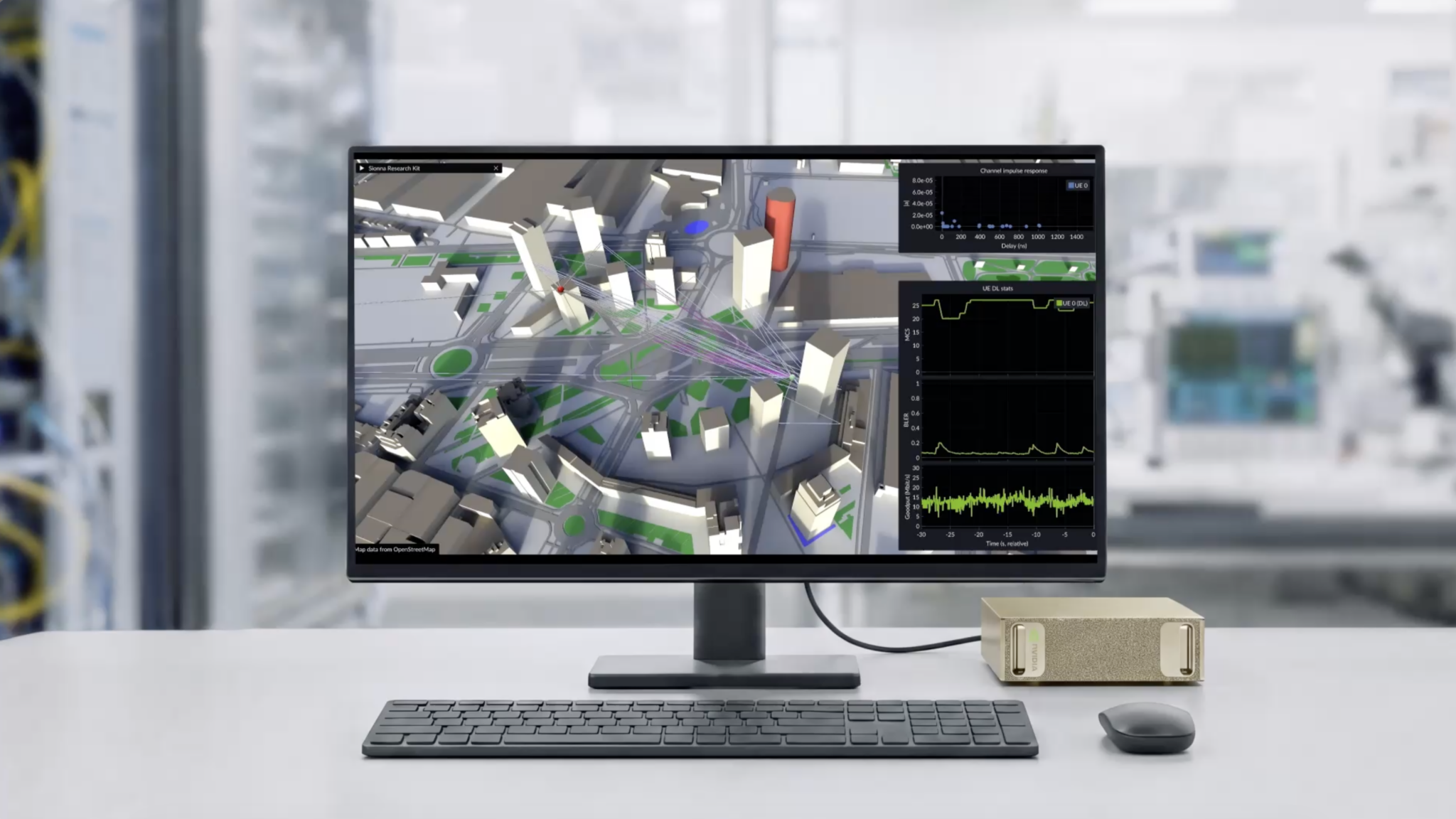
One year after NVIDIA’s open-source Aerial wireless software joined Sionna and a broader suite of open-source tools, researchers are using the platforms to accelerate development of next-generation 6G networks. The tools connect wireless simulation, AI training and experiments on real systems, helping teams explore networks that can improve signal reception, keep robots and autonomous systems connected, adapt to changing conditions and manage energy use in real time.
Over the past year, use of NVIDIA AI Aerial and NVIDIA Sionna software has grown tenfold, with more than 1 million downloads of NVIDIA’s open-source 5G and 6G tools. More than 8,000 research and academic institutions worldwide use the platforms.
The projects emerging from these tools offer a glimpse of future networks. Although they address different technical challenges, together they support a broader effort to build an AI-native 6G network that combines connectivity, computing and sensing on a software-defined platform serving billions of people, machines and agents.
Helping robots respond more quickly
A robot that picks up an object must understand its surroundings and act before conditions change. When the AI supporting that decision-making runs on a nearby server or in the cloud, wireless connectivity becomes part of the robot’s response time.
Researchers are exploring an approach called goal-directed semantic communication. Rather than transmitting complete images, the robot sends compact descriptions of objects, their locations and their relationships. Transmitting only the information required for a task can help robots respond more quickly, particularly in dynamic environments such as workplaces and warehouses.
Researchers at King’s College London created a camera-equipped robotic arm using NVIDIA Jetson AGX Orin. The system runs NVIDIA Sionna, supporting software-defined 5G networking and edge AI processing.
In fruit-sorting and cube-stacking experiments that intentionally introduced defects, the approach reduced task-completion time by 52.6% and improved the robot’s task success rate compared with periodically transmitting images.
The system also showed greater resilience. It detected falling objects, recovered from failed actions and, in configurations using a digital twin, checked planned actions for potential collisions before execution.
Teaching networks to receive signals more effectively
Live drone footage can help firefighters, while search teams can use real-time images when looking for missing people. Interference and changing radio conditions, however, can make wireless signals difficult to interpret, leading to errors and retransmissions that delay information from the field.
AI receivers address this problem by learning how to recover information from received signals more effectively. Better reception could give emergency responders a clearer and more current view of a fire scene or search area.
SoftBank demonstrated this approach by integrating a neural receiver into NVIDIA Aerial CUDA-Accelerated RAN (Aerial CUDA-Accelerated RAN) and testing it with a commercially available 5G smartphone. In controlled tests with interference, the neural receiver achieved higher uplink throughput than a conventional receiver in all 15 configurations tested, with a maximum gain of approximately 60%.
Another way to improve reception is to train a receiver for the environment in which it operates. Using the NVIDIA Aerial testbed, researchers at ETH Zurich found that tuning a neural receiver with local measurements reduced the blocking error rate by more than one-third compared with a selected pretrained version.
Using AI to reduce network power consumption
As 6G connects more devices and supports more AI applications, managing energy demand will become increasingly important.
A network may need substantial capacity to serve a crowded stadium, for example, but demand can change as spectators leave. AI can identify when excess capacity can be powered down and when it must be brought back online, helping operators reduce energy use without disconnecting devices.
Researchers at the University of Leeds developed a system that predicts network demand 10 minutes into the future and uses the forecast to guide base-station sleep decisions. Before powering down a station, the system checks whether nearby active stations can continue serving affected devices and monitors for changes that would require capacity to be restored.
The team used a portable NVIDIA DGX Spark-5G “Network in a Box” with a digital twin to validate decisions against real wireless equipment. The researchers reported a 45.6% reduction in radio access network power consumption compared with a full-power baseline while keeping devices connected.
Accelerating network simulations
Before deploying a network, researchers need to understand how it will perform when hundreds of devices compete for connectivity or when wireless signals interfere with one another. Simulation allows teams to evaluate designs before investing in equipment or field testing. Realistic simulations can take hours, however, limiting the number of ideas researchers can investigate.
The Catalonia Telecommunications Technology Center (CTTC) is addressing this challenge by integrating a GPU-accelerated radio-channel model running on Aerial CUDA-Accelerated RAN into CTTC’s open-source 5G-LENA network simulator. The models calculate how wireless signals travel between antennas and devices, a process that becomes more demanding as the simulated network grows.
In initial evaluations, the approach reduced simulation runtimes from approximately three hours to 10–20 minutes, depending on the integration, while maintaining expected statistical behavior and network performance.
Faster simulations allow researchers to compare more designs, examine more demanding scenarios and refine concepts more quickly. As the industry develops 6G, the shorter simulation cycle could help move innovations from initial proposals to thoroughly evaluated network designs before they are deployed in the real world.
At NVIDIA GTC Washington, DC, researchers and developers will introduce more innovations shaping the future of wireless networks in the 6G developer session.
NVIDIA Aerial and NVIDIA Sionna are available on GitHub.
Source: blogs.nvidia.com