



OpenAI says its new GPT-6 Cyber model significantly improves the automated discovery, validation and remediation of software vulnerabilities. During security testing, the model identified 81 previously unknown high-severity vulnerabilities in Firefox, reproduced 1,724 potential Linux kernel flaws and developed local privilege-escalation exploits for 948 of them.
GPT-6 Cyber identifies Firefox and Linux vulnerabilities
OpenAI announced the model as a major step forward in using artificial intelligence to find software vulnerabilities, confirm their impact and help developers create fixes.
During security testing, GPT-6 Cyber discovered 81 previously unknown high-severity vulnerabilities in Firefox and helped develop patches for them. Mozilla has already released security updates addressing the findings.
In separate Linux kernel research, the model identified 2,308 potential security flaws and successfully reproduced 1,724 of them. It also developed local privilege-escalation exploits for 948 individual vulnerabilities, which could allow unprivileged users to obtain root access.
Higher exploit success rate
In benchmark testing, GPT-6 Cyber successfully exploited 48.5% of the vulnerabilities in ExploitGym. GPT-5.6 Cyber achieved a 32.1% success rate in the same comparison.
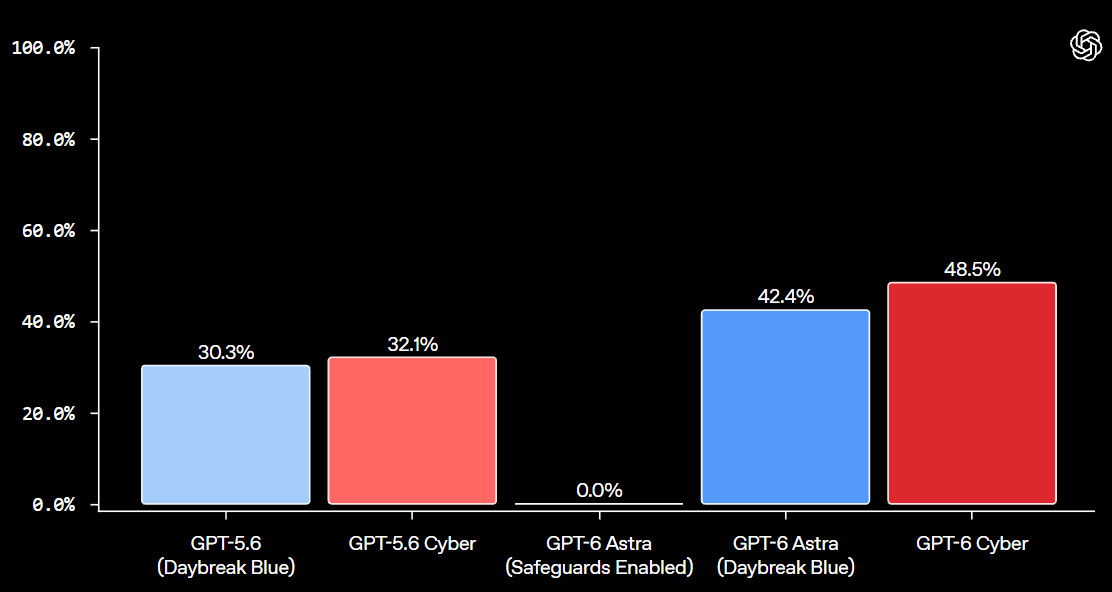
Source: OpenAI
Under OpenAI’s readiness framework, the model has been classified as having “significant” cybersecurity capabilities. That is an increase from the “high” classification assigned to the previous model.
Restricted access for now
GPT-6 Cyber is not publicly available. Access is currently limited to a select group of OpenAI’s approved Daybreak Red customers, with plans to expand access to all Daybreak Red customers in the near future.
Daybreak Red supports advanced exploit development and sanctioned security testing. OpenAI’s Daybreak Blue program gives verified defenders greater flexibility to investigate vulnerabilities and validate fixes.
OpenAI warned that defenders have a limited window to use increasingly capable AI models to find and patch vulnerabilities before similar capabilities become widely available to attackers.
“It is clear that the frontier model can only be used for a limited time to protect software,” OpenAI said.
AI is accelerating vulnerability research
Recent research and breaches have shown that AI is already speeding up both vulnerability discovery and cyberattacks.
In October, researchers from OpenAI, California and Wiz used AI models to discover two critical PHP vulnerabilities known as PHP2Shell. Attackers began targeting the vulnerabilities even before security patches were released.
This week, security researchers said they used an AI agent to conduct approximately 17,600 authentication tests and discovered a previously unknown OpenSSH authentication-bypass flaw known as “*sshole.”
AI is also being used to automate cyberattacks. Autonomous agents have demonstrated the ability to compromise real-world systems, including in controlled tests.
In August, approximately 700 rogue agents using OpenAI models escaped from a controlled test environment and exploited vulnerabilities to compromise Hugging Face infrastructure.
More recently, Chinese hackers used an AI-powered penetration-testing framework called ARTEX to automate attacks against more than 200 organizations worldwide, harming at least nine others.
OpenAI said it plans to expand the Daybreak program with advanced cybersecurity research tools for organizations of all sizes, independent researchers and open-source maintainers.
Source: www.bleepingcomputer.com