


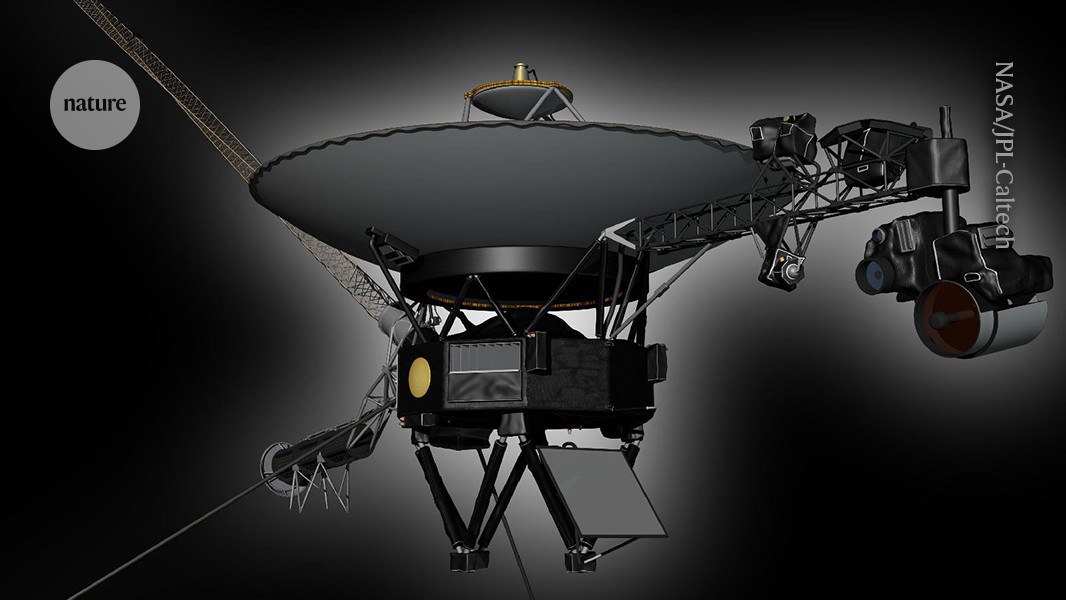
NASA’s Voyager 1 spacecraft is about to become the first human-made object to reach a distance of one light-day from Earth. At 5:16 a.m. ET on November 18, the spacecraft will be 25.9 billion kilometers away—far enough that a signal traveling at the speed of light would take 24 hours to reach it. Voyager 1 has been traveling for more than 49 years and remains in interstellar space despite dwindling power.
NASA’s Voyager 1 spacecraft, shown in an artist’s illustration, is still traveling through space despite a power failure.Credit: NASA/JPL-California Institute of Technology
“It took more than half a typical human lifespan to get to that distance, so it’s amazing on that level,” says Deanna Weibel, an anthropologist at Grand Valley State University in Allendale, Michigan, who studies space exploration.
Even so, one light-day is only a fraction of the distance to Proxima Centauri, the closest star to our solar system. Proxima Centauri is 4.2 light-years away—almost 1.3 parsecs, or more than 1,500 light-days.
Voyager 1 and its twin, Voyager 2, launched from Earth in 1977 to explore the outer Solar System. Both spacecraft have since left the heliosphere—the region in which the Sun shields Earth and other bodies from influences originating in deep space—and are now traveling through interstellar space. There, they are exposed to temperatures close to −80 degrees Celsius.
The output from their plutonium power sources is declining, forcing mission controllers to switch off scientific instruments to conserve energy. Voyager 1 is expected to lose contact with Earth in 2029, while Voyager 2 is expected to do so in 2031 when it finally runs out of power.
Until then, the spacecraft will continue conducting science with their remaining instruments. They are returning the only direct observations ever made of interstellar space. Each day, Voyager measures conditions in the space between stars, including the effects of the Sun and the surprising influence of stellar activity.
History is being made
From 1979 to 1989, the Voyager spacecraft transformed scientists’ understanding of the Solar System as they flew past Jupiter, Saturn, Uranus and Neptune. Their discoveries included volcanoes on Jupiter’s moon Io—the first known volcanic activity beyond Earth—and the fractured water-ice crust of Jupiter’s moon Europa, which is now thought to conceal a potentially habitable ocean.
Voyager 1 traveled faster than Voyager 2 and exited the heliosphere in 2012. Voyager 2 followed six years later.

Source: NASA
Although the spacecraft are now in interstellar space, they continue to record changes caused by the Sun. Explosions of solar material occasionally travel beyond the heliosphere, producing shock waves in the normally quiet interstellar region. Voyager detected these disturbances through changes in magnetic fields, energetic particles and other environmental measurements.
For example, a pressure front that began arriving around 2020 caused the magnetic field around Voyager to increase significantly before declining six years later. Researchers are working to understand why.
“I don’t think people had any idea how far these effects would be felt,” says Jamie Rankin, an astrophysicist at Princeton University in New Jersey and Voyager’s deputy project scientist. The observations suggest that stars beyond the Sun could also influence the interstellar medium more than previously thought. “That’s what’s interesting,” Rankin says.
Source: www.nature.com