


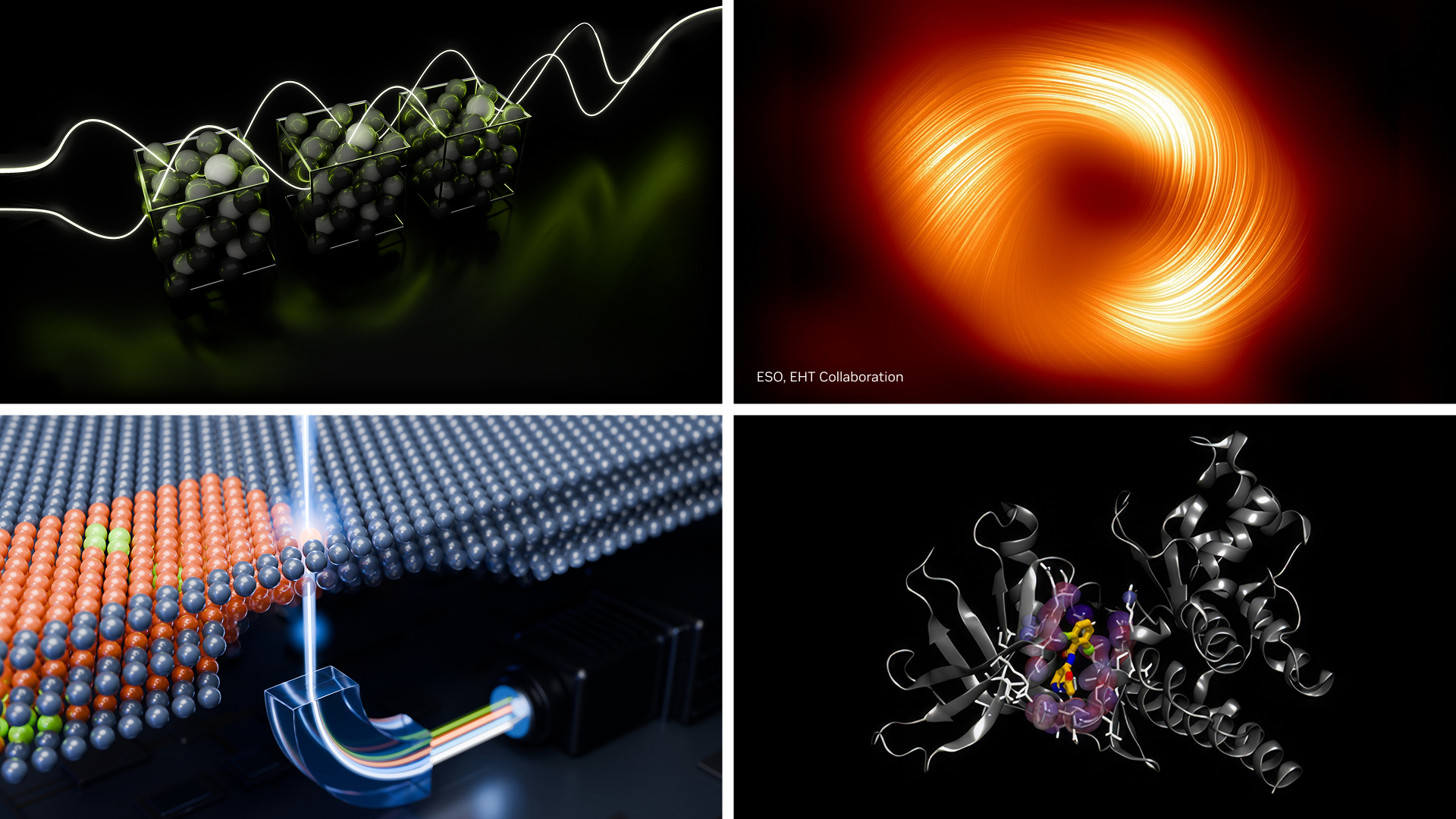
NVIDIA is expanding its CUDA-X software ecosystem with GPU-accelerated libraries designed to help scientists process large datasets and model more complex systems. The tools target research areas including astrophysics, fusion energy, drug discovery, materials science and single-cell biology, while AI-agent support is intended to help researchers analyze results and make discoveries faster.
Reconstructing black holes faster
Observing a black hole requires a telescope effectively the size of Earth. The Event Horizon Telescope achieves this by linking radio dishes around the world, generating petabytes of data that can take months to process.
Using NVIDIA cuPhoton.xBeam in the cuPhoton Toolkit, Event Horizon Telescope black-hole observations can now be correlated orders of magnitude faster, according to NVIDIA. Analyses that once took more than a month can be completed in 8 minutes.
cuPhoton combines data from a global network of radio receiving antennas to create an Earth-sized aperture, enabling very high-resolution astronomical imaging. NVIDIA says cuPhoton successfully correlated observations of the powerful black-hole jets J1924 and 3C279 and made real-time reconstruction of the Messier 87* black hole galaxy possible.
The full workflow, including data loading, processing and visualization, runs on distributed multi-GPU systems or compact platforms such as the NVIDIA DGX Spark. The system is intended to help scientists study how gas spirals inward under the extreme gravity of a black hole.
Steering fusion simulations
Keeping plasma at temperatures of millions of degrees is essential for stable, continuous fusion energy. Simulating that behavior is computationally expensive: on petascale systems, a single time step can take days, and a complete simulation can run for weeks. Experiments can also produce data faster than conventional pipelines can process it, forcing scientists to wait until an experiment ends before analyzing its results.
Researchers at Pacific Fusion used the NVIDIA cuPhoton.xLens module to extract insights during plasma simulation runs and visualize results as they emerged. The approach allows researchers to examine the full workflow while a simulation is running.
Locally running agents powered by NVIDIA Nemotron support interactive analysis. Researchers can manipulate simulations in real time, helping inform the design of fusion-reactor targets and chambers.
Searching for potential medicines
Molecular simulations allow scientists to evaluate drug designs before carrying out expensive laboratory experiments. NVIDIA says cuPotential builds on work involving researchers at the Simons Foundation Flatiron Institute and DE show research. The library can accelerate existing simulation software by up to 3x while improving calculation stability and accuracy.
cuPotential can also support the generation of synthetic data for generative AI models, the discovery of previously unknown molecular binding sites and calculations of molecular interaction strength.
NVIDIA is collaborating with Schrödinger, Amber, NAMD, Gromacs, LAMP and the Open Molecular Software Foundation to bring cuPotential acceleration to molecular-dynamics engines and workflows.
Cadence, Fathom Therapeutics, Topos Bio, Genesis Molecular AI and Tele Therapeutics are also using the technology for drug discovery, according to the source.
Accelerating materials research
Daviator is described as a collection of batched GPU kernels for the widely used Vienna Ab initio simulation package. NVIDIA Alchemy can make quantum-mechanics calculations up to 22x faster and up to 75% cheaper.
Daviator enables researchers building simulation models to use GPU acceleration across atomic systems of any size, including small systems that previously ran faster on CPUs. This acceleration supports the millions of atomic-interaction calculations required to train and run models.
At Lawrence Berkeley National Laboratory, the NVIDIA DAQIRI networking library connects high-speed electron-microscopy detectors to GPU processing and embeds analysis directly into the experiment. Researchers can identify useful signals, find previously unknown areas of interest and decide what to measure next while a measurement is underway.
The workflow supports atomic-resolution materials research in which individual elements can be distinguished, and it lays the foundation for future automated experiments.
Revealing biology at scale
The newly open-source cuSpa library accelerates cellular polygon calculations, allowing developers to create large-scale spatial graphs for next-generation patient and cancer models. NVIDIA says work involving Memorial Sloan Kettering Cancer Center achieved a 900x speedup compared with CPU processing.
Co-developed with Skubarth, the rapids-singlecell framework accelerates single-cell analysis and is now available in a container with agent support. Using the tool, Sarna Bioscience processes data 200x faster for treatment design.
10x Genomics has integrated rapids-singlecell into its Sentira platform. The integration is intended to help academic researchers, biopharmaceutical teams and basic-model developers move from large-scale spatial data to biological insights more quickly.
The NVIDIA GPU-accelerated HMMER library is also open source. It accelerates the annotation of predicted protein sequences and supports data preparation for biology-focused models. At Base Camp Research, benchmark searches ran up to 84 times faster than standard HMMER, reducing the time needed to annotate the large biological datasets used to train the company’s treatment-design models.
More information is available through the NVIDIA CUDA-X library and the related technology blog covering GPU-assisted black-hole reconstruction.
Source: blogs.nvidia.com