


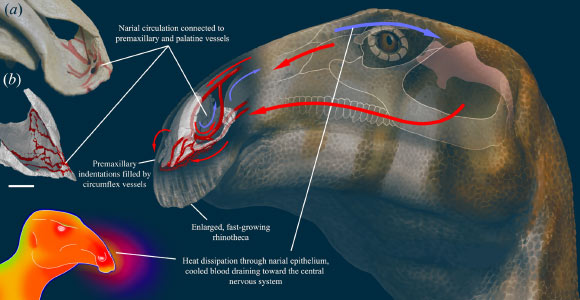
A new analysis of Tethyshadros insularis, a duck-billed dinosaur that lived on an island in what is now Italy about 81 million years ago, suggests that a supposed comb-like structure on the tip of its snout was not made of teeth. Instead, the projection and surrounding porous bone appear to have supported a dense network of blood vessels and nerves that nourished the dinosaur’s large beak and may have helped it sense, cool and process food.
Rethinking the hadrosaurid beak
“The bird’s beak is one of the most complex and versatile oral structures of any quadruped,” said Dr Alfio Alessandro Chiarenza of University College London.
Bird beaks consist of a keratinized structure covering the toothless front part of the jaws. The beaks of more than 10,000 bird species vary widely in shape, reflecting how birds feed, interact with and move through their environments. They are also involved in grooming, manipulating objects, regulating temperature, producing vocalizations and, in some cases, locomotion.
Beaks are not limited to theropod dinosaurs. Several groups of ornithischian dinosaurs independently evolved specialized beaks or beak-like structures alongside toothed jaws. Duck-billed hadrosaurids provide a clear example: they had a toothless beak at the front of the jaws and specialized tooth rows at the rear for efficient chewing.
“However, the physiological role, in vivo appearance, and paleoecological relevance of hadrosaurid beaks have been somewhat overlooked,” the researchers wrote.
The team focused on Tethyshadros insularis, one of the best-preserved dinosaurs known from Europe. When the species was first described, a forward-facing, rod-like projection along the edge of the upper jaw was interpreted as evidence of an unusual, comb-like toothed beak. That interpretation also influenced popular artistic reconstructions.
A network of vessels and nerves
The researchers used microcomputed tomography to examine the front portions of the maxilla and mandible in three Tethyshadros insularis specimens, including the holotype. CT scans can reveal canals and openings within fossil bones that mark the former pathways of blood vessels and nerves.
The scans indicate that the supposed “spike,” together with the surrounding porous bone, represents the bony evidence of an exceptionally developed neurovascular network rather than a row of teeth. The reconstruction connects circulation around the nostrils, palate and base of the beak with previously unrecognized sinuses along the midline of the upper jaw.
Large blood vessels appear to have looped along the cutting edge of the jaw, where they may have supported the keratinous covering known as a rhamphotheca. This sheath was probably larger and more complex than the underlying bone.
The researchers described this as the first detailed account of such structures in ornithopods, the group that includes duck-billed dinosaurs. Comparisons with modern birds and turtles suggested that the arrangement most closely resembles that of birds.
The team also identified comparable vascular patterns around the claws and hooves of large mammals, including horses, cattle and elephants.
“The best-documented potential functional analogs are found in the vascular tissue of the onycho-phalanx in both large ornithischians and large extant mammals with hooves or hoof-like structures,” the researchers said. In domestic ungulates, including Equus and cattle, complex vascular networks branch through both the interior and surface of the keratin-containing region of the terminal toe bone.
A beak built for wear and sensing
The findings suggest that the beak performed substantial mechanical work. One large specimen had deep wear scars on its teeth, some more than 150 micrometers wide, indicating that the dinosaur consumed highly abrasive material.
The animal may have swallowed coarse sand and limestone particles from the carbonate soils of its coastal habitat along with its plant food. Its beak was probably the primary cutting tool, and rapid growth would have been necessary to replace tissue lost through heavy wear, in a way comparable to the continuously growing incisors of rodents.
A depression on the inner surface of the premaxilla may have held a blood-filled sinus or a concentration of sensory neurons. Similar structures occur in crocodiles and some whales. In Tethyshadros, such a structure may have helped the beak detect mechanical stress.
“Thus, the hadrosaurid beak, together with the tactile papillae, may have functioned as a highly proprioceptive organ, functionally similar to that of birds,” the scientists wrote.
Cooling a large body
Tethyshadros insularis lived in a warm, low-latitude environment and had a relatively large body. If, as generally assumed, it was warm-blooded, it would have required effective ways to cool its head.
Blood flowing through the beak and nostrils could have carried heat away from the body. A similar strategy is used by birds such as the toco toucan, which dissipates a significant amount of body heat through its beak. This kind of heat exchanger would have been especially useful for an animal without a crest, sail or another obvious heat-dissipating structure.
“Taken together, these findings support a reappraisal of hadrosaurid beaks as large, dynamic, vascularized sensory and thermoregulatory organs that are comparable in functional and evolutionary complexity to avian beaks,” the paleontologists concluded.
They added that the emergence of this multifunctional beak-and-nostril complex may have helped hadrosaurids exploit a wider range of foods, respond to their environments and eventually evolve the ecological expansion and larger body sizes seen in later members of the group.
The study was published on November 11 in Royal Society Open Science.
Reference
Marco Muscioni et al. 2026. “The bird-like complexity of hadrosauroid beaks.” Royal Society Open Science 13 (11): 260392. doi: 10.1098/rsos.260392.
Source: www.sci.news