


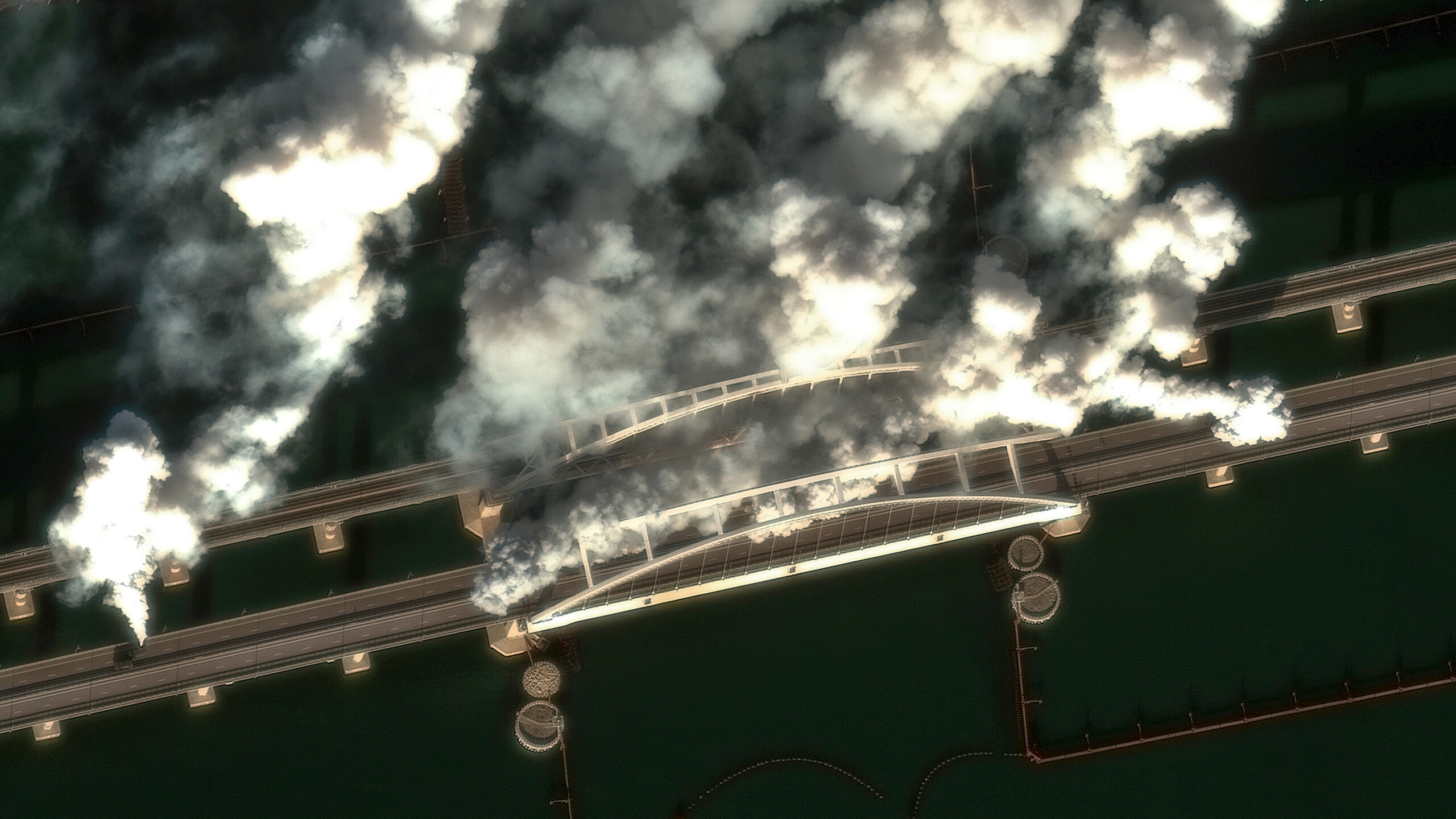
A coordinated Ukrainian attack involving drones and missiles reportedly collapsed one of the two steel arches supporting the Kerch Strait Bridge’s motorway on the nights of Nov. 15 and 16. The operation demonstrated how Ukraine can conduct strikes more than 250 kilometers from its operators without relying on Elon Musk’s military version of Starlink to guide the weapons, instead using drones equipped with mesh radios to create an airborne communications network.
Drone and missile strikes damaged the Kerch Bridge
The Kerch Strait Bridge is a major link between Russia and occupied Crimea and a prized project of Russian President Vladimir Putin. Russian sources claimed that hundreds of Ukrainian drones initially overwhelmed Russian air defenses, clearing the way for a remotely controlled missile attack focused on the bridge. The reported strike included Ukraine’s indigenous Flamingo cruise missiles.
The Institute for the Study of War reported that the coordinated wave caused sufficient damage to collapse one of the bridge’s two steel motorway-supporting arches. The reports describe the damage as the latest major attack on infrastructure that Russia uses to connect its mainland with occupied Crimea.
Ukraine used drones as airborne communication relays
The Ukrainian operation adapted a battlefield technology that Russia has also begun using: drones fitted with mesh radios. According to the Financial Times, each networked drone can act as a relay node, extending the communications link between human operators and remotely controlled missiles or attack drones.
In the attack on the Kerch Strait Bridge, the airborne mesh network reportedly enabled operators more than 250 kilometers away to guide missiles and drones remotely. The network helped the weapons evade Russian air defenses and target vulnerable points in the bridge’s structure, according to the Financial Times.
Preliminary attacks targeted Russian defenses
Ukraine’s strike followed weeks of preliminary attacks that systematically destroyed or degraded Russian air-defense systems, radars, and electronic-warfare equipment positioned to protect the bridge. The operation on the night of Nov. 15 was also described as Ukraine’s largest nighttime drone attack on Russia since the full-scale war began. Reuters reported on the attack.
Source: arstechnica.com