


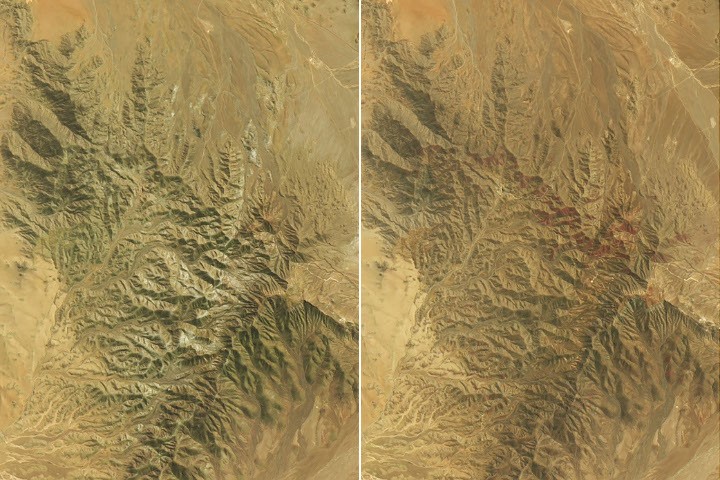
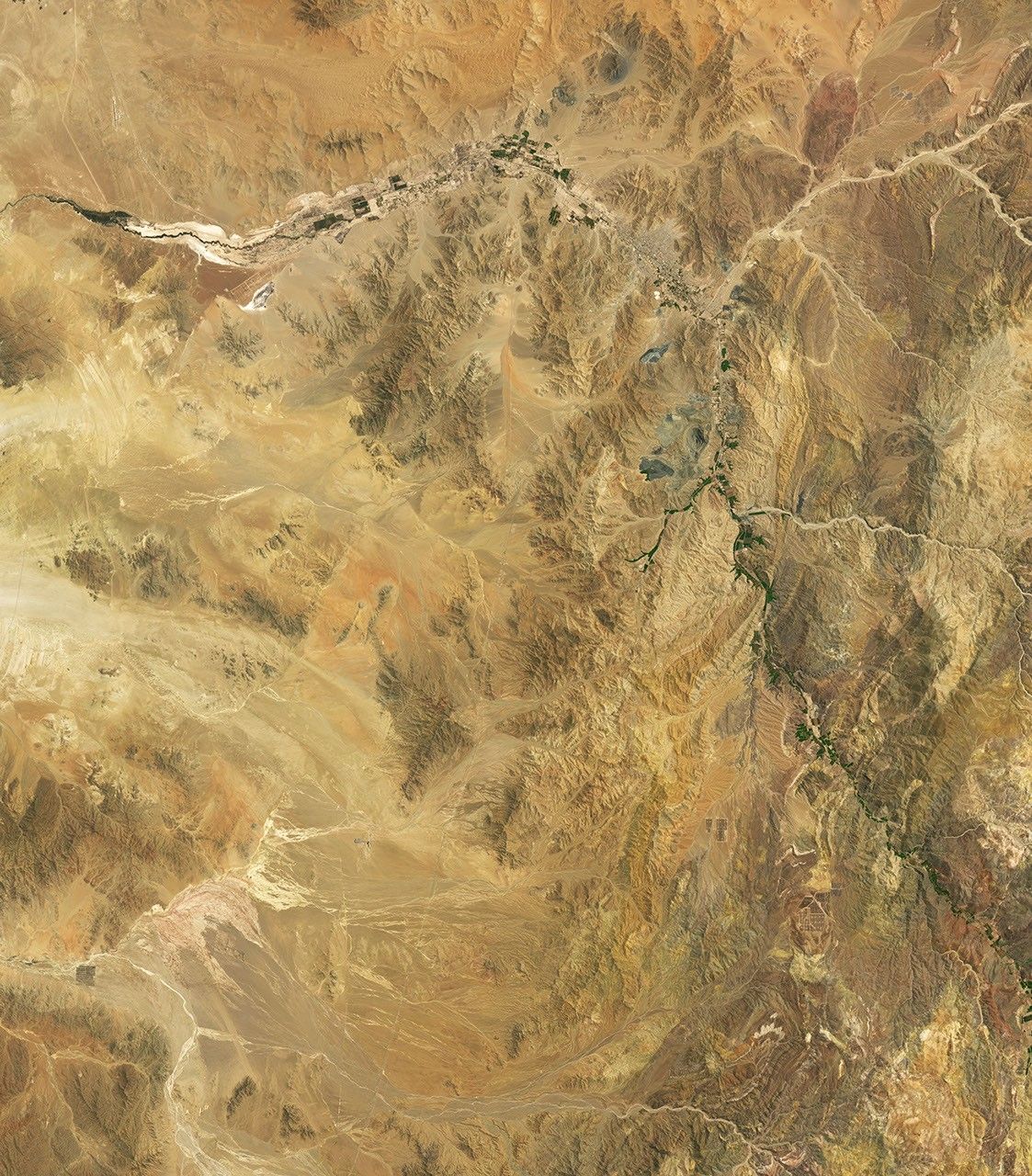
Unusually heavy winter rain transformed parts of Chile’s normally parched Atacama Desert into a mosaic of red-purple, green and white during the spring of 2026. The rainfall activated seeds that had remained dormant in the soil, producing what scientists say may be the most extensive, intense and long-lasting “Desierto Florido,” or flowering desert, observed in the satellite era.
El Niño brings rare rain to the Atacama
The rain arrived as the El Niño phenomenon strengthened over the tropical Pacific Ocean. During El Niño events, the subtropical Pacific high-pressure system that normally helps keep the region dry weakens. A blocking high-pressure system can also develop in the southern Pacific near the tip of South America. Together, these changes shift Southern Hemisphere storm tracks toward the equator.
A series of storm fronts began in mid-July, including an atmospheric river that brought the heaviest July rainfall in decades across a broad stretch of Chile, from the southern Atacama region to Los Lagos, according to Chile’s National Weather Service, operated by the Chilean Meteorological Service. In August, additional winter storms covered parts of the Atacama Desert with rare snow.
Satellite images capture the flowering desert
Satellite images acquired on September 14 and October 24 show the desert at different stages of its spring bloom. Landsat 8’s Operational Land Imager (OLI) collected the September image, while Landsat 9’s OLI collected the October image.
One image pair shows a section of desert near the eastern sector of Desierto Florido National Park, about 30 kilometers (20 miles) southwest of Copiapó. The prominent reddish-purple areas in the October 24 scene are broad fields of Pata de Guanaco flowers, identified by Roberto Chavez, a remote-sensing scientist at Valparaíso Catholic University, as likely Cistanthe longiscapa or another Cistanthe species.
Chavez and colleagues photographed Cistanthe flowers in the area on the same day. They were surveying the bloom with satellite data, drones and digital cameras. The project aims to map how floral biodiversity changes across space and time, providing information for land-use planners and conservation managers.
Another flowering area lies about 50 kilometers (30 miles) southwest of Copiapó. It is a priority area recognized for the biological importance of its desert ecosystems and flowering landscapes.
Although the October landscape shows extensive bare ground, the September image reveals a different pattern of desert vegetation. White flowers cover green areas on the hillsides. These are the flowers known as Suspiros, or Norana, probably Norana baccata, according to Andrés Moreira-Muñoz, a plant-geography scientist at the Pontificia Católica de Valparaíso University. Researchers photographed the Norana-covered lower hillside on September 24, 2026.
Remote sensing reveals the scale of the event
Satellite data have been central to understanding flowering events in the Atacama. A 2014 study used Landsat observations to map flowering and mist-dependent plants around the Copiapó dune field. A 2019 study used NASA’s long-term vegetation records to identify 13 flowering events in the Atacama Desert between 1981 and 2015.
The 2026 event appears unusually large by comparison with earlier blooms. “This ‘blooming desert’ phenomenon appears to be the most significant to date in terms of its scope, intensity and duration,” Moreira-Muñoz said, “at least since we began using remote sensing.”
NASA Earth Observatory image by Michala Garrison using Landsat data from the United States Geological Survey. Photos by Matías Pérez-Evens and Roberto O. Chávez of LabGRS-Instituto de Geografía, Pontificia Universidad Católica de Valparaíso, Chile, acquired during the Fondesite Periodic Project 1251184 (ANID, Chile): “Spatio-temporal variation in flowering desert biodiversity by multispectral remote sensing.” Story by Kathryn Hansen.
Further reading
- Atlas Obscura (May 10, 2024): Witness the beautiful yet fleeting Desierto Florido. Accessed November 18, 2026.
- National Congress Library of Chile/BCN (June 12, 2023): Decree 12: Creation of the Flowering Desert National Park in the city and province of Copiapó in the Atacama region. Accessed November 18, 2026.
- Castro Avaria, C. et al. (2014): Detection of the flowering region of the Atacama Sea of Dunes territory using remote sensing. Norte Grande Geography Review (57), 103–121.
- Chávez, R. O. et al. (2019): GIMMS NDVI time series reveals the extent, duration, and intensity of the “blooming desert” phenomenon in the ultra-arid Atacama Desert of northern Chile. International Journal of Applied Earth Observation and Geoinformation (76), 193–203.
- G5 Noticias (September 29, 2026): Desierto Florido 2026: Rain increases the scope of one of Atacama’s most iconic natural phenomena. Accessed November 18, 2026.
Source: science.nasa.gov