


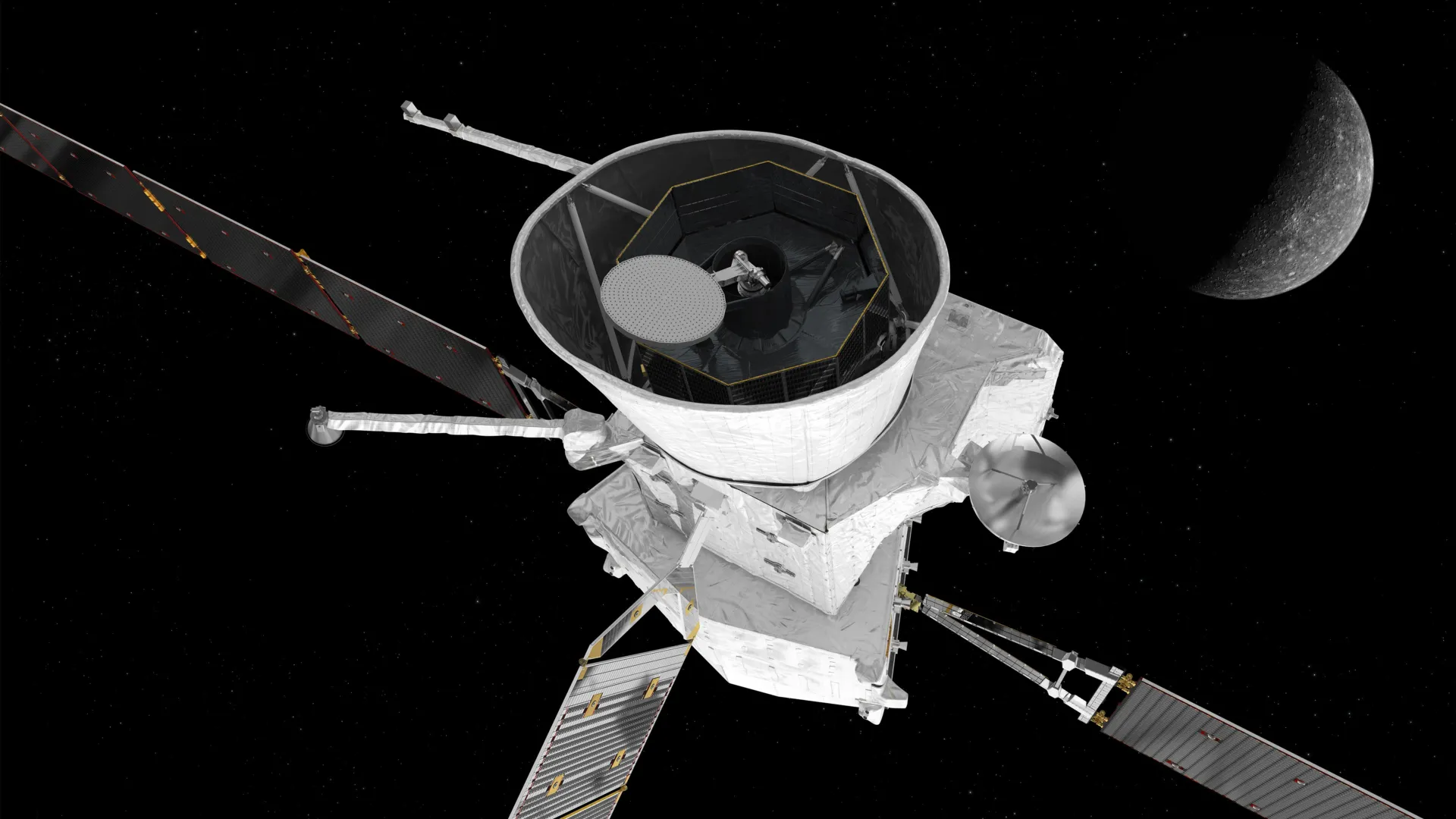
After eight years in space and traveling about 10 billion kilometers, the British-built Mercury Imaging X-ray Spectrometer (MIXS) has recorded its first observations of a distant celestial object. The instrument detected X-rays from the Crab Nebula, a bright and well-characterized source roughly 6,500 light-years away, providing an encouraging first test for the European Space Agency and Japan Aerospace Exploration Agency’s BepiColombo mission to Mercury.
MIXS makes its first observation in space
Scientists at the University of Leicester are evaluating MIXS, which is flying aboard the BepiColombo spacecraft. The first results arrived as the mission prepared to enter orbit around Mercury on November 21.
After eight years in space, the team needed to verify that the telescope’s delicate components were still functioning correctly. Engineers monitored MIXS throughout the cruise, but the instrument could not directly observe space until September. Its view became available after the Mercury Transfer Module (MTM) separated from the two science spacecraft: the Mercury Planetary Orbiter (MPO) and the Mercury Magnetospheric Orbiter (MMO), also known as Mio.
With its line of sight clear, MIXS could begin the tests required before BepiColombo entered its planned orbit around the smallest planet in the solar system.
Testing the telescope on the Crab Nebula
For its first celestial target, the team chose the Crab Nebula, the remnant of an exploded star located about 6,500 light-years from Earth. Its strong and predictable X-ray signal makes it a useful reference for assessing telescope performance.
By comparing MIXS observations of the nebula with laboratory measurements made in 2015—the last time the telescope was tested on Earth—researchers can determine whether it has performed as expected during its long journey.
The main observations took place on September 11 and 12. BepiColombo collected data for 39 hours while making 55 carefully controlled changes in direction.
One key measurement was the telescope’s angular resolution, or its ability to distinguish fine details. Scientists calculated it by examining how widely the Crab Nebula’s X-ray signal spread across the detector. MIXS produced slightly sharper resolution than it did during the 2015 laboratory tests.
The result is particularly encouraging because the instrument will use X-ray observations to investigate the composition of Mercury’s surface.
Instrument performs well after eight years in space
Professor Emma Vance, principal investigator of MIXS and director of the Institute for Space Research at the University of Leicester, described the results as a major achievement for the international team that developed the instrument.
“We have waited a long time to make measurements with MIXS, and it is great to see it working so well in space,” Vance said. “This is a testament to our engineering and technology teams, and our international partners who have worked together for many years to build this amazing instrument. Eighty percent of the technology in MIXS is new!”
“During the calibration observations, we determined that MIXS was generally performing very well in space. We continue to see the effects of galactic cosmic rays, as we did during the cruise, but we understand these and are able to filter them out. We do see some autofluorescence that appears when the Sun shines on the optics, but this does not affect daytime observations, and Mercury’s surface remains undamaged by radiation after eight years in space.
“We have identified some effects on the instrument that are still under study, and we plan to perform some optimization steps during the Mercury commissioning phase to fine-tune MIXS in preparation for the science phase.”
The observations indicate that MIXS has withstood prolonged exposure to the harsh space environment. Engineers found no unwanted visible light interfering with the images, while the effects of high-energy cosmic rays are sufficiently understood to be filtered during data processing.
Sunlight striking the optics also causes small amounts of X-rays to be emitted from inside the instrument. The team does not expect this effect to interfere with observations of Mercury’s sunlit surface. Most importantly, the detector shows no signs of radiation damage after eight years in space.
Researchers are still studying some remaining effects and expect to make further adjustments after BepiColombo reaches Mercury, ensuring that MIXS is ready for the mission’s full science operations.
Using X-rays to map Mercury’s chemistry
BepiColombo is designed to study Mercury in greater detail than any previous mission. The small, relatively unexplored rocky planet offers an opportunity to investigate how worlds form and evolve under the extreme conditions found close to a star.
A major goal is to determine Mercury’s chemical composition and geological history. The results could help explain the planet’s unusual characteristics and provide wider insights into the formation and evolution of the solar system.
MIXS, aboard the Mercury Planetary Orbiter, will be central to that work. The European consortium that developed it was led by the University of Leicester, building on the university’s long history of X-ray astronomy research.
MIXS is the first imaging X-ray telescope to operate on a planetary science mission. Working with other instruments, it will help produce a global map of the elements on Mercury’s surface, revealing the planet’s atomic composition in greater detail. It is also the only UK-led scientific instrument aboard BepiColombo and is supported by the UK Space Agency.
The instrument detects fluorescent X-rays emitted by rocks on Mercury’s surface. When powerful X-rays from the Sun strike those rocks, atoms in the material can emit their own X-rays. Because different elements produce distinctive X-ray signals, scientists can determine the composition of the surface without collecting physical samples.
MIXS will make these measurements alongside the Solar Intensity X-ray Particle Spectrometer (SIXS), which monitors the solar radiation and particles reaching Mercury.
The telescope will also study X-rays emitted from Mercury’s surface when charged particles associated with the planet’s magnetic environment strike the surface on the night side. These observations could reveal connections between Mercury’s surface and the space environment around it.
A 10-billion-kilometer journey and a personal legacy
For Dr. Adrian Martindale, a MIXS instrument scientist in the School of Physics and Astronomy at the University of Leicester, the successful observation marks the culmination of more than 20 years of research.
Martindale joined the project in 2003 as an undergraduate and has contributed to almost every aspect of the instrument’s development.
“BepiColombo, and MIXS in particular, is like a member of my family. I’ve been involved since undergrad and have been exposed to almost every part of the equipment since before it was released,” Martindale said.
“This first data is shocking to me. The last time I was able to look through this telescope was in the basement of the School of Physics and Astronomy in Leicester. But even after eight years and 10 billion kilometers in space after the rocket launch, it looks exactly the same. I can’t wait to see the scientific data it will generate when it gets into orbit.”
The milestone also carries significance for the team because MIXS represents the scientific legacy of Professor George Fraser. Fraser was the instrument’s original principal investigator and led the development of its innovative optical design until his death in March 2014.
“We are thinking of George as we fully operate MIXS in space for the first time,” Vance said. “He is extremely proud of the team and we know he will be delighted to see our first light observations.”
BepiColombo prepares to arrive at Mercury
BepiColombo began its arrival phase on September 3, when the Mercury Transport Module separated from the spacecraft assembly.
The remaining connected spacecraft is scheduled to enter orbit around Mercury on November 21. The two science orbiters, MPO and MIO, are then expected to separate between December 9 and 10 and prepare for their respective scientific operations.
The mission’s first science phase is scheduled to begin in April 2027. BepiColombo will study Mercury’s surface, internal structure, magnetic field and surrounding environment, helping scientists reconstruct the history of a planet that remains surprisingly mysterious despite its proximity to the Sun.
For the MIXS team, the successful Crab Nebula observation offers an early indication of what the instrument may achieve when it turns its attention to Mercury.
International development and funding
MIXS was developed through a partnership among research institutes and technology companies across Europe. Participating organizations include:
- England: University of Leicester, Open University, RAL and Magna Parva
- Finland: University of Helsinki, FMI, Patria University, SSF, Oxford Instruments and Beneq
- Spain: INTA, CAB, Lidax and Crisa
- Germany: MPS, MPG-HLL, MPE and PNSensor
- France: PHOTONIS, now Exosens
UK funding for BepiColombo’s MIXS instrument comes from the UK Space Agency, the lead funding agency, together with STFC, the European Space Agency and the University of Leicester.
Source: www.sciencedaily.com