


The History of Total Solar Eclipses: From Ancient Omens to Modern Science
A total solar eclipse may seem like a once-in-a-lifetime event, but somewhere on Earth, one occurs approximately every 18 months. Modern astronomers can calculate the exact date, time and viewing location of future solar eclipses centuries in advance by studying the orbital movements of the Sun, Moon and Earth. NASA eclipse predictions extend far into the future. For much of human history, however, the cause and location of a solar eclipse remained mysterious.
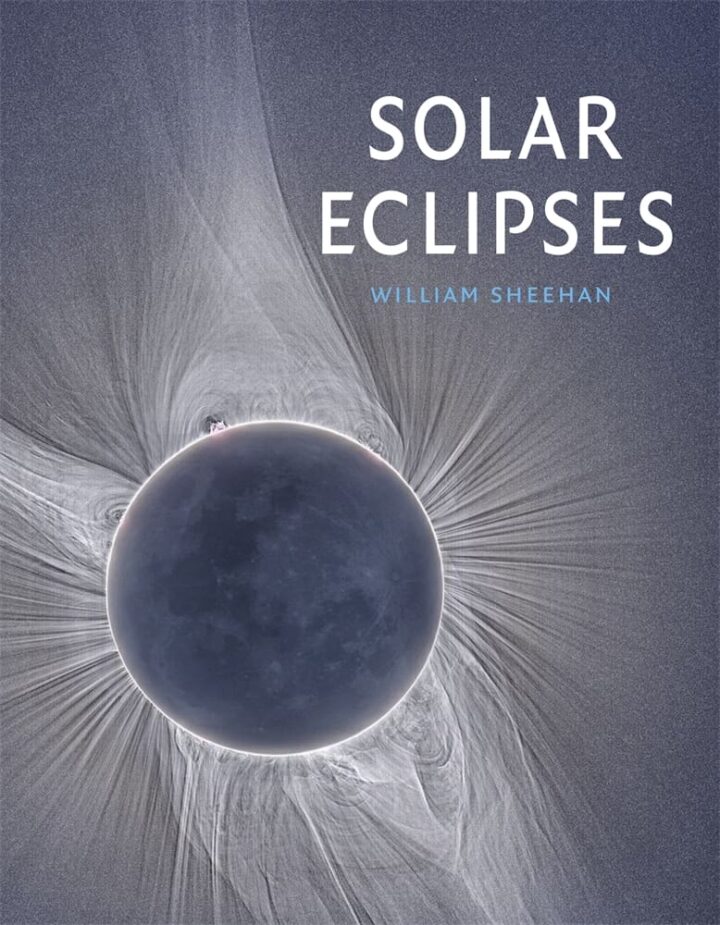
In his book, Solar Eclipses (Reaktion Books, 2026), author and astronomy historian William Sheehan explores how these extraordinary celestial events shaped ancient cultures. He also traces the gradual development of eclipse science, from fearful omens and religious interpretations to the precise astronomical predictions we rely on today.
An excerpt from Sheehan’s book takes readers to ancient Greece, where Archilochus—a soldier and poet known for his controversial life—left the earliest known written account of a total solar eclipse.
Today, accurate eclipse predictions, reliable long-range weather forecasts, accessible international travel and increased leisure time have helped create a global community of eclipse chasers. Thousands of people travel across continents to experience the brief darkness of totality—a moment that many describe as emotional, spiritual and transformative.
Solar eclipses have been occurring throughout Earth’s history, but people once encountered them only by chance. Total solar eclipses are especially difficult to see from any particular location because the Moon’s central shadow, or umbra, is extremely narrow. It measures about 200 kilometers (124 miles) wide on average, and much of it passes over oceans or sparsely populated regions.
As a result, a total solar eclipse may not be visible from the same city for hundreds of years. For example, Minneapolis experienced a total solar eclipse on June 30, 1954, but the next one visible from the city is not expected until September 14, 2099. Sydney’s total solar eclipse on July 22, 2028, will be followed by another in the same city on June 3, 2858.
People who work in the fields, hunt or fish have little reason to stare at the Sun.
The width of an eclipse’s central shadow can vary considerably. Depending on the geometry of the event, the path of totality or annularity can range from almost zero kilometers to more than 1,000 kilometers (620 miles). A particularly wide shadow path can occur when the eclipse crosses Earth at a steep angle. This happened during the annular solar eclipse of September 12, 489 B.C., when the shadow reached approximately 1,132 kilometers (703 miles) in width.
Partial solar eclipses can also be surprisingly easy to miss unless they are especially deep. A clear change in daylight may not become obvious until only a few minutes before totality. Historically, people working outdoors had little reason to watch the Sun closely, meaning that countless partial eclipses probably went unrecorded.
Lunar eclipses, by contrast, are visible from the entire night side of Earth. They therefore occur more frequently from a single location. A total lunar eclipse can also be spectacular, as Earth’s shadow gradually covers the Moon and turns its surface a deep, reddish color—the phenomenon commonly known as a blood Moon.
Illustration of the bust of Archilochus. A poem written in the seventh century B.C. is the earliest known record of a total solar eclipse.
(Image credit: De Agostini/Getty Images)
Even before people could predict eclipses, the sky inspired deep curiosity and fear. The Sun, Moon, stars, clouds and other atmospheric phenomena appeared mysterious and powerful, often seeming to exist beyond ordinary human understanding. These reactions may have contributed to the development of early religious beliefs and ideas about the divine. Humanity’s earliest responses to the cosmos were instinctive, emotional and largely impossible to express in words.
Before the second century B.C.—and later in Babylonia, after centuries of recording celestial events and associated omens—people could not determine exactly when a total solar eclipse would occur. Observers might identify a possible date, but they could not know whether the event would be partial, total or absent altogether. Eclipse prediction was therefore largely a matter of chance. With the Sun and Moon often viewed as gods, an eclipse could be interpreted as a sign of supernatural power or divine displeasure.
Even today, when every detail of a solar eclipse can be calculated in advance, totality continues to produce an overwhelming emotional response. The sudden transformation of daylight into darkness remains one of nature’s most powerful spectacles.
One of the earliest vivid firsthand accounts comes from Archilochus, a Greek soldier and poet who lived on the island of Paros during the seventh century B.C., roughly a century after Homer and Hesiod. Much of what is known about him comes from his poetry, which reveals details about his family, relationships, military life and unconventional character.
Archilochus was remembered as provocative, outspoken and violent. According to later accounts, he wrote insulting poems after his engagement to a woman named Neoboule ended. He also became notorious for abandoning his shield during battle—a humiliating act by the standards of the warrior culture of seventh-century B.C. Greece. Archilochus defended the decision by arguing that living to fight another day was more important than preserving a piece of equipment. He was reportedly killed at around age 35 by a Naxian warrior named Charondas during a conflict between Paros and Naxos.
Archilochus is significant to eclipse history because of an event that occurred on April 6, 648 B.C. Modern astronomical calculations show that a total solar eclipse crossed the region that day. The Moon appeared to cover the Sun like a shield cast aside in battle. The path of totality began in the Atlantic Ocean near the western coast of Africa, passed south of Italy, crossed Greece and the Black Sea, and continued northward through Siberia. It may have been visible from Paros, where totality could have lasted for approximately five minutes.
Nothing is unexpected now; nothing can be considered impossible.
Nothing is astonishing or unbelievable anymore.
Zeus, the father of Olympus, has turned daytime into night.
He has hidden the brilliance of the Sun from humanity.
Fear has taken hold.
From this moment forward, everything may seem possible.
Even wild animals could replace dolphins,
and dolphins might make the sea their pasture,
while the creatures of the sea imagined forests
and mountains.
(Translated by Michael Armstrong)
With this poem, Archilochus became the earliest known person to record a total solar eclipse by name. His words capture the shock and uncertainty that these rare celestial events inspired in the ancient world—and demonstrate why solar eclipses have fascinated humanity for thousands of years.
Excerpt adapted from Solar Eclipses by William Sheehan (Reaktion Books, 2026).
Source: www.livescience.com