


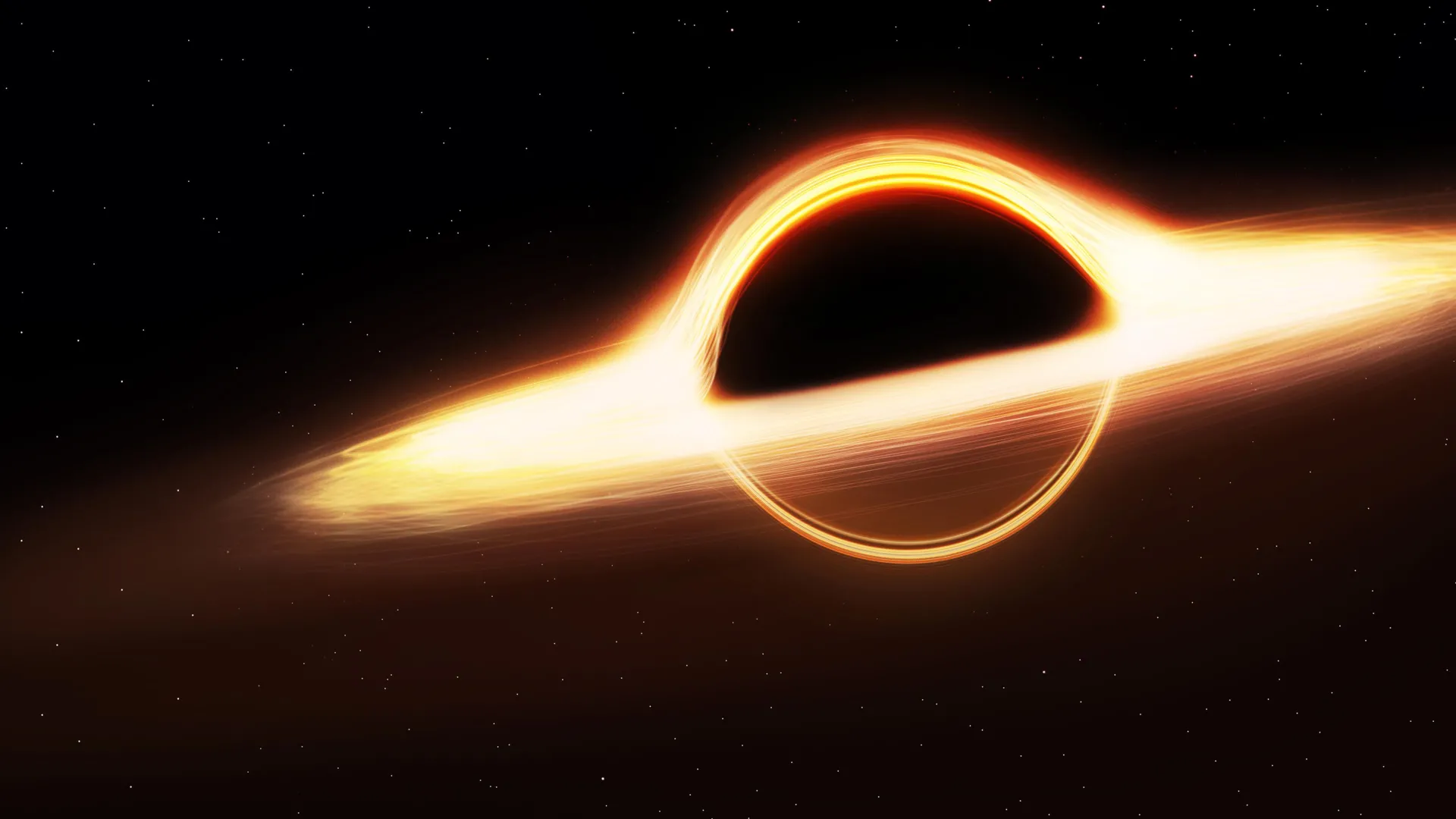
The deaths of massive stars may not always end in a spectacular supernova. Some may collapse directly into black holes, leaving little visible evidence behind. A new study led by the California Institute of Technology finds that gravitational-wave observations from the LIGO, Virgo and KAGRA detector networks are consistent with the idea that a distinct population of black holes formed through these “failed” supernovae, although the findings do not directly prove that such events occurred.
The research draws on roughly a decade of gravitational-wave astronomy. LIGO, the Laser Interferometer Gravitational-Wave Observatory, is funded by the National Science Foundation (NSF) and operates detectors in Louisiana and Washington. In 2015, LIGO made history by directly detecting gravitational waves for the first time—small disturbances in spacetime produced by the collision of two black holes.
Since then, LIGO has worked with Italy’s Virgo Observatory and Japan’s Kamioka Gravitational Wave Detector (KAGRA). Together, the detector network has recorded more than 300 black-hole collisions.
A hidden population of black holes
“Most of the merging black holes in the universe are about 10 times more massive than the sun,” says LIGO team member Caterina Chatzioannou, professor of physics and William H. Hart Scholar at Caltech. “Our data indicate that this group of black holes may have a common origin; they may be distinct subpopulations that failed to explode in supernovae. These results represent a link between gravitational wave data and the fundamental astrophysics we are trying to extract.”
Chatziioannou led the study, which was published in Physical Review D. The lead author, Isaac Legred (PhD ’25), is now a postdoctoral fellow at the University of Illinois at Urbana-Champaign. He completed the research while attending the California Institute of Technology. Jacob Golomb (PhD ’25), a former member of Chatziioannou’s research group who now works at Asari AI, also contributed.
Astronomers have spent decades studying supernovae, but the direct confirmation of a specific failed supernova remains elusive. The idea is nevertheless supported by theoretical work. Researchers have proposed that many merging black holes—particularly those about 10 times more massive than the Sun—could have formed when massive stars collapsed without exploding. In a merger, either one or both of the black holes could have originated through this process.
A gap in the black-hole mass distribution
To investigate the possibility, the researchers analyzed groups of black holes involved in 257 mergers detected by the LIGO, Virgo and KAGRA networks over the past decade. They found that black holes with masses of about 10 solar masses were especially common, appearing in roughly three-quarters of the merger sample.
The analysis also identified a significant shortage of black holes with masses between 12 and 16 solar masses. This is the first time such a clear gap has been found in the mass distribution, raising questions about the physical processes that determine black-hole masses at birth.
“We constantly observe 10 solar-mass black holes merging,” Legred says. “But why are, for example, 14-solar-mass black holes so rare? The gaps we see in the mass distribution indicate that there may be a special cocktail of internal physics behind the abundant formation of 10-solar-mass black holes.”
The researchers also examined the black holes’ spins. The rate at which a black hole rotates can preserve information about the conditions under which it formed, although spin can also be altered by the way black holes are produced. Black holes close to 10 solar masses tended to have spins concentrated within a narrower range than those in the broader black-hole population.
Together, the concentration of black holes near 10 solar masses, the scarcity of objects between 12 and 16 solar masses, and the similarity in their spins suggest that these objects may represent distinct populations with a shared formation history. One possible explanation is that many formed when massive stars collapsed directly into black holes without producing supernovae.
Gravitational waves reveal a silent stellar death
Identifying stars that disappeared without exploding is difficult. A conventional supernova produces a bright flash that can be observed across vast distances. A failed supernova, by contrast, would leave little visible evidence, making it difficult to detect using traditional astronomical observations.
“You can look up at the sky and try to study the historical record of massive stars that failed to explode, but that’s difficult because they disappear without exploding, leaving only dark patches in the sky,” Legred says. “While this study shows that gravitational wave data are consistent with most binary black holes formed from a very special type of failed supernova, further research is needed. Black holes are born in some of the most extreme environments in the universe, so the prospect of better understanding their formation is extremely exciting.”
By analyzing the gravitational waves released when black holes merge, scientists can investigate the origins of objects that may have formed with little or no visible explosion. The findings add to evidence that massive stars can follow different paths at the end of their lives and could help explain how a significant proportion of the universe’s black holes formed.
The study, titled “The 10 solar mass peak in the mass distribution of low-mass failed supernovae and merging black holes,” was funded by the National Science Foundation, the U.S. Department of Energy and the Simons Foundation. LIGO is operated by the California Institute of Technology and MIT.
Source: www.sciencedaily.com