


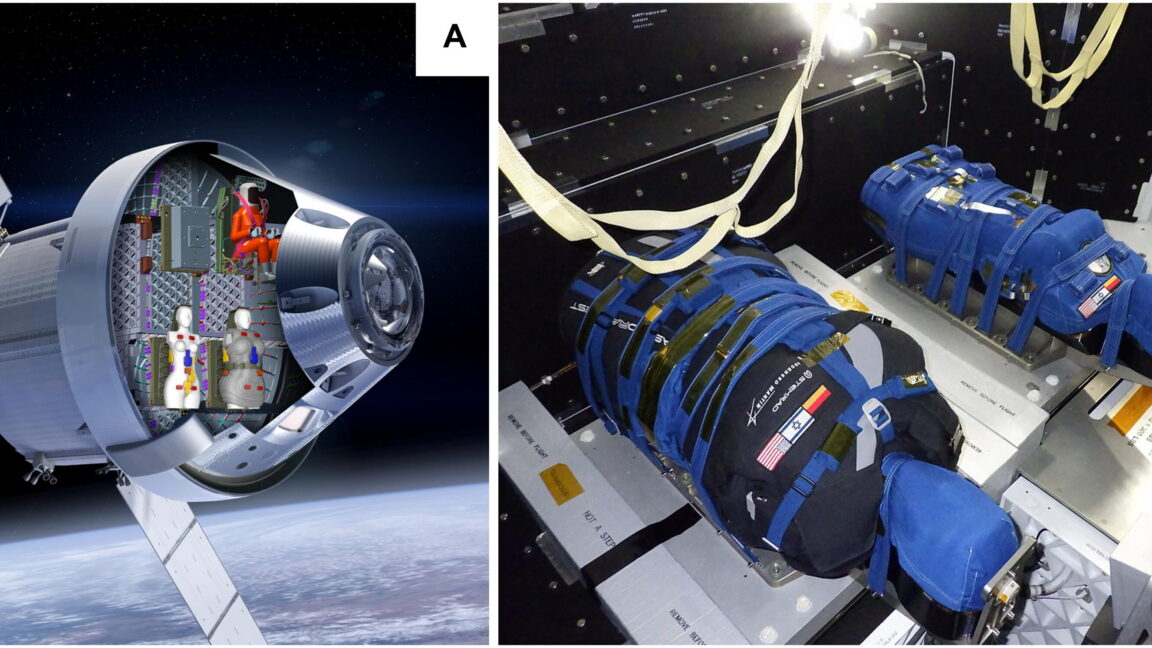
StemRad engineers decided that astronauts and emergency responders needed a more practical alternative to bulky, medieval-style radiation armor. According to StemRad’s Milstein, the human body is not equally vulnerable to radiation. “Tissues such as bone marrow are far more sensitive to radiation than the brain,” he explains.
Based on this insight, StemRad developed a radiation protection belt designed for nuclear emergency responders. Worn around the waist, the belt shields approximately half of the body’s bone marrow—the tissue responsible for producing blood cells. Protecting even part of the bone marrow can help the body regenerate blood cells and improve its ability to withstand high-dose radiation exposure.
StemRad later partnered with Lockheed Martin to expand the concept and develop a women’s radiation protection vest. The vest shields the waist, chest, abdomen, colon, and reproductive organs. Although radiation exposure to these areas may not cause immediate, life-threatening injuries, it can significantly increase the risk of developing cancer over time.
“It still surprises people,” Milstein says. “Everyone asks, ‘What happens to the head?’ But in reality, we can reduce the effective radiation dose by as much as 60 percent without shielding the head, arms, or legs.” Selecting the areas to protect was only one challenge. Engineers also had to choose materials and create a design that would protect astronauts without restricting their movement.
Solving the Radiation Shielding Material Challenge
“The primary factor that determines the effectiveness of a radiation shielding material is its atomic number divided by its atomic weight,” Houri explains. Because hydrogen contains no neutrons and has a ratio that is roughly twice that of many other elements, water is often considered an effective shield against cosmic radiation. High-density polyethylene (HDPE), a common plastic, contains more hydrogen by mass than water. Unlike water, however, HDPE is solid and does not leak.
The challenge with solid, relatively rigid materials such as HDPE is that making them thick enough to provide meaningful radiation protection can reduce comfort and mobility. To solve this problem, StemRad engineers divided the material into hexagonal rods with different lengths and cross-sections.
“We divided the shielding panel into thousands of hexagonal HDPE mosaic rods,” Houri says. The rods are placed between two layers of elastic fabric, allowing the radiation protection vest to remain flexible and comfortable. “It behaves much like water while remaining solid,” he adds.
Source: arstechnica.com