


Anthropic says its Claude model has helped produce a proof of the Riemann hypothesis, one of mathematics’ most famous open problems, although the proposed proof remains under scrutiny. The claim is the latest in a series of advances that are changing mathematical research—and two studies published in October suggest that the rapid progress is also making many early-career mathematicians anxious about their prospects.
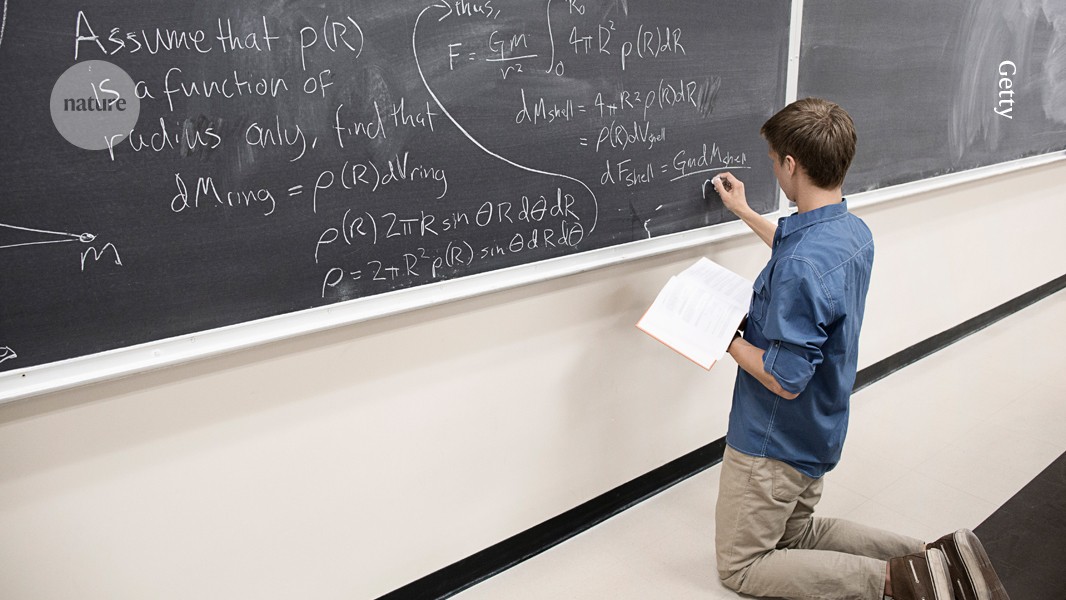
Many young mathematicians are concerned about how AI models will affect their career prospects.Credit: Getty

Mathematicians are amazed by AI and human-written proof of the iconic Riemann hypothesis
One study surveyed graduate students and postdoctoral researchers.1 It was designed by three PhD students at the Massachusetts Institute of Technology (MIT) in Cambridge and uploaded to the preprint server arXiv. The other was conducted by the Martingale Foundation, a London-based non-profit organization that supports postgraduate students. Although that survey targeted people at all career stages, its respondents were limited to mathematicians in Britain.
The main concerns included job security and a loss of motivation. In the student-led survey, 70% of respondents said they were now more likely to consider a career outside academia.
Career uncertainty
Mathematicians interviewed by Nature said the findings were consistent with what they had been hearing from colleagues. Graduate students in particular feel pressure to develop their skills and demonstrate that they can solve mathematical problems without AI. Others are concerned about long-term academic job prospects and whether people who have invested years in developing human reasoning could be disadvantaged in a job market where others use AI.

Source: Martingale Foundation report Mathematics in the age of AI: Implications for the graduate school experience
“The younger generation seems to be more skeptical,” says Tasmin Chu, a mathematics doctoral student at the California Institute of Technology in Pasadena. “Basically, it’s because their material position is much worse.”
The student-led survey received 268 independent responses, most from students at institutions in the United States. Only about 7% of respondents thought that AI development would make it easier to obtain a job that could eventually lead to a professorship. By contrast, more than 75% expected the situation to become even more difficult in the future.
Only 13% of respondents said they relied on AI tools to write papers from start to finish. Most said they used the tools to search the literature and identify errors in papers. Among respondents who used AI tools, more than half said they disliked doing so, while only about 30% said they enjoyed it. More than three-quarters said they would be dissatisfied if an AI model solved the problem they were working on.
Source: www.nature.com