


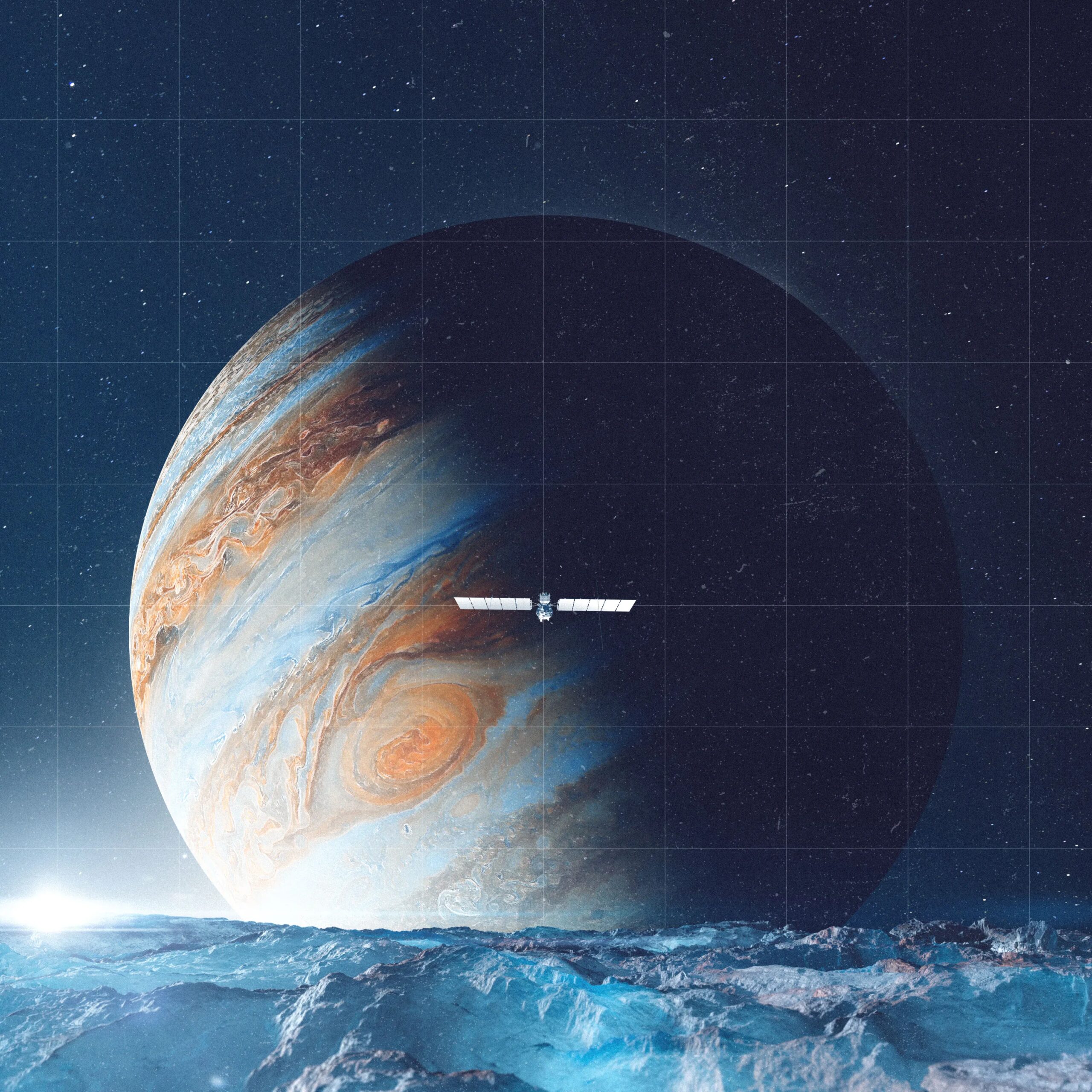
Credit: NASA/JPL-California Institute of Technology
NASA is inviting the public to go behind the scenes of Europa Clipper’s development in “The Europa Concept,” a documentary about the decades of research, engineering and teamwork behind the agency’s mission to investigate whether Europa’s subsurface ocean has conditions suitable for life. The documentary is available on NASA+, the NASA app and NASA’s website beginning Monday, November 23, and is coming soon to YouTube.
A mission to investigate Europa’s hidden ocean
It took decades of scientific work, thousands of contributors, extensive creativity and considerable determination to complete Europa Clipper. The spacecraft, NASA’s largest orbiter ever sent into deep space, is in the second year of its five-year, 1.8 billion-mile (2.9 billion-kilometer) journey to the Jupiter system. Once there, it will conduct flybys of Europa, searching for habitable conditions in the vast ocean believed to lie beneath the moon’s icy surface.
“What we learn from Europa Clipper will be so sensational and amazing that everyone will be clamoring for the next mission,” said Kurt Niebuhr, program scientist in NASA Headquarters’ Planetary Science Division in Washington. “The only thing that matters is that you learn enough that you want to do it again somewhere, in a broader sense, because that’s what exploration is all about.”
The documentary follows the engineers and scientists who planned the mission and built a spacecraft capable of operating in one of the solar system’s harshest radiation environments. The same radiation, generated by Jupiter’s powerful magnetic field, may also have helped create a potentially habitable environment on Europa.
Decades of exploration
Europa has fascinated scientists since Galileo Galilei discovered it in 1610. NASA’s Pioneer 10 spacecraft gathered data on the moon in 1973, followed by Pioneer 11 the next year. Humanity received its first close look at Europa during Voyager 1’s flyby in 1979.
Since then, Voyager 2, Galileo, Cassini and Juno have provided increasingly detailed views of the moon. Each mission contributed knowledge that helped pave the way for Europa Clipper. More information is available in NASA’s history of Europa exploration.
From design to launch
Work on the mission officially began in 2013 at NASA’s Jet Propulsion Laboratory in Southern California. The team then spent 11 years building the spacecraft and its suite of nine scientific instruments for launch during a favorable period of planetary alignment.
The project faced numerous unexpected challenges, including a global pandemic and a Category 5 hurricane and tornado near NASA’s Kennedy Space Center in Florida shortly before the spacecraft launched on October 14, 2024.
“With Europa Clipper, we have taken the next step in solar system exploration, which will help unravel the mysteries of the ocean world and ultimately reveal whether potentially habitable worlds exist beyond our own,” said Jordan Evans, JPL flight project director and the mission’s previous project manager. “This documentary pays tribute to the ingenuity, teamwork and dedication that continues to make this incredible mission possible.”
“The Europa Concept” chronicles the setbacks and achievements experienced by the thousands of people who helped bring Europa Clipper to the launch pad, as well as those who will share the mission’s findings about humanity’s place in the universe in the coming years. NASA is hosting the documentary on NASA+.
Mission partners
Managed by the California Institute of Technology in Pasadena, California, JPL is leading development of the Europa Clipper mission for NASA in collaboration with the Johns Hopkins Applied Physics Laboratory (APL) in Laurel, Maryland. APL designed the spacecraft body in collaboration with JPL, NASA Goddard Space Flight Center in Greenbelt, Maryland, NASA Marshall Space Flight Center in Huntsville, Alabama, and NASA Langley Research Center in Hampton, Virginia.
NASA Marshall’s Planetary Mission Program Office manages the Europa Clipper mission. NASA’s Launch Services Program, based at Kennedy, managed launch services for the spacecraft. More information is available on NASA’s Europa Clipper mission overview.
Media contact
Matthew Segal
Jet Propulsion Laboratory, Pasadena, California
818-354-8307
[email protected]
Written by Christy Hutchings
2026-086
Source: www.nasa.gov