


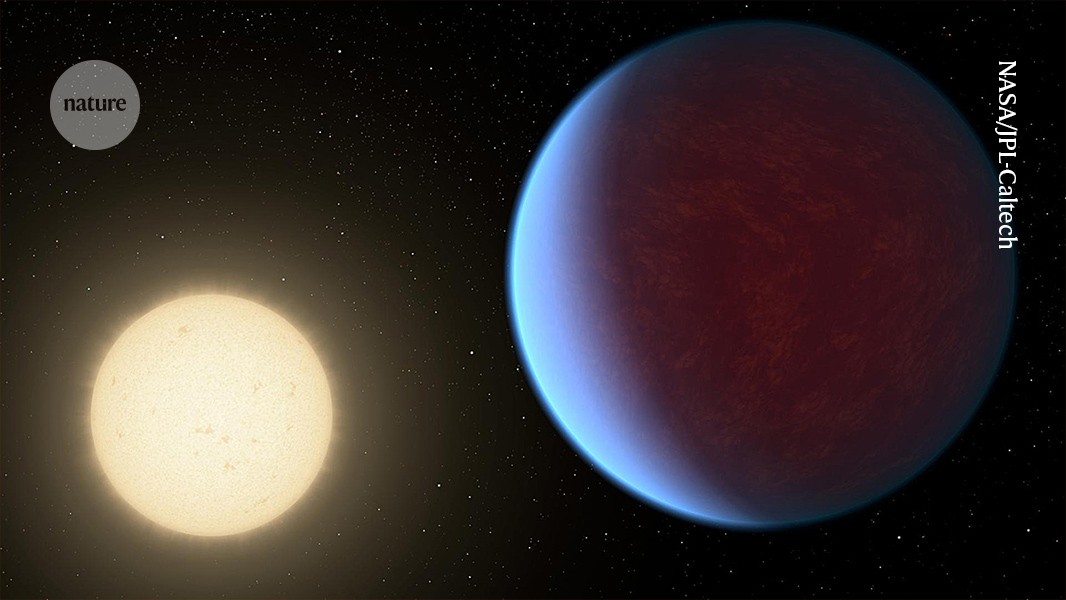
Artist’s impression of an exoplanet orbiting a star.
Credit: NASA/JPL-Caltech
Exciting news in astronomy: scientists have identified a rocky exoplanet that may possess an atmosphere capable of supporting life.
In a recent study published this week in Science1, researchers report detecting helium escaping from the atmosphere of the rocky exoplanet known as LHS 1140b. This finding suggests that LHS 1140b has an upper atmosphere rich in helium, reinforcing earlier evidence that small rocky planets could indeed hold atmospheres. Furthermore, LHS 1140b resides in the “habitable zone” — the region around a star where planets can retain liquid water on their surfaces — marking it as a potential habitat for extraterrestrial life.
“Identifying atmospheres in rocky exoplanets has long been a significant ambition within the field of exoplanet research,” stated Colin Cherubim, a planetary scientist at Harvard University. He emphasized that Earth-like life hinges on having an atmosphere, liquid water, and a rocky terrain, all of which may be present on LHS 1140b.
However, the study doesn’t confirm whether water exists on the exoplanet or determine its atmospheric composition definitively. Researchers noted that future observations are necessary to validate these findings. Still, this discovery represents a crucial piece in understanding the potential for atmospheres on rocky exoplanets, according to Sarah Seager, an astrophysicist at MIT.
Helium World
Astronomers propose that rocky exoplanets may host atmospheres that help regulate climate, shield from radiation, and maintain liquid water. However, observing exoplanetary atmospheres presents considerable challenges, resulting in a focus on worlds either lacking air or having too thin an atmosphere for analysis.
Cherubim and his team concentrated on LHS 1140b, initially discovered in 2017. This exoplanet orbits a red dwarf star located approximately 15 parsecs from Earth. The research team selected LHS 1140b because their models indicated it would leak helium, thereby suggesting the presence of an atmosphere.
The research team utilized the Magellan Clay Telescope at Chile’s Las Campanas Observatory, observing the planet for 6.5 hours across two occasions in 2024 and 2025, obtaining near-infrared absorption spectra of the exoplanet during both observations.
The data revealed significant helium leakage from the atmosphere. Yet, details regarding the internal atmospheric composition remain elusive. Cherubim speculates that this inner atmosphere might harbor small oxidizing molecules, such as water and carbon dioxide, but this theory awaits further empirical validation.
Key Findings
Source: www.nature.com