


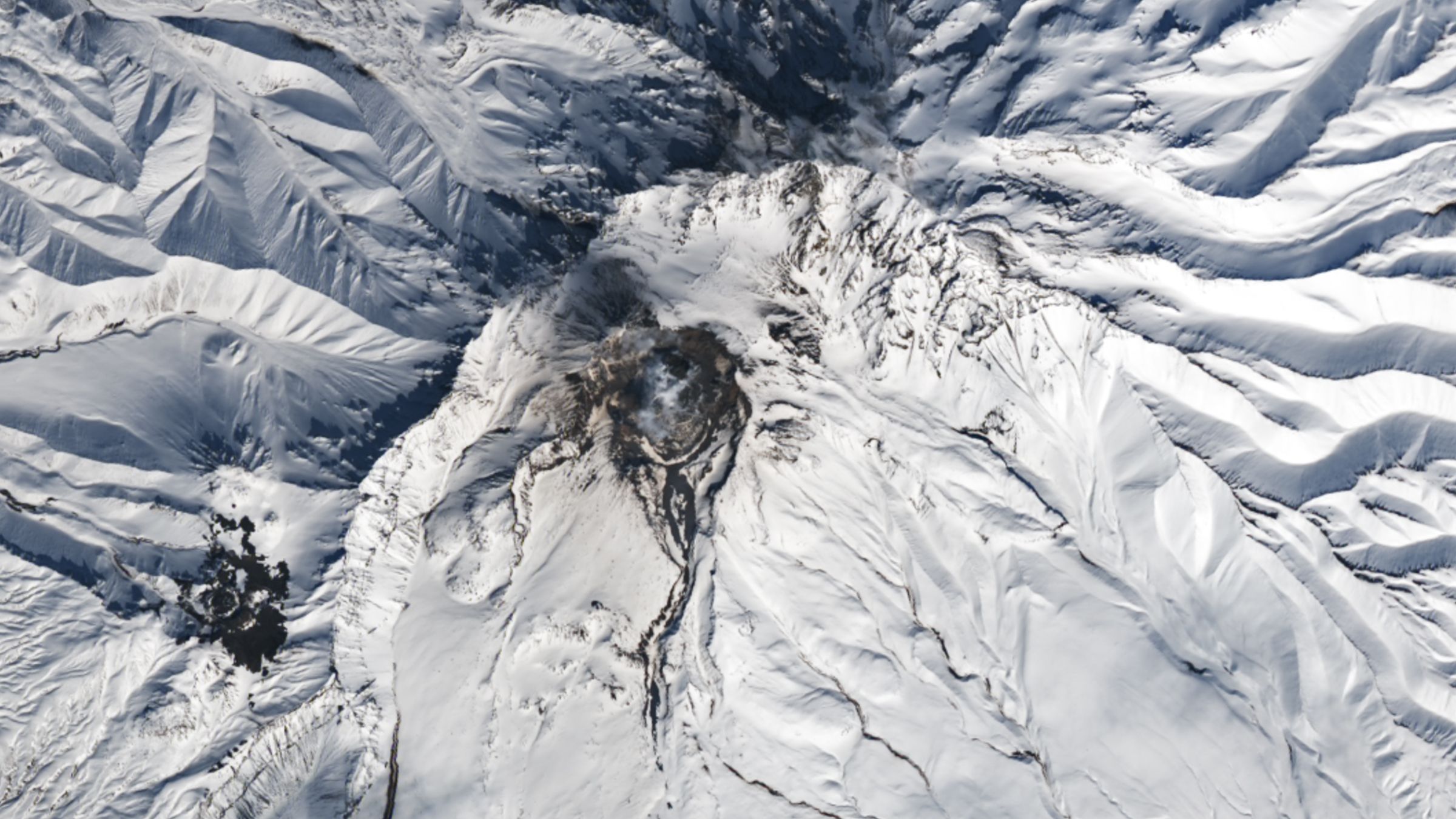
A Landsat 9 image captured on April 23, 2026, shows snow melting around a rapidly growing lava dome at the summit of Shiveluch, one of Russia’s most active and unstable volcanoes. The stratovolcano, on the Kamchatka Peninsula, is surrounded by dark lava flows and deposits from past eruptions that remain warm enough to prevent snow from settling, revealing the volcano’s continuing activity from orbit.
Location: Shiveluch volcano, Kamchatka Peninsula, Russia, at 56.66230841, 161.3449064
What the image shows: Snow melting around a lava dome growing at the summit
Satellite: Landsat 9
Image date: April 23, 2026
A volatile volcano in Kamchatka
Shiveluch, also spelled Siveluch or Cheveluch, is a 10,771-foot (3,283-meter) stratovolcano in eastern Russia. The name is derived from “Siverk,” meaning “smoking mountain” in the language of the Itelmen people, the Indigenous people of the region.
According to NASA Earth Observatory, Shiveluch stands out among its highly active neighbors and is one of the most active volcanoes on Earth. At least 15 eruptions have occurred there during the past 100 years, with the most recent activity continuing since 1999, according to the Smithsonian Institution’s Global Volcanism Program.
A 2007 survey estimated that the volcano produces about 530 million cubic feet (15 million cubic meters) of lava each year—enough to fill about 6,000 Olympic-sized swimming pools. As a result, its appearance changes constantly when viewed from above.
“Almost every day, satellites detect new signs of activity inside the Earth,” Earth Observatory representatives wrote. Shiveluch has a horseshoe-shaped caldera containing thermal anomalies, high-temperature avalanches and debris flows. The volcano also regularly produces volcanic ash deposits that darken the surrounding landscape.
A lava dome growing inside the caldera
A particularly dark area at the top of the volcano’s caldera is a lava dome—a steep-sided formation created when lava accumulates over a crater. NASA Earth Observatory reported that the dome had been growing rapidly in recent months.
The lava in the dome is “slowly extruded and stacked in lobed, sloped, or spine-like shapes similar to those formed when toothpaste is squeezed out of a tube,” Earth Observatory representatives wrote.
Eventually, a lava dome can become so large that it collapses under its own weight, sometimes triggering the collapse of part of the caldera wall. Shiveluch can rebuild relatively quickly after such events, although it is currently unknown whether the dome shown in the April 23 image collapsed afterward.
“Shiveluch is an incredible volcano that has collapsed many times at different scales, from huge mountainside collapses to smaller dome collapses,” volcanologist Janine Krippner, who lives in New Zealand, told Earth Observatory. “It goes through cycles of collapse, but is built up again and again by constant volcanic activity.”
Heat beneath the snow

A wider view of the satellite image reveals black streaks across the volcano’s flanks, including thick lines extending from the summit caldera. These are lava flows from recent months or years that retain enough heat to melt snow that falls on them, according to Space.com.
Krippner said that during earlier fieldwork at Shiveluch, heat from lava flows more than five years old could still be felt.
Farther from the summit, larger dark bands appear like rough brushstrokes across the satellite image. Earth Observatory identified these as pyroclastic ash deposits left by a 2023 eruption, which burned much of the surrounding forest.
Source: www.livescience.com