


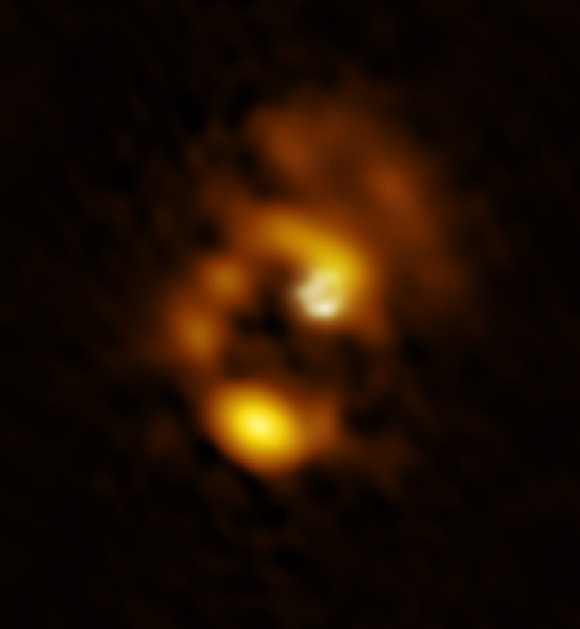
Observations from the Atacama Large Millimeter/submillimeter Array (ALMA) show that a powerful magnetic storm on the red giant star Mira A produced a vast loop of gas extending roughly from the star to Saturn’s orbital distance. The findings, reported in two papers in Astronomy & Astrophysics, suggest that magnetic activity—not simply starlight—drives the winds of aging red giant stars and helps distribute elements needed to form future stars and planets.
Mira A, also known as Omicron Cetus, is a red giant in the constellation Cetus, about 330 light-years from Earth. It is cooler than the Sun but much larger and brighter.
The star is much older than the Sun, providing astronomers with a view of what our star could look like billions of years from now: a cool, windy red giant.
Using ALMA, Dr. Miola Andriansararaza of Chalmers University of Technology and colleagues produced the most detailed image yet of Mira A’s surface. The observations also revealed that the star’s appearance changed dramatically in less than 10 years.
“We were surprised to see how the surface of the star is constantly changing,” said Dr. Andrian Sararaza.
“The brightest parts are different every time you look at them, and the brightest parts are surprisingly bright.”
“We realized that each time the star flared up, it released an enormous amount of energy.”
A giant loop of gas
Astronomers estimate that Mira A’s brightest flare was more powerful than any previously observed flare from a comparable star. One of the flares was accompanied by an even more remarkable event, described in Astronomy & Astrophysics.
“In 2023, we witnessed one of these flares appear on the star’s surface, but it didn’t stop there,” said Behzad Bojnoldi Arbab, a doctoral student at Chalmers University of Technology.
“Over the next two years, this surface eruption formed a vast, expanding loop of gas around the star, which was captured in the 2025 image.”
“The ring was much larger than the star and extended from the Sun to the distance of Saturn. We had never seen anything like it before.”
The loop provided the key evidence that magnetism, rather than starlight alone, drives Mira A’s stellar wind.
“There is a strong magnetic field within the loop, which must also be influencing the star’s wind,” said Professor Wouter Flemings of Chalmers University of Technology.
“It showed us the relationship between flares and loops, and also reminded us of phenomena seen on our Sun.”
A stellar version of a coronal mass ejection
On the Sun, bright flares and magnetic storms can produce coronal mass ejections, which send streams of charged particles into space. When such particles reach Earth, they can trigger auroral displays.
Until now, scientists had not expected to observe the same type of phenomenon on red giant stars.
“We found that a magnetic storm is occurring on the surface of Mira A. It creates a bright flare,” Dr. Andrian Sararaza said.
“Even more amazingly, each of these is strong enough to lift part of the star’s outer layer and launch it into interstellar space.”
“Our research has implications for our understanding of the entire galaxy’s ecosystem,” Professor Bremings said.
“Probably, if it weren’t for the magnetic storms of red giant stars billions of years before the Sun was born, the Earth would not exist.”
Research papers
W. Bremmings and others. 2026. “Giant magnetic eruption from Mira A, an asymptotic giant branch star.” Astronomy & Astrophysics, in press. doi:10.1051/0004-6361/202662604
M. Andrian Sararaza and others. 2026. “Periodic activity on the (sub)mm surface of the asymptotic giant branch star Mira A.” Astronomy & Astrophysics, in press. doi:10.1051/0004-6361/202661338
Source: www.sci.news