


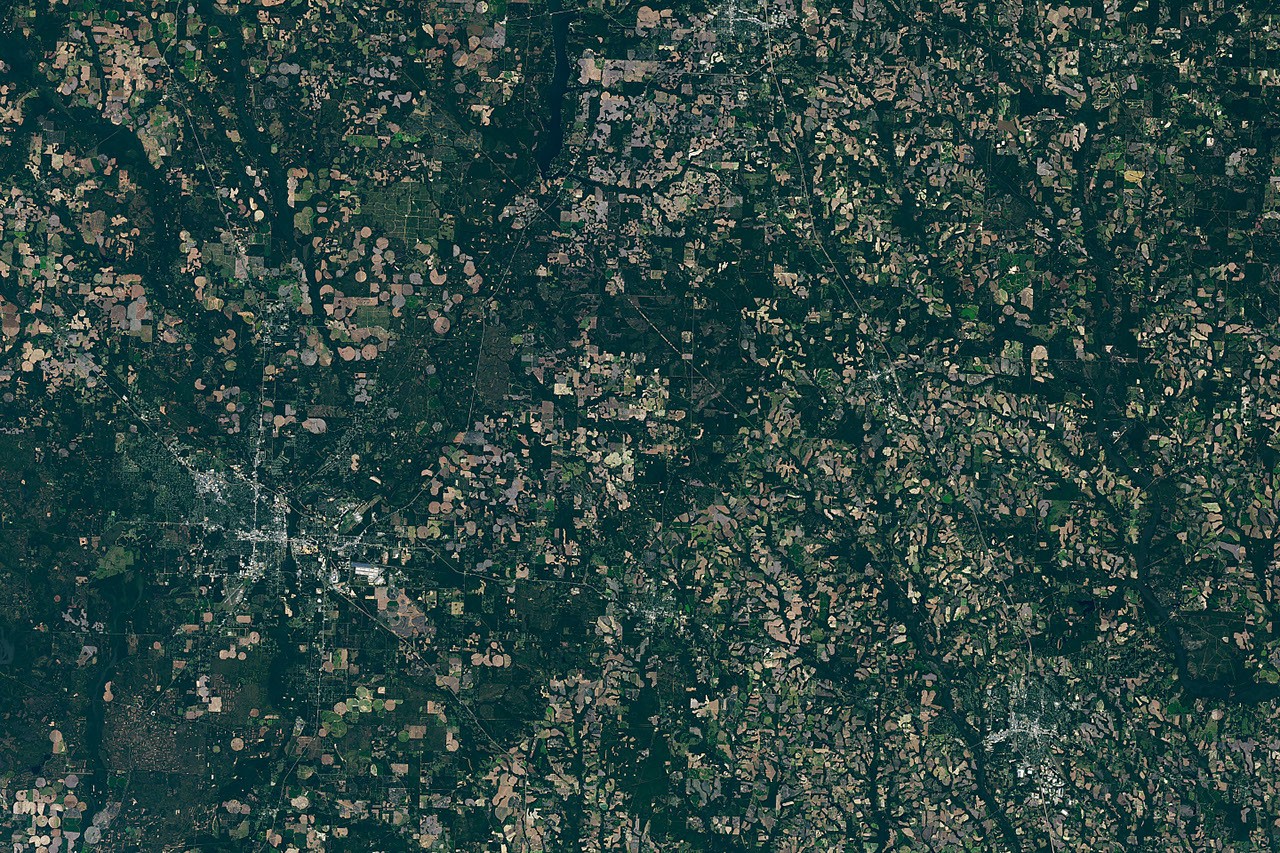
Pecans, a staple of Thanksgiving dishes across the United States, are the fruit of Carya illinensis, a North American hickory in the walnut family. Georgia has historically been one of the nation’s leading pecan-producing states, with extensive orchards around Albany in Dougherty County. A Landsat 8 image captured on October 23, 2026, shows the region during the October-to-December harvest season, when pecan orchards share the landscape with fields of peanuts, cotton and corn.
Georgia’s pecan belt
The Landsat 8 Operational Land Imager (OLI) recorded southwestern Georgia and neighboring counties around Albany. The region’s pecan orchards are concentrated along the Flint River and across the Coastal Plain.
These observations can be compared with the U.S. Department of Agriculture’s Cropland Data Layer, an annual map showing crop types throughout the continental United States. A 2025 map shows clusters of pecan fields along the Flint River and across Georgia’s Coastal Plain.
Pecan trees need substantial water and generally grow well in the region’s local conditions. Well-drained sandy soils overlie the Floridan aquifer system, which growers can use for irrigation.
A century of expansion
In the late 1800s, Georgia’s pecan orchards covered fewer than 100 acres (40 hectares). During the early 1900s, thousands of acres were planted in Dougherty and Mitchell counties in southwestern Georgia, creating a pecan boom in which orchards were sold to investors.
By the end of the 1950s, Georgia had become the leading pecan-producing state in the nation. According to 1959 agricultural census statistics, the state produced more than 17 million pounds of pecans that year.
Production has also expanded in states including New Mexico and Texas. Georgia’s orchards suffered major damage from Hurricane Michael in October 2018, followed by additional damage from Hurricane Helen, which struck inland in September 2024. Despite those setbacks, USDA figures show that Georgia’s production exceeded 100 million pounds in each of the past three years, from 2023 through 2025.
Weather and disease pressure
In 2026, a wet summer contributed to outbreaks of pecan scab in parts of Georgia. The fungal disease produces brown spots on pecan twigs, leaves and nut shells. Some growers were also still recovering from damage caused by Hurricane Helen.
A 2026 report described continued scab pressure alongside efforts to revive the state’s orchards.
NASA Earth Observatory image by Lauren Dauphin, using Landsat data from the United States Geological Survey. Story by Kathryn Hansen.
Sources
- Farm Monitor (2026), Georgia pecan growers face relentless scab pressure and Helen recovery on a fall field day in 2026. Accessed November 24, 2026.
- Today’s UGA (November 27, 2019), Georgia is the pecan capital of the United States. Accessed November 24, 2026.
- University of Georgia, Pecan nuts. Accessed November 24, 2026.
- University of Georgia College of Agricultural and Environmental Sciences (2026), Fruit and Tree Outlook for 2026. Accessed November 24, 2026.
- College of Agricultural and Environmental Sciences, University of Georgia, Pecan water requirements and irrigation schedule. Accessed November 24, 2026.
- National Agricultural Statistics Service, U.S. Department of Agriculture, 1959 Agricultural Census. Accessed November 24, 2026.
- Wells, L. (2014), Pecan cultivation trends in Georgia. HortTechnology 24(4), 475–479.
Source: science.nasa.gov