


Close Menu
HitechubHitechub
    What's Hot
    Science

    NASA+ Content Comes to the Big Screen at a Greenbelt, Maryland Movie Theater

    Technology

    Newtex Health Hospital Operator Announces Data Stolen in Cyberattack

    Science

    Why Democracy Depends on Science and Must Protect Scientific Integrity

    Important Pages:
    • About Us
    • Privacy Policy
    • Terms & Conditions
    Facebook X (Twitter) Instagram Pinterest
    Facebook X (Twitter) Instagram
    HitechubHitechub
    Friday, November 27
    • Shop
      • Fashion
        • Mens
        • Womens
        • Accessories
          • Handbags
          • Keychain
          • Masks
          • Money clicps
          • Neck Pillow
          • Rings
          • Towels
          • Wallets
        • Jewelry
        • Watches
        • T-shirts
        • Hawaiian shirts
        • Vests
        • Swim trunks
        • Swimsuits
      • Fun
        • Magic cubes
        • Magnifiers
        • Misc
        • Photo books
        • Puzzles
        • Toys
      • Home
        • Cleaning/Care
        • Mailbox covers
        • Mugs
        • Pot Holders
        • Spoon
      • Office and Electronics
        • Chairs
        • Office Supplies
        • IPad cases
        • Laptop stickers
        • Mouse pads
        • Notebooks
        • Pencil bags
        • Pens
        • Phone cases
      • Personalized
      • Pets
      • Sports
        • Cycling
          • Balaclava Mask
          • Bike Bell
          • Bike Computer
          • Bike Fender
          • Bike Grips
          • Bike Kickstand
          • Bike Light
          • Bike Locks
          • Bike Mitts
          • Bike Pumps
          • Bike Repair Stand
          • Bike Seat
          • Bike Trainer
          • Bike Wheels
          • BIKES
            • Folding Bikes
            • Road Bikes
          • Carbon Fiber Bike Products
          • Cycling Mask
          • Kid’ Bike Helmets
          • Inner Tube
          • Motorcycle Bag
          • Nylon Pedals
          • Adult Helmets
          • Photochromic Sunglasses
          • Soft Coolers
          • Suction Cup Bike Rack
          • Tool accessories
          • Winter Cloth
          • Heart Rate Monitor
        • Outdoors/Camping
          • Outdoor Bags
        • Sweatband
    • Technology
      1. AI
      2. Gadgets
      3. View All

      This is the most popular CEO in the world

      Sectors in which “Chat-GPT” is most often used

      Artificial intelligence has begun to “swallow” professions

      The unusual robot conductor of a concert in Seoul

      Here’s how you can tell if your phone is being tapped

      PlayStation 5 becomes a completely silent console and gets more space

      This is the first phone that can be used to park a car

      Best Gaming Laptops 2023: Powerful Portables for PC Games

      Why Is There a Shortage of Elevator and Escalator Mechanics?

      NordVPN Black Friday 2026 Deal: Save 78% on VPN Plans

      OpenAI Warns GPT-6.2 Astra Will Hit Usage Limits 40% Faster After Bug Fix

      Ars Staff Home Offices: From Minimalist to Maximalist Designs

    • Science
      1. Space
      2. Wheels
      3. View All

      Space Perspective: A Journey to the Edge of Space

      5 Fascinating Facts About Space

      Space Exploration: Unveiling the Wonders of the Universe

      Toyota wants to make a new generation battery with a range of up to 1,200 km

      Meet Toyota’s lunar “baby” that could make exploring the Moon easier

      What does a night drive look like with one of the most beautiful cars in the world: the Rolls-Royce Ghost

      Alpha-Gal Syndrome: Why Tick-Bite Red Meat Allergy Is Puzzling Scientists

      How to Overcome Sadness in Academia and Find Balance

      Stephen Colbert-Named Tiny Spider Has a Genome 50% Larger Than the Human Genome

      Oldest Male Killer Whale on Record May Have Been Identified Using Historic Atomic Bomb Test Data

    HitechubHitechub
    Home » 345-Million-Year-Old Fossil Fooled Scientists for Decades
    Science

    345-Million-Year-Old Fossil Fooled Scientists for Decades

    Share Facebook Twitter Pinterest WhatsApp
    Share
    Facebook Twitter LinkedIn Pinterest WhatsApp

    A 345-million-year-old fossil from Scotland that was long regarded as one of the oldest known reptiles has been reclassified as a far more ancient aquatic or amphibious animal. The finding, published in Nature, challenges decades of assumptions about the specimen’s place in evolution and suggests that features such as claws and five-toed limbs evolved in animals still closely associated with water.

    The research was led by scientists from the American Museum of Natural History and the University of Oxford, in collaboration with the European Synchrotron Radiation Facility.

    X-ray scans reveal Lizzie’s hidden anatomy

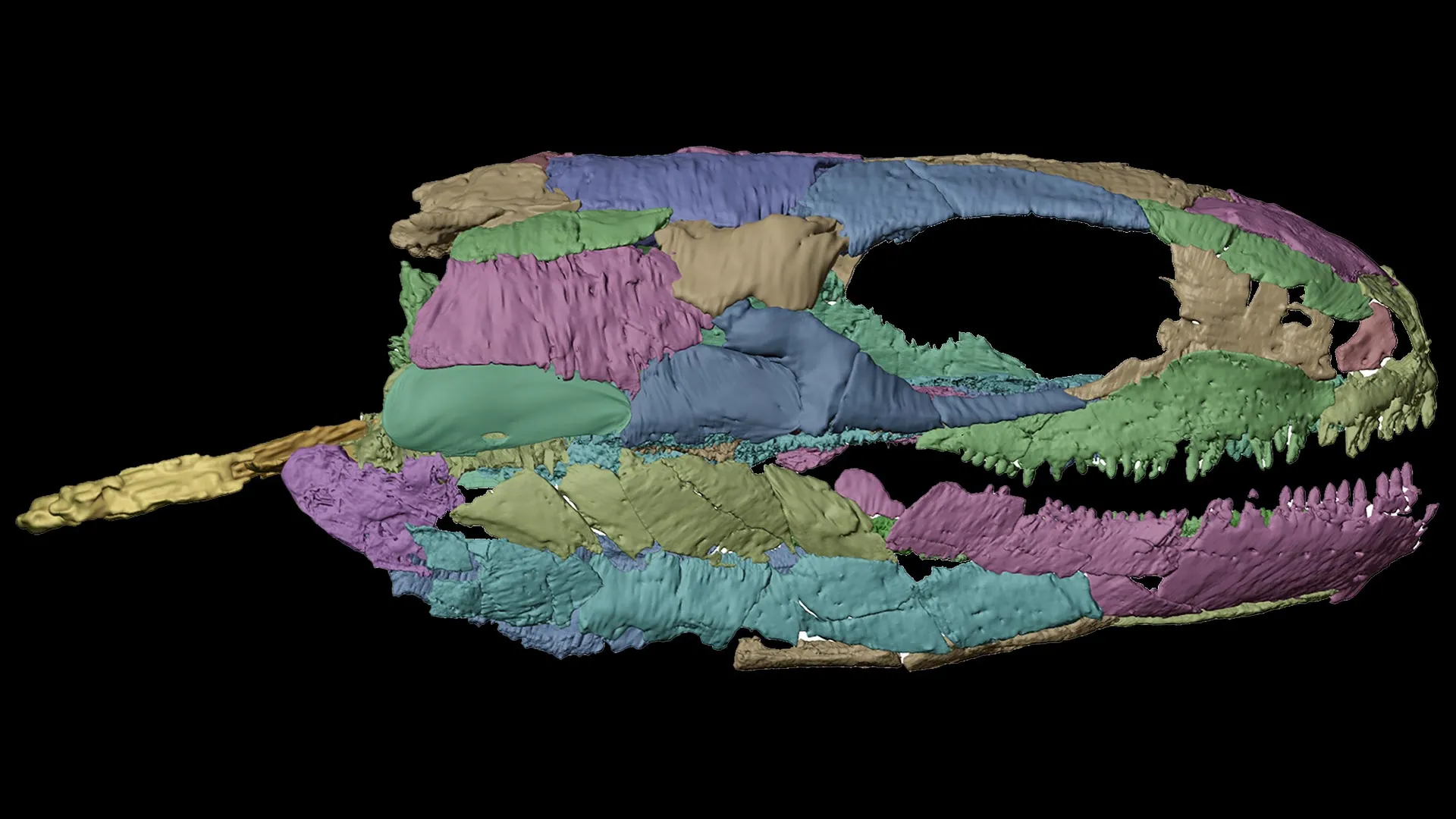
    Discovered in 1984, the fossil belongs to a species called Westrotiana Ligier. Nicknamed “Lizzie” because of its lizard-like appearance, the specimen consists of a nearly complete skeleton preserved between two crushed slabs of rock.

    Early descriptions focused mainly on visible anatomical features, including four limbs with fingers and toes that appeared to end in claw-like tips. These characteristics set Westrotiana apart from many other animals living at the time, whose limbs were more fin-like.

    Although the fossil’s distorted condition made its anatomy difficult to interpret, researchers widely considered it the oldest known amniote adapted to life on land. Amniotes are a major group of vertebrates that includes reptiles, birds and mammals. After the fossil was scientifically described in 1990, Westrotiana became an important reference point for researchers studying when and how these animals first evolved.

    “Lizzie has been a symbol of the early evolution of amniotes for decades,” said Xavier Jenkins, a postdoctoral fellow in the museum’s paleontology department and co-first author of the study. “But when we were finally able to look inside the fossil, we discovered an animal that looked completely different than what we expected.”

    Using powerful X-ray imaging at the European Synchrotron Radiation Facility in Grenoble, France, the scientists examined structures hidden beneath the rock and reconstructed parts of the animal’s anatomy that had previously been inaccessible.

    The results revealed features unlike those expected in an early reptile. Lizzie had a primitive skull, bony internal gills and a fish-like mouth containing thousands of tiny teeth. Together, these characteristics rule out the fossil’s previously proposed position on the evolutionary lineage leading to reptiles. Instead of living primarily on land, Westrotiana may have been aquatic or amphibious.

    “The strikingly primitive skull features suggest that Lizzie was not only not a reptile, but belonged to an even more ancient lineage. Looks can be deceiving, and it turns out that Lizzie lived a very different lifestyle than we previously thought,” said study co-lead author Ben Igielman, who began the study while in graduate school at the University of Oxford.

    Reptile-like features may have evolved in aquatic animals

    The discovery also changes how scientists understand the origins of anatomical features traditionally associated with vertebrates adapted to life on land.

    Researchers now believe that traits such as claws and the five-toed arrangement of the limbs—common in reptiles and mammals—were already present in early animals that remained closely connected to aquatic environments. These organisms belonged to an evolutionary lineage that led to tetrapods, the broader group of vertebrates that includes amphibians and amniotes.

    “This is a big surprise,” said study co-author Roger Benson, the museum’s Macaulay curator of paleontology. “Today we think of amphibians as more ‘primitive’ than reptiles, but this shows that some of the reptilian features were already present in the ancestors of both amphibians and reptiles.”

    Ancient footprints may need to be reinterpreted

    The findings could also affect the interpretation of prehistoric fossil footprints. A recently discovered trail has been used as evidence that amniotes first appeared during the Devonian period, more than 359 million years ago.

    The impressions clearly record the movements of tetrapods with clawed fingers. However, if distant relatives of Westrotiana also had claws, those footprints are no longer sufficient to identify their makers as amniotes.

    Some tracks previously attributed to early amniotes may instead have been left by more ancient amphibians from the tetrapod evolutionary lineage.

    “The broader lesson is that terrestrial-looking traits such as reptilian feet, weight-bearing forelimbs, and claw-like phalanges are not unique to quadrupeds, but rather accumulated over time in their relatives, animals that still lived in and out of water,” Jenkins said.

    Other contributors to the study include Jason Head of the University of Cambridge, Vincent Fernandes of the European Synchrotron Radiation Facility, Lucy Roberts of the Natural History Museum, London, and Timothy Smithson of the University of Cambridge’s Zoological Museum.

    The research was funded by the National Science Foundation through grant EAR-PF 2518154; the National Environmental Research Council through grants NE/S000739/1, NE/W007576/1 and NE/L002507/1; and the Biotechnology and Biological Sciences Research Council through grant BB/X014819/1.

    Source: www.sciencedaily.com

    Share. Facebook Twitter Pinterest LinkedIn WhatsApp
    Previous ArticleNext-Generation Bionic Hands Let Users Feel Touch Again
    Next Article Ars Staff Home Offices: From Minimalist to Maximalist Designs

    Related Posts

    Science

    Alpha-Gal Syndrome: Why Tick-Bite Red Meat Allergy Is Puzzling Scientists

    Science

    How to Overcome Sadness in Academia and Find Balance

    Science

    Stephen Colbert-Named Tiny Spider Has a Genome 50% Larger Than the Human Genome

    Science

    Oldest Male Killer Whale on Record May Have Been Identified Using Historic Atomic Bomb Test Data

    Science

    Has AI Cracked Internet Encryption? Rumored Breakthrough Claim Surprises Scientists

    Science

    Indonesian Wildfires Threaten Orangutans and Their Future

    Science

    Hidden Underground Caves in Australia May Reveal Otherworldly Secrets

    Science

    Why Women Seem Better at Multitasking Than Men: The Surprising Science

    Add A Comment
    Leave A Reply Cancel Reply

    Stay In Touch
    • Facebook
    • Twitter
    • Instagram
    • Pinterest
    Top Picks
    Technology

    Building a Strong Material Foundation for Artificial Intelligence (AI)

    How Advanced Materials Enable AI Data Centers and Next-Generation Semiconductors At Syensqo, we think about…

    QNAP Warns Hackers Infiltrated NAS Devices in Plex2Shell Attack

    Porsche 911 GT3 Touring Review: A Lightweight Sports Car That Outperforms Its Class

    OpenAI Adds Invisible Watermarks to ChatGPT and Codex Text in the EU

    Have Scientists Discovered Extraterrestrial Life? Hundreds of Researchers Weigh In

    Most Popular
    Science

    Storm Cleanup Begins as Thousands Remain Without Power

    Science

    ESA Satellite Images Reveal Europe’s Record-Breaking Summer Heatwave From Space

    Categories
    • AI (9)
    • Gadgets (6)
    • Science (3,601)
    • Space (3)
    • Technology (3,032)
    • Wheels (3)
    Our Picks
    Science

    Bronze Ring Carved from Alexandria Lighthouse Discovered in Palace on Submerged Egyptian Island

    Technology

    SS7 and Diameter Attacks: How Signaling Vulnerabilities Compromise Mobile Phones

    © 2026 Hitechub.
    • Home
    • About Us
    • Privacy Policy
    • Terms & Conditions

    Type above and press Enter to search. Press Esc to cancel.

    GDPR Cookie Banner

    We are using cookies to give you the best experience on our website.

    You can find out more about which cookies we are using or switch them off in .

    Ad Blocker Enabled!
    Ad Blocker Enabled!
    Our website is made possible by displaying online advertisements to our visitors. Please support us by disabling your Ad Blocker.