


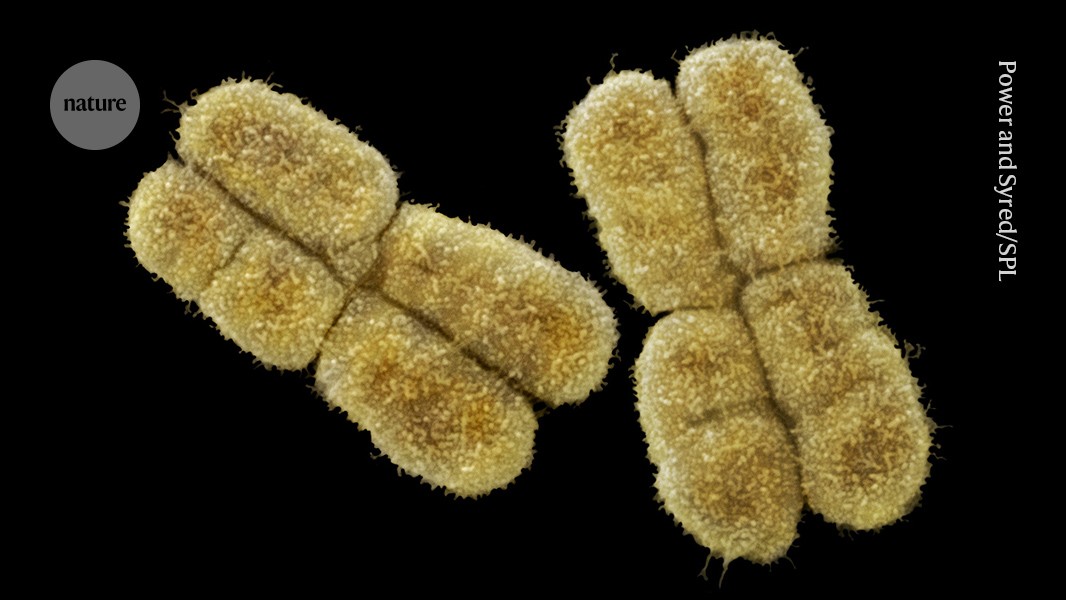
Chromosomes are held together by a protein structure called cohesin, which decreases with age. Credit: Power and Syred/Science Photo Library
Researchers have developed an artificial “molecular glue” that stabilizes chromosomes in the eggs of aged mice. The system, called TALhesin, reduced chromosome-segregation errors in older mouse eggs and could eventually contribute to improved fertility treatments for women over 35, although it has not yet been shown to work as a treatment in humans.
Chromosomes in animal eggs are held together by a protein structure called cohesin. Cohesin helps chromosomes divide correctly during cell division, but its levels decline with age. As a result, chromosomes can separate prematurely and be distributed inaccurately between daughter cells.
Eggs with too many or too few chromosomes have a condition known as aneuploidy. Such eggs can contribute to infertility, failed in vitro fertilization (IVF) treatment and early miscarriage, particularly in women over 35.
Biochemist Melina Schuh and her colleagues at the Max Planck Institute for Interdisciplinary Sciences in Göttingen, Germany, designed TALhesin to prevent premature chromosome separation. The system uses an engineered protein that binds to regions of chromosomes where cohesin normally resides. The engineered proteins then bind to one another, creating an artificial connection between the chromosome regions.
“This is a very creative, well-designed and well-thought-out approach,” says Bettina Mihalas, a reproductive biologist at the University of New South Wales in Sydney, Australia. Mihalas says that many groups are studying how age-related declines in cohesin affect fertility, but this is the first approach to replace cohesin’s function with an artificial system.
The study was published in Science on November 26.
Restoring chromosome stability
The researchers injected immature mouse eggs with messenger RNA that encoded the engineered protein. The eggs then produced the TALhesin protein. Fluorescence microscopy confirmed that the protein bound to chromosome regions where natural cohesin is normally lost.
The artificial system reduced premature chromosome segregation in eggs from mice aged 13, 17 and 20 months compared with untreated eggs. In 17-month-old mice, the proportion of eggs without early chromosome-segregation errors increased from 46.7% to 74.1% after TALhesin treatment. That was similar to the proportion observed in eggs from younger mice.
Chromatids, the two identical halves produced when a chromosome is copied, must separate at the correct time during cell division. To control the timing of the artificial chromosome connection, the researchers added “molecular scissors” to the system. These scissors switched off the artificial bonding system at the appropriate stage.
Tests with human eggs
The researchers also adapted TALhesin to produce an engineered protein that binds to regions of human chromosomes where cohesin normally resides.
Experiments with donated human eggs showed that the TALhesin protein accumulated in these regions. Chromosomes with higher levels of the engineered protein also tended to have shorter distances between their chromatids, indicating that TALhesin can hold the chromosomes together.
Further research will be needed to determine whether the approach can be used safely and effectively in human fertility treatments.
Source: www.nature.com