


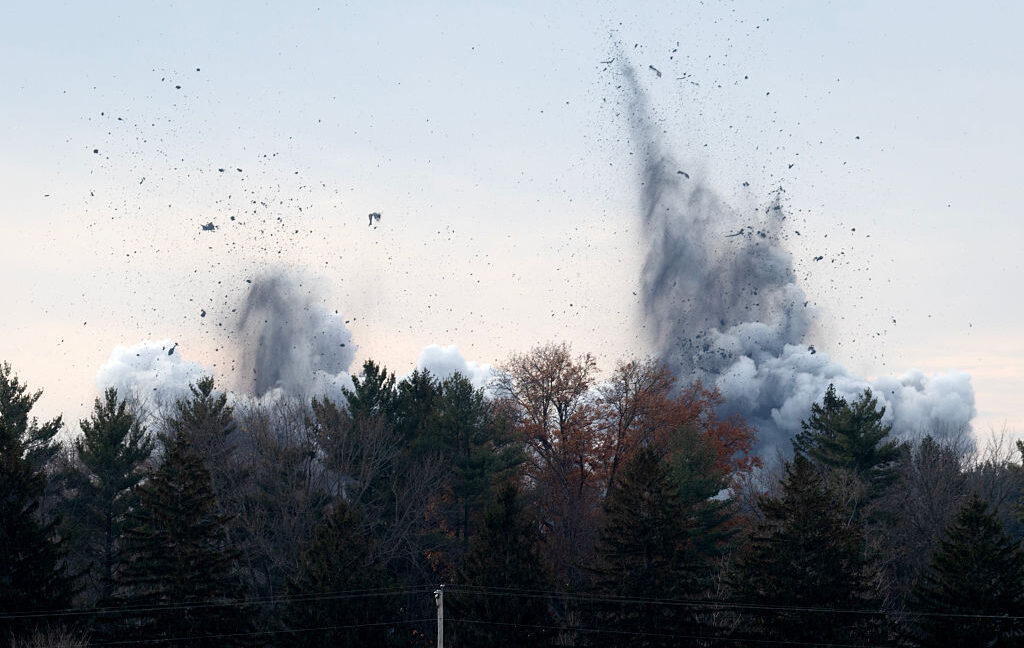
The US Army deliberately detonated 68 barrels containing 9,700 pounds (4.4 tons) of degraded lead azide at the Iowa Army Ammunition Plant in Middletown, Iowa, around 9 a.m. PT Wednesday. The operation was intended to prevent an uncontrolled spontaneous explosion of the crystallized, highly unstable compound, sending a gray-white cloud over southeastern Iowa.
Residents urged to evacuate or shelter indoors
Middletown, a town of fewer than 400 people, is home to the Iowa Army Ammunition Plant (IAAAP). Residents within eight miles of the facility were advised to evacuate. People farther away were told to shelter in place, keep windows and doors tightly closed, turn off fans, and set indoor air systems to recirculate air.
Iowa local outlet KWQC captured smoke plumes rising from two earth-covered containers that exploded simultaneously. A journalist for the outlet, reportedly positioned at a safe distance, said during a live television broadcast that he could see and feel the shockwave moving across the field. He wore a mask for the remainder of the broadcast.
Lead contamination concerns
Lead is a neurotoxin that does not break down in the environment and can pose serious health risks, particularly to young children and pregnant people.
Before the explosion, the Army released a map showing the modeled movement and distribution of the plume. The modeling suggested that airborne lead could travel about 160 miles southwest of the facility, while dust deposition could cover roughly 200 square miles in that direction.
Researchers and government officials have collected air and soil samples from the area. The results will provide baseline measurements of lead levels following the explosion and any resulting fallout.
Source: arstechnica.com